

New Delhi: In a conflict that has redefined energy security overnight, the United States and Israel’s military campaign against Iran has triggered the most severe disruption to global oil flows since the 1970s. With Iran effectively sealing the Strait of Hormuz – the narrow chokepoint between Iran and Oman – more than 20 million barrels of oil per day have been halted, representing roughly one-fifth of worldwide petroleum consumption. This dwarfs the 1973 Arab oil embargo, which removed just 4.5 million barrels daily, or about 7 percent of global supply at the time. Brent crude, the international benchmark, has rocketed from $66 per barrel before the February 28 strikes to above $100, with fresh spikes pushing it past $113 amid conflicting signals from Washington and Tehran.
The ripple effects extend far beyond fuel pumps. From semiconductor production to fertiliser supplies and everyday grocery bills, the Middle East war is exposing vulnerabilities in supply chains that policymakers once considered resilient. This 2026 oil crisis is not just a repeat of history; it is reshaping commodity markets, industrial output, financial stability, and geopolitical alliances in ways the 1973 shock never did.
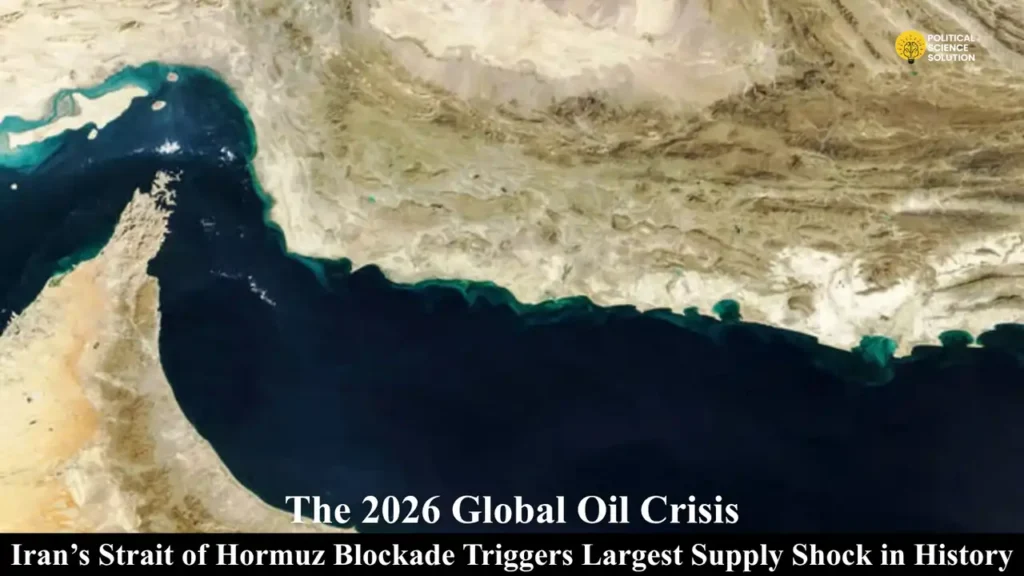
Strait of Hormuz: The World’s Most Critical Energy Artery Under Siege
The Strait of Hormuz has become the epicentre of the crisis. This narrow sea passage carries the bulk of Gulf oil and liquefied natural gas exports to global markets. Iran’s blockade – allowing only a handful of vessels through while halting the rest – has stopped transit of 20 million barrels daily. Independent analysis from Gavekal Research estimates that Gulf exporters, including Iran, can reroute at most 3.5 million barrels per day via pipelines to terminals outside the strait. Even at maximum capacity, the world still faces a net shortfall of around 15 million barrels per day as long as shipping remains suspended at either end.
This is no ordinary bottleneck. The Gulf region serves as the primary artery for urea, ammonia, sulphur, and other essential fertilisers. India, in particular, relies heavily on LNG imports from the area for its domestic fertiliser production. Any prolonged closure threatens crop yields worldwide and drives food inflation in import-dependent nations.
Industrial supply chains are also buckling. Qatar, which accounts for one-third of global helium exports, has seen production disruptions. Helium is indispensable for semiconductor manufacturing, medical imaging equipment, and high-tech applications. With flows interrupted, factories from Asia to Europe are scrambling for alternatives.
Asymmetrical Pain: Asia Bears the Brunt While the US Feels Minimal Direct Impact
Geography has created a stark divide in suffering. The United States imports very little oil through the Strait of Hormuz, thanks to its domestic shale boom and energy self-sufficiency achieved since 2019. In contrast, more than 80 percent of the oil and LNG shipped through the strait in 2024 headed to Asian markets. Developing economies across South Asia, Southeast Asia, and Northeast Asia are absorbing the heaviest blows.
Vietnam holds fewer than 20 days of oil reserves. Pakistan and Indonesia each have about 20 days. These thin buffers mean the crisis could rapidly translate into fuel shortages, factory shutdowns, and soaring transport costs. Cambodia has already seen petrol prices jump almost 68 percent between February 23 and March 11. Vietnam recorded a nearly 50 percent rise, Nigeria 35 percent, Laos 33 percent, and Canada 28 percent.
In the United States, the national average petrol price climbed from under $3 per gallon to more than $5 in some states – hitting $8 in California. Yet the broader American economy remains insulated compared with its Asian counterparts.
Stagflation Risks and Policy Headaches for Central Banks
Economists warn of stagflation – the toxic mix of high inflation, stagnant growth, and rising unemployment that plagued the 1970s. Surging oil prices feed directly into higher costs for manufacturing, transport, and agriculture. With natural gas vital for urea production, fertiliser shortages could shrink harvests and push food prices even higher in lower-income countries where families already spend a large share of income on basics.
Central banks face an impossible balancing act. Rate hikes to tame inflation risk choking growth further, while holding rates steady allows price pressures to embed. The International Energy Agency (IEA), established in 1974 precisely to counter the 1973 embargo, has urged consumers and businesses to travel less, work remotely, and switch to electricity for cooking instead of gas. These conservation pleas, however, offer limited relief if the strait remains closed.
1973 Oil Embargo: The Historical Parallel That Falls Short
To understand the scale of today’s shock, rewind to October 1973. Egypt and Syria launched a surprise attack on Israel during Yom Kippur, the holiest day in the Jewish calendar when Israeli radio, television, shops, and transport shut down. The assault aimed to reclaim territory lost in the 1967 Six-Day War – the Golan Heights, Sinai Peninsula, Gaza Strip, West Bank, and East Jerusalem.
US President Richard Nixon authorised a massive military airlift to Israel despite warnings from Saudi Arabia’s King Faisal. On October 17, the Organization of Arab Petroleum Exporting Countries (OAPEC) retaliated: oil prices rose 70 percent, production was cut 5 percent per month, and shipments to the United States, Netherlands, Portugal, and South Africa were banned. At the time, the Middle East produced 36 percent of world oil. The embargo created a global shortfall of 4.5 million barrels daily.
In the US, crude prices jumped from under $3 to more than $12 per barrel (equivalent to $22 to $75–80 in today’s dollars). Petrol rose from 38 cents to 55 cents per gallon – a 45 percent increase. Stations ran dry. Nixon imposed fuel rationing, lowered speed limits, and introduced year-round daylight saving time. Western Europe and Japan suffered acutely. Japan imported 77 percent of its crude from the Gulf; the UK introduced a three-day workweek and banned Sunday driving.
The embargo lifted in March 1974 after Henry Kissinger brokered disengagement agreements, but the damage lingered. US inflation soared to 12.3 percent in 1974 from 3.4 percent in 1972. Unemployment climbed from 4.6 percent to 9 percent by May 1975. GDP contracted 0.5 percent in 1974 after 5.7 percent growth the prior year. Japan’s economy shrank 1.2 percent in 1974 after 8 percent growth. The UK saw 1.7 percent contraction after 7.3 percent expansion. Central banks responded with aggressive rate hikes – the US Fed eventually reaching 20 percent under Paul Volcker, triggering a deeper recession to crush inflation.
2026 Crisis: Prices, Responses, and Immediate Global Reactions
Today’s numbers tell a harsher story. Within the first week of strikes, Brent futures leapt almost 7 percent. After President Donald Trump announced a five-day delay on further strikes against Iranian energy facilities to allow talks, prices fell more than 10 percent to around $100 before climbing back above $103 on Tuesday amid doubts about negotiations. Iran has rejected claims of direct contact with Washington, calling them market manipulation.
The IEA coordinated its largest-ever release of strategic reserves: 400 million barrels from its 32 member nations – more than double the volume released after Russia’s 2022 invasion of Ukraine. The United States alone is contributing 172 million barrels this year. This drawdown will offset roughly 20 days of lost Hormuz flows but will take months to fully deploy. Even at maximum scale, the system cannot sustain a prolonged closure.
On Friday, the Trump administration lent an additional 45 million barrels from the US Strategic Petroleum Reserve directly to oil companies. China postponed planned fuel price increases to ease the burden on drivers. The UK emphasised its “diverse and resilient” supply while monitoring the situation. The US temporarily waived sanctions on Russian oil and eased restrictions on Iranian oil already at sea.
Shell CEO Wael Sawan warned that South Asia felt the impact first, followed by Southeast and Northeast Asia, with Europe likely next in April. UK businesses reported the sharpest monthly cost rise since 1992, citing adverse effects on demand, input prices, and supply chains.
Why 2026 Is Structurally Different from 1973
Analysts stress that while parallels exist, key differences matter. The 1973 shock came from a coordinated multinational bloc targeting specific Western nations. Today’s disruption stems from a single actor controlling one transit point, with no unified production cuts among Gulf producers. Some countries are far more exposed than others.
Oil’s share of global primary energy has fallen from 46.2 percent in 1973 to 30.2 percent today, thanks to diversification into North Sea oil, US shale, LNG, and nuclear power. Yet that shift occurred mainly in OECD nations – Europe, North America, Japan, South Korea, and Australia. Developing Asian economies that grew fastest over the past three decades remain overwhelmingly dependent on Hormuz routes.
The 1973 crisis prompted lasting policy shifts: Nixon’s Project Independence aimed for US energy self-sufficiency by 1980; Europe invested heavily in nuclear; Japan pivoted from oil-intensive industries to electronics and LNG. Today the US is already a net energy exporter. The IEA’s emergency architecture has been activated only six times since 1974, including this 2026 episode. Member nations hold more than 1.2 billion barrels in strategic reserves, with another 600 million under government obligation from industry.
Longer-Term Outlook: Recession Risks and the Push for New Energy Security
Every major oil price spike since 1973 – 1973, 1978, and 2008 – has preceded some form of global recession. Economists now debate whether 2026 will follow the pattern. In lower-income nations, rising energy costs could quickly spark food riots as grain and fertiliser imports become unaffordable.
The conflict has also highlighted the Gulf as a strategic theatre where economic, political, and social interests collide. Flexible diplomacy and diverse partnerships will be essential to navigate future crises.
As markets digest fresh headlines – oil trading above $100 amid conflicting claims on US-Iran talks, stock indices showing mixed results with Asian gains offsetting US and European weakness – one truth stands clear: the 2026 oil crisis is rewriting the rules of global energy dependence. Whether the strait reopens soon or the blockade drags on, the economic, industrial, and geopolitical aftershocks will be measured in years, not months.
This is the largest supply disruption ever recorded by the IEA. The world is watching, conserving, and preparing – but the narrow channel between Iran and Oman remains the ultimate test of resilience for the 21st-century economy.
Frequently Asked Questions
1. How does the 2026 Iran Strait of Hormuz crisis compare to the 1973 oil embargo?
The 2026 crisis is significantly larger in scale. The 1973 Arab oil embargo removed 4.5 million barrels per day (about 7% of global supply at the time), while the current closure of the Strait of Hormuz has halted more than 20 million barrels per day — roughly one-fifth of worldwide petroleum consumption. Brent crude prices jumped from $66 to over $100 per barrel in 2026 (a 60%+ surge), compared to the 1973 increase from under $3 to over $12 per barrel. Unlike 1973, which primarily targeted Western countries through coordinated production cuts, today’s disruption stems from a single chokepoint controlled by Iran, hitting Asian economies hardest.
2. Why is the Strait of Hormuz so critical to the global economy in 2026?
The Strait of Hormuz is the world’s most vital energy artery. It carries approximately 20% of global oil and liquefied natural gas (LNG) shipments daily. More than 80% of the oil and LNG passing through it in 2024 went to Asian markets. Beyond crude oil, the Gulf supplies key fertilisers (urea, ammonia, sulphur) and helium from Qatar, which is essential for semiconductor manufacturing and medical imaging. A prolonged blockade creates shortages in fuel, food production, and high-tech industries, driving up inflation worldwide and exposing the asymmetrical impact on import-dependent developing nations.
3. What are the main economic impacts of the 2026 Middle East oil crisis?
The crisis is triggering stagflation risks — high inflation combined with slowing growth and potential unemployment. Petrol prices have risen sharply: US national average climbed from under $3 to over $5 per gallon (reaching $8 in California), while countries like Cambodia saw nearly 68% increases, Vietnam 50%, and others 28–35%. Industrial supply chains are disrupted, especially helium for chips and LNG for fertiliser production in India. Global food systems face pressure due to higher fertiliser and transport costs. Stock markets are volatile, businesses report the biggest cost rises since 1992 in the UK, and lower-income Asian countries with thin oil reserves (Vietnam <20 days, Pakistan & Indonesia ~20 days) are most vulnerable.
4. How are governments and the IEA responding to the 2026 oil shortage?
The International Energy Agency (IEA) has activated its emergency system for the sixth time since 1974, coordinating the largest-ever release of 400 million barrels from strategic reserves — more than double the 2022 Russia-Ukraine response. The US is contributing 172 million barrels and separately lent another 45 million from its Strategic Petroleum Reserve. The Trump administration delayed strikes on Iranian energy facilities for five days to allow talks and temporarily waived sanctions on Russian and Iranian oil. China postponed fuel price hikes, while the UK emphasised its diverse energy supply. Conservation measures include recommendations to travel less, work remotely, and switch cooking fuels. However, experts warn these steps provide only short-term relief if the Hormuz closure persists.
5. What makes the 2026 oil crisis different from previous shocks like 1973?
Several structural differences stand out. In 1973 the shock came from a unified Arab bloc targeting specific Western nations; today it is driven by one actor controlling a single transit route with no coordinated Gulf-wide production cuts. Global oil dependence has dropped (from 46.2% of primary energy in 1973 to 30.2% today), but diversification benefits mainly OECD countries. Asian developing economies — which grew rapidly in recent decades — now face the heaviest burden, with 80% of their oil imports routed through Hormuz. The US is now energy self-sufficient, unlike in 1973. The crisis also threatens broader supply chains (helium, fertilisers) and raises acute stagflation risks in a more interconnected global economy.