
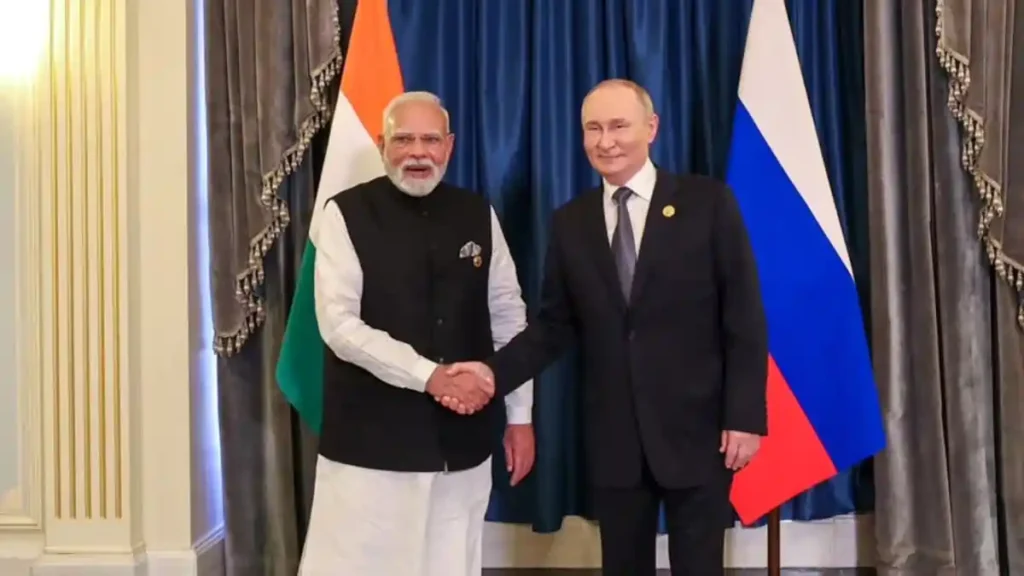
New Delhi: In a powerful reaffirmation of one of the world’s most enduring strategic partnerships, Prime Minister Narendra Modi and Russian President Vladimir Putin concluded the 23rd India-Russia Annual Summit on Friday, marking the 25th anniversary of the 2000 Declaration on Strategic Partnership and celebrating the elevation to a “Special and Privileged Strategic Partnership” in 2010.
Held at Hyderabad House and Rashtrapati Bhavan, the summit saw the signing of 16 major agreements and MoUs spanning defence, trade, energy, nuclear power, space, Arctic cooperation, healthcare, culture, education, and counter-terrorism, while both leaders jointly set an ambitious roadmap for bilateral relations till 2030.
Trade Target Doubled: $100 Billion by 2030
The centrepiece of the summit was the adoption of the “Programme for the Development of Strategic Areas of India-Russia Economic Cooperation till 2030” – commonly called Economic Programme 2030. The two nations formally raised their bilateral trade target from the earlier $30 billion (set in 2019) to a new goal of $100 billion by 2030, up from the current $68.7 billion recorded in FY 2024-25.
To achieve this, both sides decided to fast-track negotiations for a Free Trade Agreement (FTA) between India and the Eurasian Economic Union (EAEU). The first round of talks concluded last week, and President Putin personally called for an “early signing” to remove barriers to goods, services, capital, and technology flows.
De-Dollarisation Push: National Currency Settlements and CBDC Interoperability
Recognising Western sanctions constraints, India and Russia agreed to significantly expand bilateral settlements in Indian rupees and Russian roubles. The leaders directed their central banks to deepen interoperability between India’s UPI and Russia’s SPFS, as well as explore linkages between Central Bank Digital Currencies (CBDC). Special Rupee Vostro Accounts and escrow mechanisms through non-sanctioned banks will be further strengthened to clear pending payments.
Energy Security: Uninterrupted Russian Oil, Gas, and Nuclear Support
President Putin personally assured Prime Minister Modi of “uninterrupted” supplies of crude oil, petroleum products, and natural gas irrespective of global geopolitical turbulence. Russia also reiterated long-term commitment to India’s civil nuclear programme, including six units at Kudankulam, future small modular reactors (SMRs), and full nuclear fuel cycle cooperation, supporting India’s target of 100 GW nuclear capacity by 2047.
Defence Ties Move to Joint R&D and Co-Production Era
The summit marked a decisive shift from the traditional buyer-seller model to joint research, development, and co-production of advanced defence systems under the 2021–2031 military-technical cooperation agreement.
Key decisions:
- Expanded “Make in India” manufacturing of spare parts, aggregates, and equipment for Russian-origin platforms (Su-30MKI, T-90 tanks, S-400, submarines, etc.), including for export to third countries.
- Continued support for ongoing programmes such as BrahMos missiles, AK-203 rifles, and licensed production of other systems.
- Regular joint exercises (INDRA series and participation in Zapad-2025) and technology transfer.
Mega Connectivity Corridors Get Major Push
Both leaders agreed to operationalise three strategic corridors:
- International North-South Transport Corridor (INSTC)
- Chennai–Vladivostok Eastern Maritime Corridor
- Northern Sea Route (NSR) through the Arctic
A dedicated MoU was signed on “Training of Specialists for Ships Operating in Polar Waters” to build Indian expertise for Arctic navigation. India also expressed readiness to play a more active role as an Observer in the Arctic Council.
Russian Far East and Arctic: New Frontier for Indian Investment
Guided by the 2024–2029 Action Plan, both countries will deepen trade and investment in energy, mining, agriculture, timber, diamonds, and maritime infrastructure in Russia’s Far East and Arctic regions.
Space and Nuclear Technology Cooperation
ISRO and Roscosmos welcomed deepening collaboration in:
- Human spaceflight (Gaganyaan training continues)
- Satellite navigation (NavIC–GLONASS integration)
- Planetary exploration and scientific missions
Additionally, Delhi University and Russia’s HSE University signed an agreement to establish a joint “Space Mirror Lab”.
Counter-Terrorism: Zero-Tolerance Pledge
In a strong joint message, PM Modi and President Putin:
- Condemned the April 2025 Pahalgam terror attack in Jammu & Kashmir and the 2024 Crocus City Hall attack in Moscow.
- Called for “zero tolerance” against all UN-listed terrorist entities including Al-Qaeda, ISIS/Daesh, Lashkar-e-Taiba, Jaish-e-Mohammed, and their proxies.
- Demanded an end to safe havens, terror financing, and cross-border terrorism.
- Pushed for early adoption of the Comprehensive Convention on International Terrorism (CCIT) at the UN.
Multilateral Support
Russia reiterated full backing for India’s permanent membership in a reformed UN Security Council and pledged complete support for India’s 2026 BRICS Chairship.
In return, India welcomed Russia’s decision to adopt the Framework Agreement to join the International Big Cat Alliance (IBCA), and noted Moscow’s interest in becoming a member of the International Solar Alliance (ISA) and Coalition for Disaster Resilient Infrastructure (CDRI).
Both nations also committed to cooperate on low-carbon development, climate finance, and implementation of Article 6 of the Paris Agreement.
People-to-People and Cultural Ties
- India announces Free 30-Day E-Tourist Visa for Russians In a major tourism booster, Prime Minister Modi announced that India will “very soon” launch a completely free 30-day e-tourist visa and 30-day group tourist visa for Russian citizens.
Other initiatives:
- MoUs on migration and mobility to facilitate movement of skilled Indian professionals to Russia.
- Continued strong education ties – nearly 20,000 Indian students currently study in Russian universities, mainly medicine.
- Cultural festivals: Bharat Utsav 2025 in Moscow and Indian Film Festivals across Russian cities.
State Banquet Highlights
President Droupadi Murmu hosted a grand state banquet at Rashtrapati Bhavan featuring Kashmiri Gucchi Doon Chetin, Achaari Baingan, Yellow Dal Tadka, Gur Sandesh, and South Indian Murukku. The Naval band performed Indian classical ragas Amritavarshini and Nalinkanthi, Bollywood hit “Phir Bhi Dil Hai Hindustani”, and the famous Russian folk tune Kalinka.
Putin’s Departure
President Putin departed from Palam Technical Airport late Friday night. External Affairs Minister Dr S. Jaishankar saw him off.
Addressing Challenges Head-On
While celebrating the partnership, both sides acknowledged existing challenges:
- Trade imbalance (India’s imports >$63 bn vs exports ~$5 bn)
- Delays in S-400 and Akula-class submarine deliveries due to the Ukraine conflict
- Sanctions-related payment bottlenecks
- Recruitment of Indian nationals into Russian military through fraudulent agents
Solutions proposed:
- Aggressive promotion of Indian pharmaceuticals, IT services, engineering goods, and agriculture to Russia via the upcoming FTA.
- Indigenous production and joint spares manufacturing under iDEX and IRIGC-M&MTC.
- Strengthened migrant protection through MADAD portal and eMigrate system.
Conclusion: A Partnership That Withstood the Test of Time
As Prime Minister Modi stated, “In the last ten years, the world has witnessed many ups and downs, yet India-Russia friendship has continuously grown stronger.” President Putin echoed that the summit outcomes will give “new energy” to bilateral ties.
With trade surging, defence ties maturing into genuine co-development, energy flows remaining uninterrupted, and new frontiers opening in the Arctic and Far East, the 23rd India-Russia Annual Summit has firmly placed the Special and Privileged Strategic Partnership on a higher trajectory for the next decade.
The next summit – the 24th – will be hosted by Russia in 2026.
FAQs
1. What is the new bilateral trade target between India and Russia announced in December 2025?
India and Russia have set an ambitious target of $100 billion in annual bilateral trade by 2030 (up from $68.7 billion in FY 2024–25). The leaders adopted the “Economic Programme 2030” and decided to fast-track the India–Eurasian Economic Union (EAEU) Free Trade Agreement to achieve this goal.
2. Did India announce any new visa policy for Russian tourists during Putin’s visit?
Yes. Prime Minister Narendra Modi announced that India will very soon launch a completely free 30-day e-tourist visa and a 30-day group tourist visa for all Russian citizens to boost tourism and people-to-people ties.
3. What major defence decisions were taken at the 23rd India-Russia Summit?
The summit shifted focus from buying Russian weapons to joint research, development, and co-production. Key decisions include:
Regular joint military exercises (INDRA, Zapad-2025)
Manufacturing spare parts and equipment for Russian-origin platforms (S-400, Su-30MKI, T-90 tanks, submarines) in India under Make in India
Export of these Indian-made spares to third countries
Continued support for BrahMos, AK-203 rifles, and new co-development projects
4. How are India and Russia planning to reduce dependence on the US dollar?
Both countries agreed to:
Use Special Rupee Vostro Accounts and non-sanctioned banks to clear pending payments
Expand trade settlements in Indian rupees and Russian roubles
Develop interoperability between India’s UPI and Russia’s SPFS payment systems
Explore linkages between Central Bank Digital Currencies (CBDCs)
5. Which new areas of cooperation were highlighted in the 2025 summit?
Major new/emerging areas include:
- Arctic & Northern Sea Route: MoU on training Indian seafarers for polar waters; deeper investment in Russia’s Arctic
- Russian Far East: Expanded trade and investment in energy, mining, diamonds, agriculture, and maritime infrastructure
- Civil nuclear energy: Support for Kudankulam Units 3–6, future small modular reactors, and full fuel-cycle cooperation
- Space: Strengthened ISRO–Roscosmos partnership in Gaganyaan, satellite navigation, and planetary missions
- Multilateral: Russia joined India’s International Big Cat Alliance (IBCA); expressed interest in International Solar Alliance (ISA) and CDRI
Key Search Terms: 23rd India Russia Summit 2025, Modi Putin meeting December 2025, India Russia $100 billion trade target, India Russia FTA EAEU, India Russia defence co-production, Kudankulam nuclear plant, Northern Sea Route cooperation, free visa for Russians to India, International Big Cat Alliance Russia, Pahalgam terror attack condemnation, India Russia national currency trade 2025.