

New Delhi: In a landmark development for Indian Ocean security cooperation, Bangladesh has officially become the fifth full member of the Colombo Security Conclave (CSC), with India’s National Security Adviser Ajit Doval personally inviting his Bangladeshi counterpart Khalilur Rahman to the upcoming 7th NSA-level meeting in New Delhi on November 19-20, 2025.
The announcement, made during the 8th Deputy National Security Adviser (DNSA)-level virtual meeting hosted by Mauritius, marks a significant expansion of the regional security framework that began as a trilateral maritime dialogue in 2020.
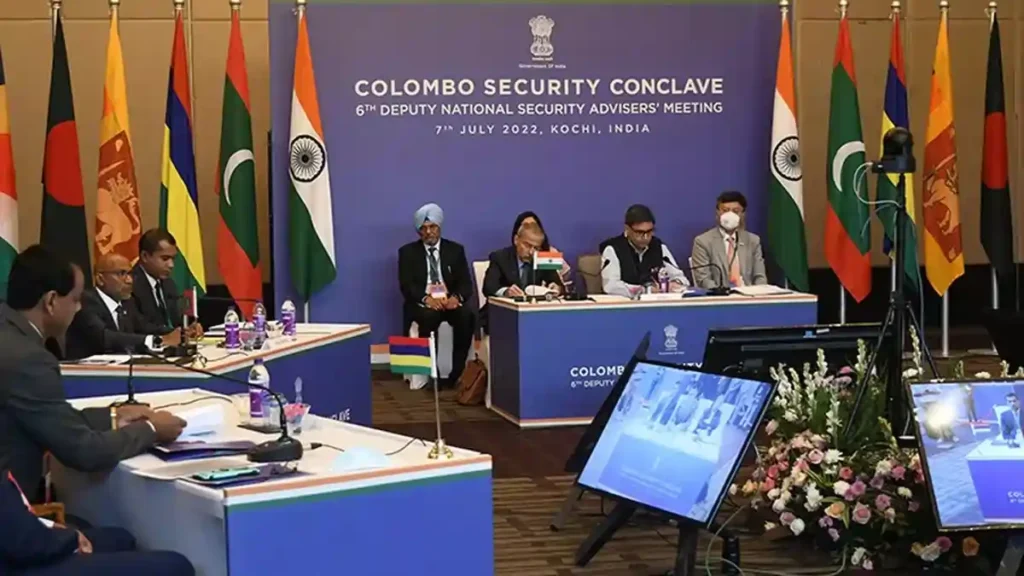
A Warm Welcome at the 8th DNSA Meeting
The virtual session saw enthusiastic support from founding members — India, Sri Lanka, Maldives, and Mauritius — as they formally inducted Bangladesh into the fold. Seychelles, a long-standing observer, also participated, reinforcing the conclave’s inclusive approach.
Key representatives included:
- India: Pankaj Kumar Singh, Deputy National Security Adviser (Internal Affairs)
- Bangladesh: Lt. Gen. Mizanur Rahman Shameem, Principal Staff Officer, Armed Forces Division
- Maldives: Major General (Retd.) Hameed Shafeeg
- Mauritius: Yoidhisteer Thecka
- Sri Lanka: General LHSC Silva
- CSC Secretariat (Colombo): Acting Secretary Commodore AD Weerasinghe
- Seychelles: Lt Col Michael Hollanda, Commander, Seychelles Defence Forces
Participants reviewed progress under the CSC Roadmap 2023-2024 and reaffirmed decisions from prior meetings, including the 7th DNSA meeting in Maldives (July 2023) and the 6th NSA meeting in Mauritius (December 2023).
From Trilateral Dialogue to Regional Powerhouse
Launched in 2020 by India, Sri Lanka, and the Maldives, the CSC was initially focused on expanding trilateral maritime cooperation. Mauritius joined as the fourth member during the fifth meeting in Malé in March 2022. Bangladesh’s entry now completes a strategic arc across the northern Indian Ocean.
The conclave operates on five core pillars:
- Maritime Security
- Countering Terrorism
- Combating Transnational Organised Crime
- Cyber Security
- Humanitarian Assistance and Disaster Relief
These pillars address real-time threats — from illegal fishing and piracy to terror financing, human trafficking, cyberattacks, and climate-induced disasters.
NSA Ajit Doval’s Strategic Outreach
The upcoming 7th NSA-level meeting in New Delhi will be a defining moment. NSA Ajit Doval, who represented India at the 6th NSA meeting in Mauritius on December 7, 2023, has taken a lead role in expanding the CSC’s influence.
His direct invitation to Khalilur Rahman, Bangladesh’s National Security Adviser since April 9, 2025, comes at a delicate juncture in bilateral ties. Yet, it reflects a shared commitment to regional stability over political differences.
“His participation at the Colombo Security Conclave in New Delhi is in continuation of the Interim Government’s efforts to foster mutually beneficial regional cooperation,” stated the Press Office of Bangladesh’s Chief Adviser.
Khalilur Rahman: A Rising Diplomatic Force
Mr. Rahman, previously the Chief Adviser’s High Representative for the Rohingya Issue, has emerged as a key voice in Dhaka’s interim government. A strong advocate for a ‘humanitarian corridor’ to aid civilians in Myanmar’s Rakhine state, he brings deep expertise in crisis response — a priority under CSC’s humanitarian pillar.
His recent engagements include:
- Leading Bangladesh’s delegation at the China-Indian Ocean Region Forum in Kunming
- Representing Dhaka in high-level talks with the US, Qatar, and China
Just hours after the New Delhi visit was announced, Mr. Rahman met Indian High Commissioner Pranay Verma at his residence in Dhaka’s Baridhara — a quiet but symbolic gesture of goodwill.
Bangladesh’s Regional Push Under Yunus
The interim government, led by Chief Adviser Muhammad Yunus, has made regional cooperation a top priority. Key milestones include:
- Yunus elected BIMSTEC Chair in April 2025
- Active efforts to reactivate SAARC
- Consistent participation in multilateral forums
“The government emphasises regional cooperation as a priority and has actively participated in meetings of various regional bodies,” the official release noted.
Why This Matters: A Stronger Indian Ocean Shield
Bangladesh’s strategic location at the apex of the Bay of Bengal, its long coastline, and its experience combating cross-border threats make it a vital addition to the CSC.
- Maritime Security: Enhanced monitoring of shipping lanes and illegal activities
- Counter-Terrorism: Shared intelligence on radical networks
- Transnational Crime: Stronger action against trafficking and smuggling
- Cyber Security: Joint defense against digital threats to critical infrastructure
- Humanitarian Aid: Coordinated response to cyclones, floods, and refugee crises
Looking Ahead: New Delhi Summit Agenda
The November 19-20 meeting is expected to:
- Finalize Bangladesh’s integration into ongoing CSC programs
- Launch an updated 2025-2026 Roadmap
- Explore joint training, tabletop exercises, and information-sharing protocols
- Discuss potential expansion (with Seychelles eyeing deeper engagement)
Hosted by NSA Ajit Doval, the summit will bring together top security leaders from all five member states, with the CSC Secretariat in Colombo providing logistical and strategic support.
A New Chapter in Regional Resilience
The Colombo Security Conclave has evolved from a maritime-focused dialogue into a robust platform for multidimensional security cooperation. With Bangladesh now on board, and India at the helm of the upcoming summit, the CSC is poised to set new benchmarks in collective action.
As climate threats rise, terror networks adapt, and cyber risks grow, this expanded alliance sends a clear message: the Indian Ocean region is ready to secure its future — together.
FAQs
1. What is the Colombo Security Conclave (CSC), and when was it established?
The Colombo Security Conclave is a regional security grouping established in 2020. It began as a trilateral maritime cooperation dialogue between India, Sri Lanka, and the Maldives, and later expanded to include Mauritius (2022) and now Bangladesh as the fifth member. Seychelles participates as an observer.
2. When and how was Bangladesh officially welcomed as the fifth member of the CSC?
Bangladesh was formally welcomed as the fifth member during the 8th Deputy National Security Adviser (DNSA)-level meeting, hosted virtually by Mauritius on Wednesday (November 12, 2025). The announcement was made with full support from existing members — India, Sri Lanka, Maldives, and Mauritius.
3. Who will represent Bangladesh at the upcoming 7th NSA-level CSC meeting in New Delhi?
Khalilur Rahman, Bangladesh’s National Security Adviser (appointed April 9, 2025), will lead the delegation. This will be his first official visit to India since taking office. He previously served as the Chief Adviser’s High Representative for the Rohingya Issue.
4. When and where is the 7th NSA-level meeting of the Colombo Security Conclave being held?
The meeting is scheduled for November 19–20, 2025, in New Delhi, India. It will be hosted by NSA Ajit Doval, who extended a personal invitation to his Bangladeshi counterpart. The summit follows the decision made during the 8th DNSA virtual meeting.
5. What are the five core pillars of cooperation under the Colombo Security Conclave?
The CSC focuses on:
Humanitarian Assistance and Disaster Relief (HADR)
Maritime Security
Countering Terrorism
Combating Transnational Organised Crime
Cyber Security