

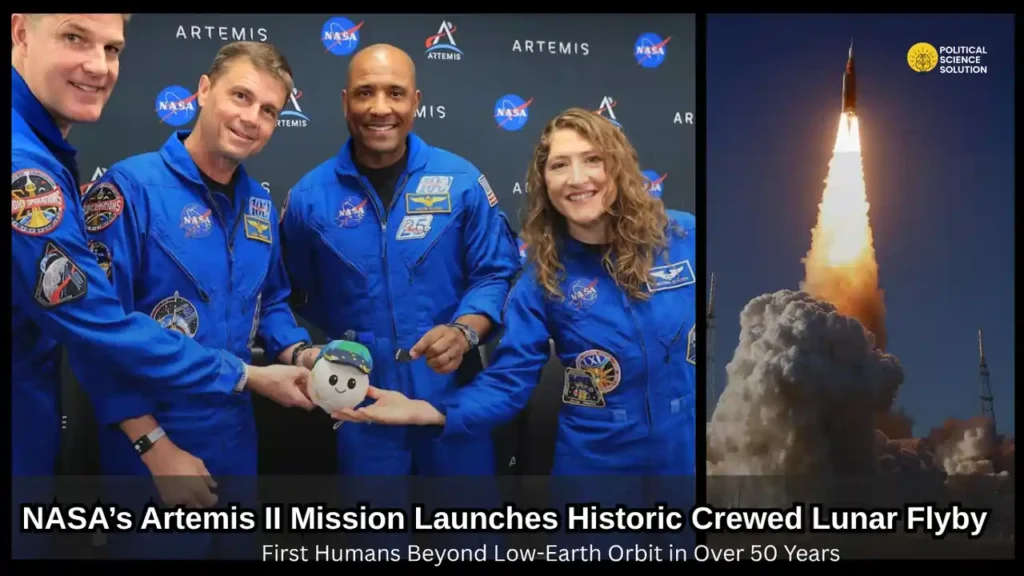
New Delhi: NASA has successfully launched Artemis II, the first crewed mission to the vicinity of the Moon since the Apollo era ended in 1972. On April 1, 2026, the towering Space Launch System (SLS) rocket carrying the Orion spacecraft lifted off from Kennedy Space Center in Cape Canaveral, Florida, sending four astronauts on a nearly 10-day journey that will take them farther from Earth than any humans have traveled in more than five decades. This milestone flight marks a pivotal step in NASA’s Artemis program, which aims to return humans to the lunar surface and lay the groundwork for eventual crewed missions to Mars.
The launch comes at a time of renewed global momentum in lunar exploration, driven by scientific discovery, economic potential, and strategic competition among spacefaring nations. Yet just hours after a flawless liftoff, the crew encountered an unexpected challenge: a temporary malfunction in the Orion capsule’s advanced toilet system. While quickly resolved, the incident highlights both the complexities of long-duration spaceflight and the significant engineering advances that have been made since the Apollo days.
Understanding the Artemis Program: NASA’s Blueprint for Sustainable Lunar Exploration
Artemis stands as NASA’s flagship human space exploration initiative, focused on establishing a lasting human presence on and around the Moon. Central to international cooperation is the Artemis Accords, a set of principles launched in 2020 that have now been signed by more than 60 nations, including India in 2023. These agreements promote peaceful, transparent, and sustainable activities in space.
The program is structured in progressive missions:
- Artemis I (2022) was an uncrewed test flight that successfully demonstrated the SLS rocket and Orion spacecraft during a lunar orbit.
- Artemis II (2026), now underway, is the first crewed mission, conducting a lunar flyby without landing.
- Artemis III (2027) will serve as a demonstration in low Earth orbit to test commercial lunar landers.
- Artemis IV (2028) targets the first crewed lunar landing under the Artemis banner.
- Artemis V (2028) will focus on scientific research, initiate construction of a lunar base, and achieve a second lunar landing.
This phased approach builds on decades of experience while incorporating new international partnerships and commercial capabilities.
Why the Moon Matters Again: Scientific, Economic, Strategic, and Exploratory Drivers
Global interest in lunar missions has surged for compelling reasons. Scientifically, studying the Moon offers insights into the origin and evolution of Earth and the broader solar system. Economically, the Moon promises opportunities in the growing space economy, including the utilization of resources such as water ice for life support and potential helium-3 deposits that could support future fuel and energy needs. Strategically, the Moon serves as a critical testing ground and gateway for deep-space missions, allowing crews to rehearse long-duration operations essential for Mars exploration. At the national level, successful lunar programs enhance prestige and demonstrate technological dominance in space.
These motivations have spurred parallel efforts worldwide. India’s Chandrayaan series has made landmark discoveries, including water molecules on the lunar surface, and achieved the first soft landing near the Moon’s south pole. China’s Chang’e 6 completed a robotic sample-return mission from the lunar far side. Japan’s Smart Lander for Investigating Moon (SLIM) achieved the first high-precision pinpoint landing. Together, these accomplishments underscore a vibrant international race that complements NASA’s human-focused Artemis program.
The Historic Launch: From Kennedy Space Center to Deep Space
The 32-storey SLS rocket roared to life on Wednesday, April 1, 2026, rising from Launch Pad at Kennedy Space Center amid cheers from tens of thousands of spectators. Aboard Orion were NASA astronauts Reid Wiseman (commander), Victor Glover, and Christina Koch, along with Canadian Space Agency astronaut Jeremy Hansen. Their mission: a looping trajectory around the Moon and back, pushing the boundaries of human spaceflight.
Launch Director Charlie Blackwell-Thompson captured the moment perfectly, telling the crew: “On this historic mission, you take with you the heart of this Artemis team, the daring spirit of the American people and our partners across the globe, and the hopes and dreams of a new generation. Good luck, Godspeed Artemis II. Let’s go.”
Five minutes after liftoff, Commander Wiseman radioed back: “We have a beautiful moonrise, we’re headed right at it.”
The launch was not without pre-flight drama. In the hours leading up to ignition, hydrogen fuel loading—a phase that had triggered a dangerous leak during an earlier countdown test—proceeded smoothly. More than 700,000 gallons (2.6 million litres) of propellant were successfully loaded. NASA also cleared multiple technical hurdles, including a communications glitch with the rocket’s flight-termination system and an out-of-range temperature reading on a battery in Orion’s launch-abort system. All issues were resolved without delaying the countdown.
Mission Timeline: From Earth Orbit to Lunar Flyby and Safe Return
Once in space, the crew will spend the first one to two days in high Earth orbit performing comprehensive systems checks on Orion’s life-support, propulsion, navigation, and communications systems. Upon completion, the spacecraft will execute a critical translunar injection burn, propelling it out of Earth orbit toward the Moon.
The journey to the Moon will take several days, during which the astronauts will monitor spacecraft performance while traveling deeper into space than any human since Apollo. Orion will then swing behind the Moon on a free-return trajectory, using lunar and terrestrial gravity to arc back toward Earth with minimal fuel expenditure. This phase will mark the mission’s farthest distance from our planet.
On the return leg, additional deep-space tests will evaluate power systems, thermal controls, and crew operations. As Orion re-enters Earth’s atmosphere at approximately 40,233 km per hour (25,000 miles per hour), the capsule will endure intense heating before splashing down in the Pacific Ocean, where recovery teams will retrieve the astronauts.
NASA science mission chief Nicky Fox contextualized the flight’s generational significance: “There are a lot of people who don’t remember Apollo. There are generations who weren’t alive when Apollo launched. This is their Apollo.”
Hours After Launch: The Unexpected Toilet Glitch and Swift Resolution
Despite the flawless ascent, a minor but notable issue emerged within hours. Mission specialist Christina Koch reported a problem with the Universal Waste Management System (UWMS)—the spacecraft’s toilet—specifically noting that the toilet fan was jammed. NASA spokesperson Gary Jordan confirmed the urine-collection portion was temporarily offline, though solid-waste functionality remained intact.
NASA’s Director of Flight Operations Norm Knight attributed the glitch to a controller issue. Flight controllers promptly guided Koch through troubleshooting steps. After a brief period of focused work, she confirmed the fix: “Houston, Integrity, good checkout.” Capcom Amy Dill responded: “Happy to report that the toilet is going to be used. We do recommend letting the system get to operating speed before donating fluid, and then letting it run a little bit after donation.”
While inconvenient, the episode was resolved quickly and stands in stark contrast to earlier lunar missions.
From Apollo Plastic Bags to the Modern Universal Waste Management System
During the Apollo program, astronauts had no onboard toilets whatsoever. They relied on adhesive-rimmed plastic bags and funnels for both urine and solid waste. The system was notoriously messy and unreliable; leaks were common, and crews reported floating waste and vomit in the cabin. Astronaut Ken Mattingly, during Apollo 16, famously quipped after describing the ordeal: “I used to want to be the first man to Mars… This has convinced me that, if we got to go on Apollo, I ain’t interested.” A post-Apollo NASA report bluntly gave waste disposal “poor marks” for crew satisfaction.
The UWMS represents more than a decade of engineering evolution. Collins Aerospace began development under NASA contract in 2015. The system, tested on the International Space Station in 2020 with final installation in 2021, features a compact, titanium 3D-printed design suitable for multiple spacecraft types, including Orion. Key improvements include:
- Handles and foot restraints for stability in microgravity
- Simultaneous urine and feces processing
- Unisex urine-collection devices
- A solid door providing privacy in the cramped “hygiene bay,” roughly the size of an airplane lavatory
- Airflow technology that draws waste away from the body
Lockheed Martin’s Blaine Brown, director of Orion mechanical systems, emphasized its importance: “absolutely an important component on this ship.” Project manager Melissa McKinley of NASA’s UWMS team added: “I think of waste management as an evolution of design… There is so much learning that goes into it.” Historian David Munns of the City University of New York noted that a reliable toilet is “mission-critical”—without it, the entire flight could be jeopardized.
The Orion capsule itself, while larger than Apollo modules, has an interior volume comparable to two SUVs, making every cubic inch precious. The new toilet brings long-sought creature comforts to lunar voyages, directly addressing decades of astronaut feedback.
Broader Implications: Paving the Way for Moon Bases and Mars Missions
Artemis II is more than a flyby; it is a dress rehearsal for sustained human operations beyond Earth. By validating Orion’s deep-space performance and gathering data on crew health and spacecraft systems, the mission will directly inform Artemis III through V, including lunar landings and the construction of a lunar base. Lessons learned—right down to the toilet—will shape future Mars campaigns, where even longer durations and greater isolation will demand even more robust life-support technologies.
As the crew continues their journey, the world watches. For a generation that never witnessed Apollo firsthand, Artemis II symbolizes humanity’s renewed commitment to exploring the cosmos. With international partners, commercial innovation, and hard-won engineering triumphs, NASA is not simply repeating history—it is writing the next chapter.
The successful launch, rapid resolution of the toilet issue, and smooth early operations signal strong progress. As Orion swings toward the Moon, the mission reaffirms that space exploration remains one of humanity’s most ambitious and unifying endeavors. Updates will continue as the crew completes their historic loop around the Moon and returns safely to Earth.
FAQs
1. What is NASA’s Artemis II mission and when did it launch?
NASA’s Artemis II is the first crewed lunar flyby mission in over 50 years. It launched on April 1, 2026, from Kennedy Space Center, Florida, using the SLS rocket and Orion spacecraft with four astronauts.
2. Who are the astronauts on the Artemis II mission?
The crew includes NASA astronauts Reid Wiseman (commander), Victor Glover, Christina Koch, and Canadian astronaut Jeremy Hansen. They are performing a 10-day journey around the Moon.
3. What happened with the toilet on the Artemis II spacecraft?
Hours after launch, the Orion capsule’s toilet fan jammed due to a controller issue. Astronaut Christina Koch reported the problem, but the crew quickly resolved it through troubleshooting steps.
4. How does Artemis II differ from the Apollo missions?
Unlike Apollo, which had no onboard toilets and used plastic bags, Artemis II features NASA’s advanced Universal Waste Management System with a door, unisex design, and simultaneous waste handling for better crew comfort.
5. What are the future plans after Artemis II?
Artemis III (2027) will test commercial landers in low Earth orbit, while Artemis IV (2028) aims for the first crewed lunar landing, followed by Artemis V for scientific research and Moon base construction.