

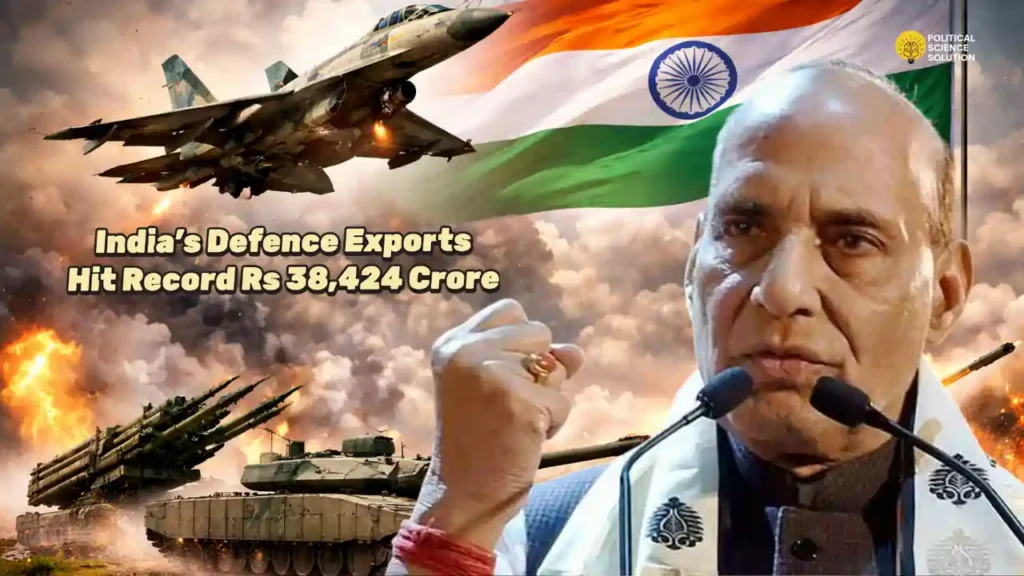
New Delhi: In a major boost to India’s push for self-reliance in defence, the country’s defence exports have surged to an all-time high of Rs 38,424 crore in the financial year 2025-26. This marks a robust 62.66 per cent growth over the previous fiscal’s Rs 23,622 crore, reflecting the growing global confidence in Indian-made defence products and the success of collaborative efforts between public and private sectors.
Defence Minister Rajnath Singh described the achievement as a “landmark milestone” and a “big jump” that underscores India’s emergence as a trusted global player in defence manufacturing. In a post on X, the minister highlighted how the Rs 14,802 crore increase demonstrates “the growing global trust in India’s indigenous capabilities and advanced manufacturing strength.” He added that the milestone showcases the power of a collaborative and self-reliant defence ecosystem, aligning perfectly with Prime Minister Narendra Modi’s vision to position India among the world’s top defence exporters.
The Ministry of Defence termed the 2025-26 figure a historic accomplishment that has nearly tripled in value over the last five years. Exports have shown steady growth from 2021-22 through 2025-26, building on consistent policy support and industry innovation. This upward trajectory not only strengthens India’s strategic position but also signals the country’s transition from being primarily an importer to a significant exporter of defence equipment.
Breakdown of Contributions: DPSUs Lead with 54.84%, Private Sector Close at 45.16%
A notable feature of this record performance is the balanced contribution from both Defence Public Sector Undertakings (DPSUs) and the private industry. DPSUs accounted for 54.84 per cent of the total exports, contributing Rs 21,071 crore. This represents a massive 151 per cent surge compared to their Rs 8,389 crore in the previous financial year.
The private sector, on the other hand, contributed 45.16 per cent or Rs 17,353 crore — up from Rs 15,233 crore last year, registering a 14 per cent growth. Together, these figures illustrate the expanding role of private players in India’s defence ecosystem, even as public sector entities continue to anchor the sector.
The Ministry noted that the number of defence exporters has also risen sharply — from 128 in the previous fiscal to 145 this year, a 13.3 per cent increase. This expansion in the exporter base points to broader industry participation and improved ease of doing business for smaller players.
Global Footprint Expands to Over 80 Countries
India’s defence exports now reach more than 80 countries worldwide as of FY 2025-26. Beyond complete systems, the country has established itself as a reliable global partner for systems and sub-systems, with Indian products finding integration into international supply chains. The Ministry of Defence emphasised that this widespread acceptance highlights the quality and competitiveness of indigenous defence products.
The sharp rise in exports is seen as a direct outcome of years of focused policy interventions aimed at indigenisation. India’s indigenous defence production had already touched a record high in FY 2023-24, laying a strong foundation for the current export success.
Strategic, Diplomatic and Economic Significance of the Milestone
This record-breaking export figure carries deep strategic importance. It positions India as a global manufacturing hub for defence equipment, reducing dependency on foreign suppliers and enhancing national security through self-reliance. Diplomatically, defence exports foster long-term partnerships, build trust, and promote interoperability with friendly nations.
Economically, the growth is expected to generate significant employment opportunities and further encourage private sector participation in the defence industry. The achievement directly supports the Atmanirbhar Bharat goal, under which India aims to achieve ₹3 lakh crore in defence production and ₹50,000 crore in exports by 2029. The current momentum suggests the country is well on track to meet these ambitious targets.
The Ministry of Defence stated that the performance reflects the increasing global acceptance of “Made in India” defence products and their growing integration into global supply chains. This success story is not just about numbers — it represents a fundamental shift in how the world perceives India’s defence manufacturing capabilities.
Persistent Challenges Despite Impressive Growth
While the record exports are cause for celebration, the defence sector continues to face several challenges that need sustained attention. High import dependence in certain critical technologies remains a concern, as does vulnerability to global supply chain disruptions. Intense competition from established global defence players and occasional regulatory delays also pose hurdles for exporters.
Addressing these issues will be crucial to sustaining the growth momentum and ensuring that India not only maintains but accelerates its position in the international defence market.
Key Government Initiatives Driving the Export Surge
The government has rolled out several targeted initiatives to promote defence exports and strengthen the overall ecosystem. The Innovations for Defence Excellence (iDEX) Framework has been instrumental in nurturing innovation by engaging startups and MSMEs, bringing fresh ideas and agile solutions into the sector.
FDI liberalisation allowing up to 74 per cent foreign direct investment under the automatic route has facilitated greater technology inflow and collaboration with global partners. The Defence Acquisition Procedure 2020 has prioritised indigenous content in defence procurement, giving a strong push to local manufacturing.
The establishment of Defence Industrial Corridors (DICs) in Uttar Pradesh and Tamil Nadu has created dedicated industrial ecosystems that support manufacturing, testing, and export activities. Additionally, the Research, Development and Innovation (RDI) Scheme is fostering collaboration among DPSUs, private companies, MSMEs, and startups — creating a vibrant innovation network.
The Department of Defence Production has also streamlined defence export regulatory processes. A revamped online portal and simplified Standard Operating Procedure (SOP) for authorisations have significantly reduced procedural delays and improved the overall ease of doing business for exporters.
Broader Defence Sector Momentum in FY 2025-26
The export achievement comes alongside other positive developments in the defence sector. The Ministry of Defence has fully utilised its capital outlay of Rs 1.86 lakh crore for defence services in FY 2025-26 at the Revised Estimates stage. Acceptance of Necessity (AoN) was accorded for 109 proposals worth Rs 6.81 lakh crore — compared to only 56 proposals worth Rs 1.76 lakh crore in FY 2024-25. Capital procurement contracts for 503 proposals amounting to Rs 2.28 lakh crore were signed during the year, indicating accelerated modernisation and procurement activity.
These figures underline the government’s commitment to strengthening both domestic capabilities and export potential simultaneously.
A Collaborative Success Story
Rajnath Singh has repeatedly emphasised that this milestone is the result of collective efforts by all stakeholders — from DPSUs and private industry to startups, MSMEs, and research organisations. The balanced growth between public and private sectors, coupled with policy support and innovation, has created a self-sustaining defence ecosystem.
The minister’s message is clear: India is scripting an impressive defence exports success story. The 62.66 per cent growth is not a one-off spike but the outcome of sustained reforms, focused indigenisation, and global outreach.
Looking Ahead: Sustaining the Momentum
As India moves towards its 2029 targets of ₹3 lakh crore in production and ₹50,000 crore in exports, the focus will remain on addressing challenges, scaling innovation through iDEX and RDI, attracting more FDI, and expanding the exporter base further. The steady growth trajectory since 2021-22 provides a strong foundation, but continued reforms in regulatory processes and technology development will be key to maintaining this upward curve.
The record Rs 38,424 crore in defence exports for FY 2025-26 is more than a statistical high — it is a testament to India’s evolving role as a defence manufacturing powerhouse. With global trust in indigenous capabilities at an all-time high and a collaborative ecosystem firing on all cylinders, the coming years promise even greater achievements in India’s journey towards complete self-reliance in defence.
This landmark performance not only enhances India’s strategic autonomy but also opens new avenues for economic growth, job creation, and international partnerships. As the Ministry of Defence and industry stakeholders build on this momentum, the message to the world is loud and clear: India is ready to supply world-class defence solutions and emerge as a preferred global partner.
FAQs
1. What is the record defence export figure achieved by India in FY 2025-26?
India’s defence exports reached an all-time high of ₹38,424 crore in FY 2025-26, marking a 62.66% increase over the previous year’s ₹23,622 crore.
2. How much did DPSUs and the private sector contribute to India’s defence exports in FY 2025-26?
Defence Public Sector Undertakings (DPSUs) contributed 54.84% (₹21,071 crore), while the private sector accounted for 45.16% (₹17,353 crore) of the total exports.
3. To how many countries does India export defence equipment as of FY 2025-26?
As of FY 2025-26, India exports defence equipment to more than 80 countries worldwide, with the number of exporters rising to 145 from 128 in the previous fiscal.
4. What are the major government initiatives supporting India’s defence exports?
Key initiatives include the iDEX Framework, 74% FDI under automatic route, Defence Acquisition Procedure 2020, Defence Industrial Corridors in Uttar Pradesh and Tamil Nadu, and the RDI Scheme.
5. What is India’s target for defence production and exports by 2029?
India aims to achieve ₹3 lakh crore in defence production and ₹50,000 crore in defence exports by 2029 under the Atmanirbhar Bharat initiative.