

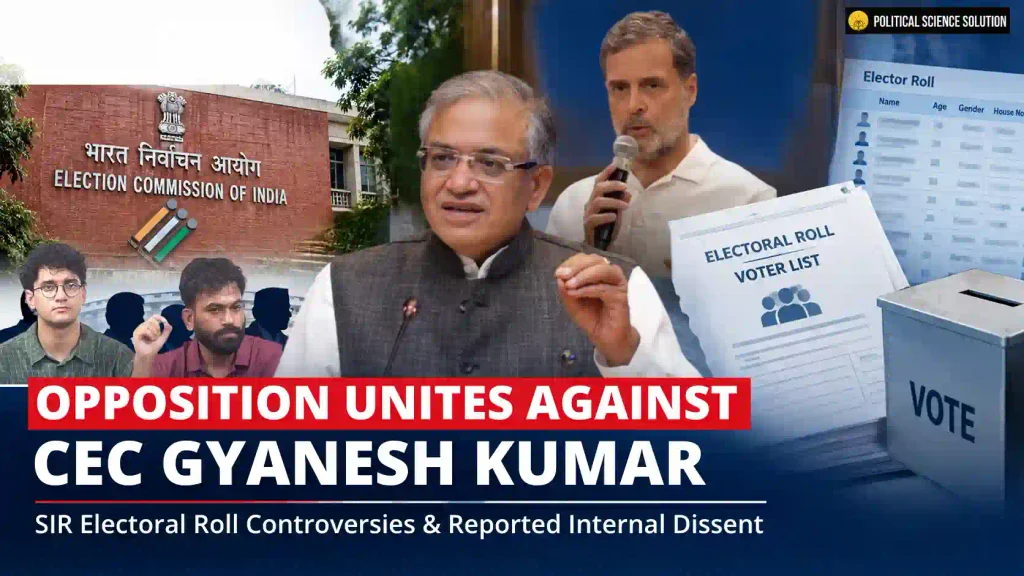
New Delhi: A wave of sharp criticism from major opposition parties has intensified against Chief Election Commissioner Gyanesh Kumar and the Election Commission of India following detailed reports of internal objections within the poll body over the Special Intensive Revision of electoral rolls. Leaders from the Aam Aadmi Party, Communist Party of India (Marxist), Communist Party of India, Congress, Samajwadi Party, Shiv Sena (UBT) and others have accused the process of enabling large-scale voter deletions that allegedly favoured the ruling Bharatiya Janata Party, describing it as a fundamental threat to democratic integrity and demanding immediate action including Kumar’s removal, arrest and the cancellation of recent elections in several states.
Indian Express Report Reveals 14 Written Objections by Election Commissioners
The controversy centres on revelations that Election Commissioners Sukhbir Singh Sandhu and Vivek Joshi raised written objections at least 14 times over a 10-month period. These notes reportedly concerned decisions taken in the Commission’s name regarding voter-list changes, the Special Intensive Revision process itself, modifications to Form 6, and restricted access to electoral-roll data. One objection from Sandhu characterised certain actions taken against the commissioners’ written advice as unauthorised and illegal. The reports also highlighted gradual centralisation of the electoral-roll database, raising questions about whether statutory procedures were fully followed. Opposition leaders have seized on these disclosures to argue that the integrity of the Election Commission itself is now under question.
Arvind Kejriwal Labels CEC Mastermind of Biggest Scam, Demands Arrest and Fresh Polls
Arvind Kejriwal, national convener of the Aam Aadmi Party and former Delhi chief minister, led one of the strongest attacks during a press conference in New Delhi. He characterised the deletion of voters through the Special Intensive Revision as the biggest scam in independent India and labelled Gyanesh Kumar the mastermind and chief of vote chori. Kejriwal demanded Kumar’s immediate arrest and prosecution. He further called for the annulment of all elections held in Delhi, Maharashtra, Bihar, West Bengal and Haryana over the past few years, insisting they be conducted afresh. According to Kejriwal, the three-member Commission had been effectively bypassed through unilateral orders issued by the Chief Election Commissioner. He claimed that meetings of the full Commission had not taken place for several months while orders continued to be issued. As a result, he argued, the entire Special Intensive Revision process—through which approximately 13 crore names have been struck off draft rolls across 30 states and union territories—is illegal because it lacked official approval from the full Commission. Kejriwal demanded that the process be cancelled entirely, that all changes made under it be reversed, and that the voter list from three years earlier be restored. He also alleged that Electoral Registration Officers had been denied proper access to voter databases and questioned the legality of changes made to Form 6. In his view, if voter lists are being prepared from the Election Commission’s central office rather than by local Electoral Registration Officers or Sub-Divisional Magistrates, the integrity of the entire national voter list stands compromised.
CPI(M) and CPI Call for Immediate Removal of Gyanesh Kumar
The Communist Party of India (Marxist) and the Communist Party of India echoed these concerns and formally called for Gyanesh Kumar’s removal from the post of Chief Election Commissioner. CPI(M) leader and Rajya Sabha member John Brittas stated that the revelations raise serious questions not only about the election process but, more importantly, about the integrity of the Election Commission itself. He noted that the disclosures strengthen long-standing suspicions and concerns raised by the CPI(M), other opposition parties and civil society organisations since the Special Intensive Revision began. Brittas wrote to President Droupadi Murmu seeking her urgent intervention. He highlighted that over 13 crore names have been struck off draft rolls across 30 states and union territories and that more than 33 lakh Delhi voters have been issued notices. He urged that pending proceedings for the removal of the Chief Election Commissioner proceed without obstruction and that the Union Government take a clear stand before the Supreme Court seeking annulment of the Special Intensive Revision wherever it is found unlawful.
CPI General Secretary D. Raja described the situation as a grave crisis and called Kumar the face of an electoral purge that is eroding public trust in the constitutional body. Raja insisted that the Chief Election Commissioner has no right to continue and must resign to restore trust and credibility in the Election Commission of India. He reiterated the party’s consistent warning that governments cannot be allowed to handpick voters in a democracy.
Rahul Gandhi Brands Alleged Vote Chori as Treason Against Constitution
Lok Sabha Opposition Leader Rahul Gandhi framed the alleged vote chori as a crime against the Indian people and a direct attack on the Constitution. He stated that the Bharatiya Janata Party, the Rashtriya Swayamsevak Sangh and the Election Commission who organised it have committed an act of treason and that justice will be served. In a video message addressed to Election Commission officials, Gandhi warned that their actions are wrong, constitute treason and are against the nation. He cautioned them not to forget that a time of reckoning will come and that those responsible will be held accountable.
Akhilesh Yadav Demands No Future Elections Under Kumar
Samajwadi Party chief Akhilesh Yadav said the report raises serious questions about the Election Commission. He noted that senior officers of the Commission had written notes about wrongdoings 14 times in 10 months and described this as a danger to the Constitution and democracy. Yadav alleged that his party had previously complained about the deletion of voters’ names without any action being taken. He further claimed that the “UP model” of electoral management had been implemented in West Bengal and Bihar. Yadav demanded that any future elections should not be held under Gyanesh Kumar and expressed concern that issues with electoral rolls could eventually affect voting rights more broadly.
Uddhav Thackeray, Manish Tiwari and Other Leaders Escalate Pressure
Shiv Sena (UBT) chief Uddhav Thackeray demanded Kumar’s immediate removal. He observed that opposition parties had been raising their voices for several years against what they described as invalid and anti-democratic acts and decisions of the Election Commission. Now that two Election Commissioners have raised their concerns in writing and also written to the Cabinet Secretary, Thackeray said, Prime Minister Narendra Modi should immediately sack Gyanesh Kumar. He called for all opposition parties to unite on the issue to ensure the Chief Election Commissioner’s removal and also demanded that Kumar be put behind bars.
Congress MP Manish Tiwari pointed to the possibility of an invisible hand beyond the Election Commission influencing its functioning. He noted that if the two Election Commissioners were repeatedly objecting to decisions concerning the Special Intensive Revision of electoral rolls and the process still continued, it suggested external influence. Tiwari referred to the rules governing the three-member poll panel, under which decisions are to be taken unanimously or, in case of disagreement, by majority.
AAP MP Sanjay Singh described the Special Intensive Revision as electoral loot. He said reports mention dissent expressed 14 times, with the two Election Commissioners repeatedly telling the Chief Election Commissioner that his method was wrong and that the centralised system being created to delete and add votes was improper. Despite these objections, according to Singh, unilateral decisions continued. He demanded that elections held under Kumar be cancelled and conducted again.
Congress leader P. Chidambaram stated that if the Indian Express report is correct, it raises questions about both individual decisions and the Commission’s overall decision-making process. He called for recent Election Commission decisions to be reviewed by a Parliamentary Committee and demanded that the Special Intensive Revision be suspended.
Other opposition leaders including Trinamool Congress general secretary Abhishek Banerjee, Congress general secretary K.C. Venugopal, Rashtriya Janata Dal MP Manoj Jha, Trinamool Congress leader Derek O’Brien, Rajya Sabha MP Kapil Sibal, Shiv Sena (UBT) MP Sanjay Raut, DMK spokesperson T.K.S. Elangovan and CPI(M) MP John Brittas also criticised the poll panel or sought action against Kumar.
Election Commission Defends Process as Routine Internal Deliberations
The Election Commission of India has firmly countered the allegations. It stated that written notes, suggestions and differing views form a normal part of its internal process and help ensure transparency, legal compliance and operational rigour. All official orders and decisions, the Commission said, carry full legal sanctions and follow statutory procedures. Objections raised during the draft stage were part of routine deliberations aimed at improving electoral processes and protecting voter rights. Focusing on 14 internal notes while overlooking the much larger body of approvals, decisions, instructions and initiatives presents only one side of the picture, the Commission argued. It asserted that all these decisions are the outcome of unanimous decisions of the full Commission over the past year, covering the Special Intensive Revision, electoral-roll revisions and other reforms. The Commission added that its digital platforms, including ECINet, operate under strict data-security protocols, while Electoral Registration Officers and District Election Officers continue to exercise their statutory powers over voter registration and deletion.
New Wave of Scams Exploits Special Intensive Revision Process
Parallel to the political controversy, a new form of fraud has emerged that exploits public awareness of the Special Intensive Revision. Scammers posing as Election Commission officials contact citizens by telephone or WhatsApp, claiming that their self-enumeration forms contain errors or have been rejected. Victims are then pressured to share sensitive banking details or download suspicious files. Documented cases include a Bengaluru technology professional who lost nearly 3.5 lakh rupees and a senior citizen from Pune who lost more than 4 lakh rupees after being told their forms had mistakes. Election Commission officials do not contact citizens through calls or WhatsApp for such purposes, and the entire Special Intensive Revision form process is completely free of charge. Citizens are advised to verify any communication through official channels and never to share personal or financial information in response to unsolicited messages claiming to concern electoral forms.
Mounting Pressure Puts Election Commission Under National Scrutiny
The converging political and public concerns have placed the functioning of the Election Commission under intense scrutiny. Opposition parties continue to press for institutional accountability, judicial intervention and the restoration of public confidence in the electoral process, while the Commission maintains that its internal deliberations and final decisions remain fully compliant with the law. As the Special Intensive Revision proceeds across the country, the debate over transparency, centralisation of data and the independence of constitutional bodies is expected to remain at the centre of national political discourse.
FAQs
1. What is the Special Intensive Revision (SIR) of electoral rolls and why has it become controversial?
The Special Intensive Revision is an ongoing nationwide exercise by the Election Commission of India to update and clean electoral rolls. Opposition parties allege that the process has led to the deletion of approximately 13 crore names from draft rolls across 30 states and union territories, with over 33 lakh voters in Delhi alone receiving notices. They claim the exercise was pushed through despite repeated internal objections and has allegedly placed the BJP in an advantageous position. Critics describe the scale of deletions as the biggest scam in independent India and argue that the process bypassed proper full-Commission approval.
2. What exactly did the Indian Express report reveal about internal disagreements within the Election Commission?
The report stated that Election Commissioners Sukhbir Singh Sandhu and Vivek Joshi raised written objections at least 14 times over a 10-month period. These objections covered decisions on voter-list changes, the SIR process, modifications to Form 6, and restricted access to electoral-roll data. One note from Sandhu described certain actions taken against the commissioners’ written advice as “unauthorised and illegal.” The report also pointed to gradual centralisation of the electoral-roll database and claimed that meetings of the full Commission had not been held for several months while unilateral orders continued to be issued.
3. What specific demands have opposition leaders made against Chief Election Commissioner Gyanesh Kumar?
Arvind Kejriwal demanded Kumar’s immediate arrest and prosecution, calling him the “mastermind” and “chief” of vote chori, and sought cancellation of recent elections in Delhi, Maharashtra, Bihar, West Bengal and Haryana. CPI(M)’s John Brittas and CPI’s D. Raja called for Kumar’s removal or resignation, with Brittas writing to President Droupadi Murmu for urgent intervention. Rahul Gandhi termed the alleged actions treason against the Constitution. Akhilesh Yadav demanded that no future elections be held under Kumar. Uddhav Thackeray sought Kumar’s sacking and imprisonment, while other leaders including Manish Tiwari, Sanjay Singh, P. Chidambaram and several more called for suspension of SIR, parliamentary review, or annulment of the process.
4. How has the Election Commission of India responded to the allegations of internal dissent and unilateral decision-making?
The Election Commission stated that written notes, suggestions and differing views are a normal part of its internal process and help ensure transparency, legal compliance and operational rigour. It asserted that all official orders and decisions carry full legal sanctions, follow statutory procedures, and are the outcome of unanimous decisions of the full Commission over the past year. The Commission said focusing only on 14 internal notes ignores the larger body of approvals and initiatives. It also clarified that its digital platforms operate under strict data-security protocols and that Electoral Registration Officers and District Election Officers continue to exercise their statutory powers.
5. What new scams are being reported in connection with the Special Intensive Revision and how can citizens protect themselves?
Scammers are impersonating Election Commission officials and contacting people via calls or WhatsApp, claiming that SIR self-enumeration forms have errors or have been rejected. Victims are then pressured to share banking details or download suspicious files. Documented cases include a Bengaluru tech professional who lost nearly ₹3.5 lakh and a Pune senior citizen who lost over ₹4 lakh. The Election Commission has clarified that its officials never contact citizens on calls or WhatsApp regarding forms, and the entire SIR process is completely free of charge. Citizens should verify any communication only through official ECI channels and never share personal or financial information in response to unsolicited messages.