

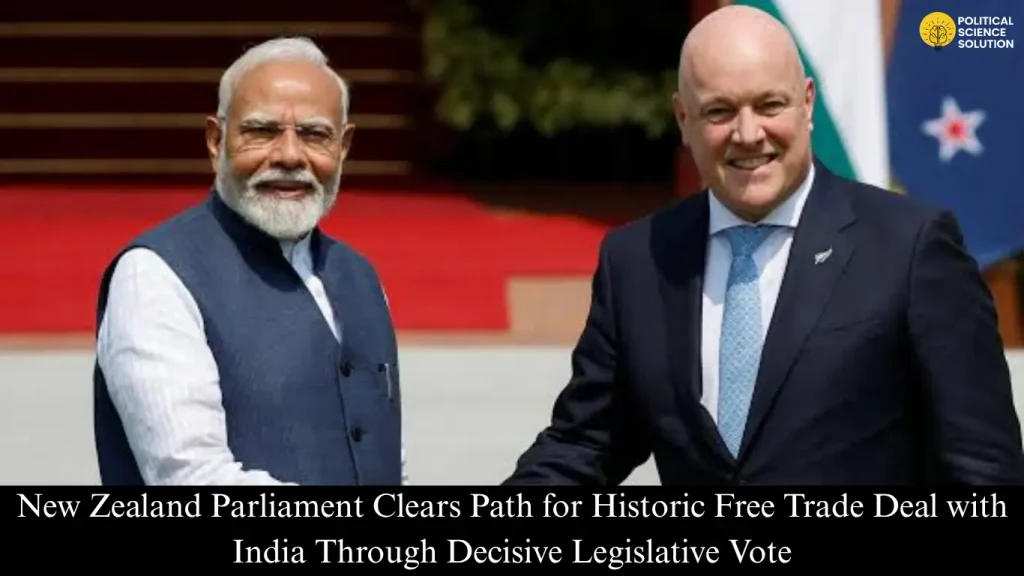
New Delhi: New Zealand lawmakers have taken a decisive step toward activating a comprehensive free trade agreement with India after approving the necessary implementing legislation. The measure cleared Parliament by a strong 93-29 margin, reflecting broad political consensus that includes the opposition Labour Party. This development positions the Pacific nation to unlock substantial tariff reductions, expanded market access, and long-term investment flows with one of the world’s largest emerging economies.
Parliamentary Vote Secures Strong Bipartisan Backing
The legislation received support from the ruling National Party, the Labour opposition, and ACT New Zealand. Official records show 93 votes in favour and 29 against during the second-reading stage. Trade Minister Todd McClay characterised the outcome as delivering “immediate and substantial” benefits for exporters. He confirmed that the high-quality agreement is expected to enter into force later this year, fulfilling a key policy priority for the current government.
Prime Minister Christopher Luxon described the pact as a “once-in-a-generation” opportunity. He emphasised that it will open access to India’s 1.4 billion consumers while generating additional jobs and higher incomes for New Zealanders. In a post on X, Luxon wrote: “People told me a free trade agreement with India wasn’t possible. Well, today that deal passed its final vote in Parliament. It’s happening.” The cross-party endorsement reduces uncertainty for businesses planning to expand into the Indian market.
Immediate Tariff Relief for New Zealand Exporters
Under the agreement, tariffs on about 95 percent of New Zealand’s exports to India will be eliminated or significantly reduced. More than half of the covered products—precisely 57 percent of current export volumes—will become duty-free from the first day the deal takes effect. The kiwifruit sector alone anticipates savings of approximately NZ$125 million in tariffs across the initial five years, according to government assessments.
New Zealand has agreed to grant duty-free treatment across 100 percent of its tariff lines for Indian goods. India has committed to tariff liberalisation on 70 percent of its tariff lines, representing roughly 95 percent of the value of existing bilateral trade. Sensitive categories, particularly most dairy products, retain protective measures to safeguard domestic interests on both sides.
Expanded Opportunities for Indian Producers and Services Trade
Indian exporters stand to gain unrestricted access to the New Zealand market for all goods. The agreement prioritises growth in labour-intensive industries including textiles and apparel, leather and footwear, gems and jewellery, engineering goods, processed foods, ceramics, carpets, and automobiles. Beyond merchandise trade, the pact includes chapters on services, temporary entry for skilled professionals, student mobility, and cooperation in agriculture and technology.
These provisions create structured pathways for professionals and students to move between the two countries while fostering technical collaboration in key economic areas. The overall framework aims to deepen commercial ties in a balanced manner that addresses the priorities of both economies.
Long-Term Investment Commitment Anchors the Partnership
New Zealand has pledged to facilitate or invest 20 billion US dollars—also referenced in official statements as NZ$20 billion, equivalent to around Rs 1 lakh crore—in India over the next 15 years. The capital is expected to target manufacturing, infrastructure development, and innovation. This multi-year investment pipeline complements the tariff reductions and is designed to generate sustained economic linkages rather than one-off trade gains.
The two governments have set a clear target of doubling bilateral trade by 2030. This ambition builds on the existing commercial foundation and leverages the preferential access created by the new agreement.
Rapid Negotiations and Formal Signing in 2026
The free trade agreement was formally signed in New Delhi on 27 April 2026. Negotiations concluded in just nine months after talks commenced in March 2025, reflecting intense diplomatic focus from both sides. Once the remaining domestic ratification processes are completed in Wellington and New Delhi, the agreement will enter into force. Indian Commerce Secretary Rajesh Agrawal has stated that India is working to operationalise the pact “as soon as possible,” with indications pointing to a possible start date in the second half of October.
Current Scale of Bilateral Commerce
Two-way trade between New Zealand and India reached 2.29 billion US dollars in the year to June 2026 according to one set of figures. Parallel official data place the total at NZ$3.99 billion, or approximately Rs 19,500 crore, for the same period. India currently ranks as New Zealand’s ninth-largest market for goods and services exports. These baseline numbers underscore the growth potential that preferential tariff treatment and investment facilitation are expected to unlock.
Path to Implementation and Next Steps
With parliamentary approval secured, both governments must finalise administrative and legal formalities. Once those steps conclude, tariff schedules will activate, investment facilitation mechanisms will begin operating, and mobility and cooperation provisions will take effect. New Zealand exporters will gain immediate cost advantages on a majority of shipments, while Indian producers will enjoy complete duty-free entry into the New Zealand market.
The agreement carefully balances ambition with political practicality. Preferential access for New Zealand agricultural and other exports is paired with improved opportunities for Indian manufacturing and labour-intensive goods. Protections for sensitive sectors remain in place, ensuring the deal can command lasting domestic support. Services chapters and people-to-people measures further broaden the partnership beyond traditional merchandise trade.
Broader Economic Significance for Both Nations
For New Zealand, the agreement delivers tangible cost savings and improved competitiveness in a large and expanding market. For India, it secures preferential access to a high-income economy and attracts substantial long-term capital focused on productive sectors. The combination of near-term tariff relief, progressive liberalisation covering 95 percent of New Zealand exports, full market opening for Indian goods, and a 15-year investment commitment establishes a comprehensive platform for deeper engagement.
The parliamentary vote removes the principal domestic obstacle on the New Zealand side. Attention now turns to the final procedural steps required for the agreement to become operational. Officials on both sides have signalled intent to move expeditiously, raising the prospect of implementation later this year—potentially within the second half of October. When that occurs, the long-anticipated free trade partnership between New Zealand and India will begin delivering concrete commercial results for businesses and workers in both countries.
Frequently Asked Questions
1. What was the outcome of the parliamentary vote on the India free trade agreement legislation?
New Zealand’s Parliament approved the implementing legislation by a clear 93-29 margin. The bill received support from the governing National Party, the opposition Labour Party, and ACT New Zealand. Trade Minister Todd McClay described the result as delivering immediate and substantial benefits for exporters, while Prime Minister Christopher Luxon called the overall agreement a once-in-a-generation opportunity that opens access to India’s 1.4 billion consumers.
2. When is the free trade agreement expected to enter into force?
Both countries must complete their remaining domestic ratification processes before the deal becomes operational. Indian officials have indicated that the agreement could take effect in the second half of October 2026. New Zealand Trade Minister Todd McClay has stated that the high-quality pact is expected to enter into force later this year. The agreement was originally signed in New Delhi on 27 April 2026 after negotiations that lasted only nine months from March 2025.
3. What tariff reductions will New Zealand exporters receive under the deal?
Tariffs on approximately 95 percent of New Zealand’s exports to India will be eliminated or significantly reduced. From the first day the agreement takes effect, 57 percent of New Zealand’s current exports to India will become duty-free. The kiwifruit industry alone is projected to save about NZ$125 million in tariffs over the first five years. New Zealand will provide duty-free access across 100 percent of its tariff lines for Indian goods, while India has liberalised 70 percent of its tariff lines covering roughly 95 percent of the value of bilateral trade. Protections remain in place for sensitive sectors, including most dairy products.
4. What investment commitment has New Zealand made to India?
New Zealand has agreed to facilitate or invest 20 billion US dollars (also reported as NZ$20 billion, equivalent to around Rs 1 lakh crore) in India over the next 15 years. The investment is expected to focus on manufacturing, infrastructure, and innovation. This long-term capital commitment is intended to complement the tariff reductions and support deeper economic ties between the two countries.
5. What is the current scale of trade and the future target under the agreement?
Two-way trade totalled 2.29 billion US dollars in the year to June 2026 according to one measure, while parallel figures place the total at NZ$3.99 billion (approximately Rs 19,500 crore) for the same period. India ranks as New Zealand’s ninth-largest market for goods and services exports. The two governments have set a target of doubling bilateral trade by 2030. The agreement also covers services, temporary entry for skilled professionals, student mobility, and cooperation in agriculture and technology, creating additional avenues for growth beyond merchandise trade.