
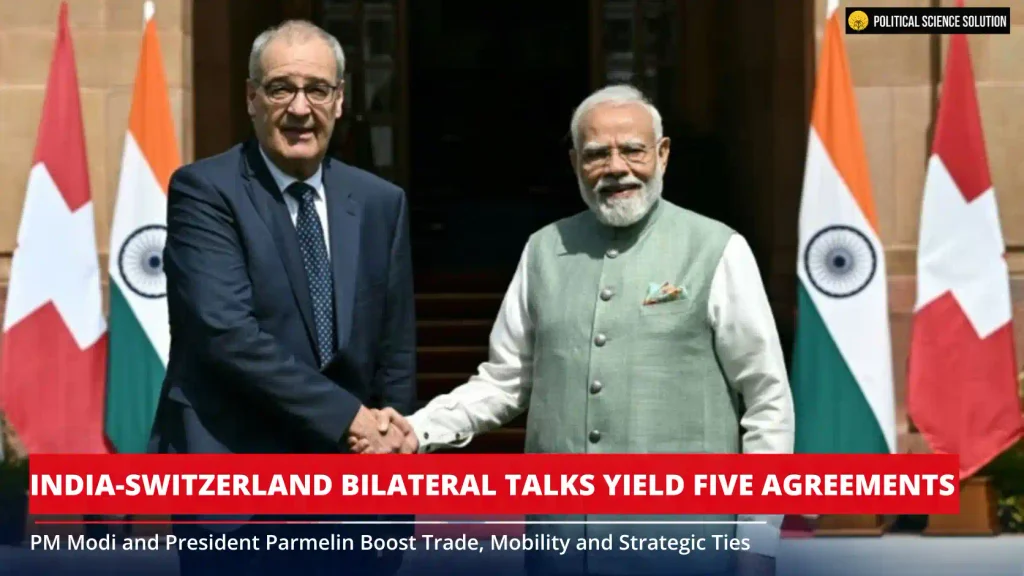
New Delhi: Prime Minister Narendra Modi and Swiss President Guy Parmelin held comprehensive bilateral discussions in New Delhi on Monday, culminating in the signing of five agreements that expand cooperation across migration, professional exchanges, transportation technologies, scientific research and innovation. The meetings took place during Parmelin’s three-day state visit, which coincides with the first anniversary of the India-European Free Trade Association Trade and Economic Partnership Agreement, or TEPA, coming into force.
Parmelin arrived in the Indian capital on the morning of the talks accompanied by a high-level delegation of senior officials and business leaders. Minister of State for Road Transport and Highways Ajay Tamta received him at the airport. A ceremonial welcome followed at the forecourt of Rashtrapati Bhavan, where President Droupadi Murmu and Prime Minister Modi greeted the Swiss leader. A tri-services guard of honour was presented. External Affairs Minister S. Jaishankar later called on the visiting president. Parmelin also paid floral tributes to Mahatma Gandhi at Rajghat. Later in the day he was scheduled to meet President Murmu, who would host an official banquet in his honour.
In a joint press interaction after the talks, Modi welcomed Parmelin’s commitment to strengthening India-Switzerland relations. He recalled that India had implemented the historic TEPA with the European Free Trade Association countries—Switzerland, Iceland, Norway and Liechtenstein—in October of the previous year. Modi described TEPA as India’s first free-trade agreement with a European economic bloc and an ambitious framework designed to promote investment, innovation, employment and shared prosperity. Under the agreement, India aims to attract 100 billion US dollars in investment and generate one million direct jobs over the next 15 years.
Expanded Market Access and Investment Facilitation
The two leaders announced a series of decisions intended to improve market access for Indian exports in Switzerland while easing two-way investment. Modi stated that these steps would raise Indian shipments of agricultural products, pharmaceuticals, textiles and engineering goods. At the same time, India expects new Swiss capital to flow into biotechnology, life sciences, banking, insurance, food processing and sustainability-related sectors. Both sides expressed the intention to develop trusted supply chains and reliable solutions that could serve global markets.
Switzerland remains India’s largest trading partner within the EFTA grouping and ranks as India’s 15th-largest overall trade partner, with bilateral commerce valued at approximately 25 billion dollars. Roughly 340 Swiss companies operate in India and have invested around 11 billion dollars, primarily in pharmaceuticals, chemicals, precision engineering and advanced technology. Nearly 30,000 Indians, including students and professionals active in financial services, engineering, information technology and pharmaceuticals, reside in Switzerland.
Parmelin characterised the partnership as mutually beneficial. He noted that India gains access to capital, technology transfers and improved market entry for high-value-added goods, while Switzerland benefits from trade with a large and steadily growing partner at a time when global commerce faces greater unpredictability. He underlined the importance of concluding an investment-protection agreement swiftly and of making progress on intellectual-property discussions to further stimulate investment flows.
Five Agreements Formalised
The two countries signed five instruments. The first is a Migration and Mobility Partnership that seeks to promote orderly mobility under principles of equal treatment, while preventing irregular migration and human trafficking in accordance with national laws. It provides for multiple-entry visas valid for up to five years, permitting stays of up to six months on each visit, as well as renewable one-year student permits.
The second agreement governs the exchange of young professionals who take up temporary employment in the other country to enhance professional and language skills within their fields. It initially covers 300 participants annually from each side, a number that may rise to 500. Verification of nationality and residency status is expected to be completed within 30 to 90 days.
A third memorandum of understanding addresses promotion and collaboration on transportation technologies, mobility systems and infrastructure in identified areas. It is intended to foster cooperation in sustainable infrastructure, electric vehicles, ropeways and tunnels. Modi cited existing examples of Swiss-linked infrastructure work, including the ropeway in Varanasi, the Jewar Airport project in Noida, and railway and tunnelling initiatives in hilly regions. He invited Swiss infrastructure firms to invest at scale in India and to participate in capacity building, design and manufacturing.
The fourth instrument is a Letter of Intent between India’s Department of Science and Technology and the Swiss National Science Foundation aimed at promoting long-term cooperation between the two research communities.
The fifth is an Implementation Arrangement for cooperation in innovation, technology transfer and entrepreneurship. Modi announced that new joint research projects would be launched in priority areas such as health, clean energy and space. He also noted that both countries had identified fresh possibilities for cooperation in military exchanges and defence production, and had agreed to deepen collaboration in nuclear energy.
Shared Democratic Values and Historical Bonds
Modi emphasised that the friendship between India and Switzerland rests on centuries-old foundations. He recalled that in the nineteenth century Swami Vivekananda perceived a glimpse of the Himalayas in the Swiss Alps, and that Mahatma Gandhi had spent time in Switzerland interacting with its people. Those historical memories, he said, continue to resonate in the contemporary relationship.
Parmelin, speaking after the ceremonial welcome, described the visit as an excellent opportunity to underscore the importance both countries attach to the relationship. He said the partnership is founded on shared democratic values, trust and mutual respect, and expressed hope that the visit would serve as a stepping stone toward further growth, deepening and strengthening of the long-standing ties. In his formal remarks he highlighted that India, the world’s most populous democracy, and Switzerland, one of the oldest democracies, share fundamental values.
Regional and Global Issues
International and regional matters, including the conflicts in Ukraine and West Asia, featured in the discussions. Modi stated that both sides believe in dialogue and diplomacy and work for global peace and stability. He reiterated that India has supported every meaningful effort toward peace in those theatres and that both countries agree on the necessity of reforming global institutions to address growing challenges.
Sibi George, secretary (West) in the Ministry of External Affairs, informed media that India and the EFTA bloc had agreed to establish a special group to examine all issues related to trade and investment and to address existing constraints. Modi also referred to the India-EFTA Prosperity Summit scheduled for Wednesday, describing it as an important platform for translating the promise of the trade and investment partnership into concrete outcomes.
Artificial Intelligence and Future Outlook
Both leaders discussed artificial-intelligence governance, with the aim of promoting a model that is innovative and equitable. Modi recalled that India had hosted a major AI summit in February and extended best wishes to Switzerland for hosting the next edition in Geneva the following year. He expressed confidence that the two countries would continue to advance responsible, inclusive and human-centric artificial intelligence.
Parmelin stressed that in difficult global times it is essential to create win-win situations at the international level. He viewed the mobility agreements as embodiments of high-quality cooperation and reiterated Switzerland’s interest in rapidly concluding an investment-protection pact.
The visit marks Parmelin’s first state visit to India, although he had earlier attended the AI Impact Summit in February. Throughout the engagements, both sides projected continuity and ambition: expanding economic linkages under TEPA, easing people-to-people mobility, deepening scientific and technological collaboration, exploring defence and nuclear opportunities, and coordinating positions on global challenges. The five agreements signed on Monday provide concrete institutional frameworks intended to convert these shared priorities into measurable outcomes over the coming years.
By anchoring the relationship in democratic values, historical affinity and practical economic interests, India and Switzerland have signalled their determination to move beyond traditional trade statistics toward broader strategic and societal cooperation. The decisions taken during the Modi-Parmelin talks are expected to influence bilateral investment flows, professional mobility, research partnerships and infrastructure development for the remainder of the decade and beyond.
FAQs
1. What were the five agreements signed between India and Switzerland during the Modi-Parmelin talks?
India and Switzerland signed five instruments: a Migration and Mobility Partnership promoting orderly movement under equal-treatment principles while combating irregular migration and human trafficking (including multiple-entry visas up to five years and renewable student permits); an agreement on the exchange of young professionals allowing temporary employment for skill and language development (initially 300 participants per country annually, expandable to 500); a memorandum of understanding on collaboration in transportation technologies, mobility systems and infrastructure (covering sustainable infrastructure, electric vehicles, ropeways and tunnels); a Letter of Intent between India’s Department of Science and Technology and the Swiss National Science Foundation for long-term research cooperation; and an Implementation Arrangement for cooperation in innovation, technology transfer and entrepreneurship.
2. How does the India-EFTA Trade and Economic Partnership Agreement (TEPA) relate to these talks?
The discussions marked the first anniversary of TEPA’s entry into force. Prime Minister Modi described TEPA as India’s first free-trade agreement with a European economic bloc and an ambitious framework for investment, innovation, jobs and shared prosperity. Under it, India aims to attract USD 100 billion in investment and create one million direct jobs over 15 years from the EFTA countries (Switzerland, Iceland, Norway and Liechtenstein). The leaders announced further steps to expand market access for Indian exports (agriculture, pharmaceuticals, textiles, engineering goods) and attract Swiss investment in biotechnology, life sciences, banking, insurance, food processing and sustainability.
3. What specific opportunities do the new mobility agreements create for Indian students, professionals and youth?
The Migration and Mobility Partnership provides multiple-entry visas valid for up to five years with stays of up to six months per visit, plus renewable one-year student permits, while emphasising equal treatment and measures against irregular migration. The young-professionals exchange agreement enables temporary employment in the partner country to build professional and language skills, starting at 300 people per country each year (potentially rising to 500), with nationality and residency verification targeted within 30–90 days. Together these open structured pathways for Indians in Switzerland in fields such as finance, engineering, IT and pharmaceuticals.
4. Did the leaders discuss defence, nuclear energy or international conflicts?
Yes. Prime Minister Modi stated that the two sides identified new possibilities for cooperation in military exchanges and defence production and agreed to deepen collaboration in nuclear energy. On global issues, both leaders discussed the conflicts in Ukraine and West Asia. Modi reiterated that India and Switzerland believe in dialogue and diplomacy, support every meaningful effort toward peace, and share the view that reform of global institutions is essential to address emerging challenges.
5. What is the current scale of India-Switzerland economic and people-to-people ties?
Switzerland is India’s largest trading partner within EFTA and its 15th-largest overall trade partner, with bilateral trade worth about USD 25 billion. Approximately 340 Swiss companies operate in India with cumulative investments of around USD 11 billion, mainly in pharmaceuticals, chemicals, precision engineering and advanced technology. Nearly 30,000 Indians live in Switzerland, working or studying in financial services, engineering, IT and pharmaceuticals. The new agreements and TEPA-related measures are intended to expand these linkages further through improved market access, investment facilitation and professional mobility.