

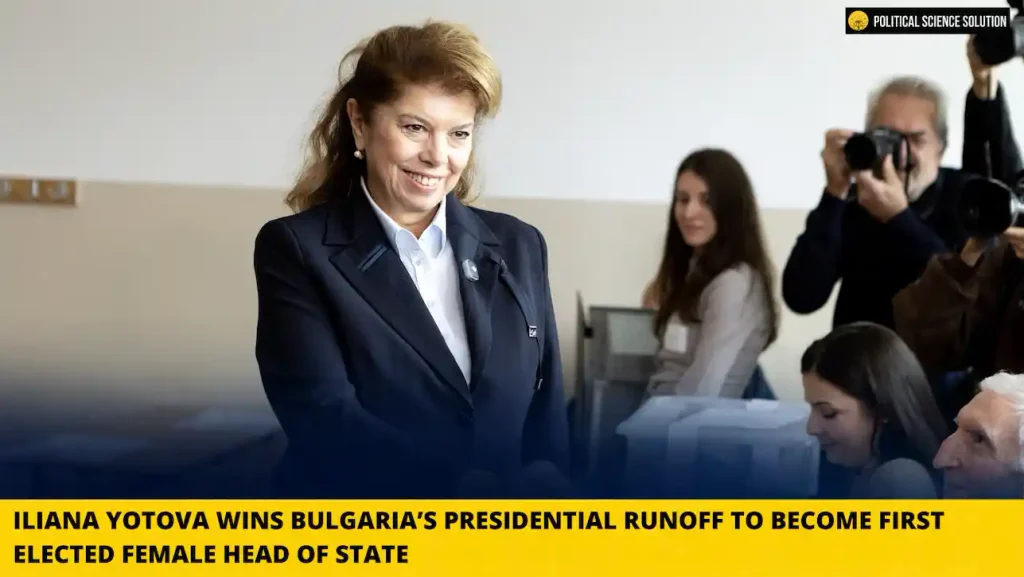
New Delhi: Bulgaria has elected Iliana Yotova as its first female president after she secured a decisive 57.6 percent of the vote in the November 1 runoff. Her opponent, former caretaker prime minister Andrey Gyurov, finished with 39.5 percent. Official results released on November 2 by the Central Election Commission confirmed the outcome and handed a significant political boost to Prime Minister Rumen Radev, whose Progressive Bulgaria party had strongly backed Yotova for the largely ceremonial yet influential role.
Yotova, aged 61 or 62 according to varying reports, is scheduled for inauguration on January 22. She will serve a five-year term and may seek one additional term under Bulgarian law. Gyurov conceded the same day the final tallies were announced, stating that the results reflected the will of Bulgarian citizens and must be accepted as they stood.
Election Outcome and Immediate Reactions
With every ballot counted, Yotova’s margin proved comfortable. She shared the victory with her chosen vice-presidential running mate, Kiril Valchev, a 53-year-old lawyer and journalist who has directed the official Bulgarian News Agency since 2021. In her post-election remarks Yotova emphasized national consensus. “I voted for national consensus through dialogue, for institutions that work for citizens, for a strong state with its own foreign policy in a strong Europe,” she declared.
European Commission President Ursula von der Leyen quickly congratulated the winner and voiced readiness to continue working together on security and defense, competitiveness, and energy independence. Her message on social media underscored the goal of “a strong Bulgaria in a strong Europe.”
Political Backdrop and Radev’s Role
The presidential contest served as the first major electoral test for Radev’s Progressive Bulgaria party after it captured an outright majority of 131 seats in the 240-member parliament during the April 2026 legislative election. Yotova had become acting president in January when Radev stepped down to lead that parliamentary campaign. Political analysts widely described Radev’s ticket as Kremlin-friendly. Both leaders have consistently called for a diplomatic resolution to Russia’s war in Ukraine and have resisted further Bulgarian military assistance to Kyiv.
Observers note that Yotova’s victory keeps the presidency aligned with the governing majority. This concentration of power has prompted concerns about the effectiveness of institutional checks and balances, even though parliament retains primary decision-making authority under the Bulgarian constitution.
Black Sea Drone Attacks Shape the Campaign Climate
The election took place against a tense security backdrop. Over the preceding month a series of drone strikes hit merchant vessels off Bulgaria’s Black Sea coast. The attacks killed at least 24 seafarers, triggered international condemnation, and heightened fears that the war in Ukraine was spilling further into the region. Both presidential candidates condemned the incidents. Radev stated that the strikes’ outcome “benefits the Russian Federation.” Days before the runoff he observed that two ships had been struck and sunk in Romanian waters after Bucharest attributed responsibility to Russia, adding that many people assume identifying an aggressor will halt the attacks.
Yotova similarly avoided naming Russia as the perpetrator. During the campaign she said she did not want to see “foreign flags in Bulgaria,” a remark widely interpreted as a reference to displays of the Ukrainian flag outside public institutions.
Campaign Framing: Peace Versus War
Prime Minister Radev explicitly framed the runoff as a choice “between war and peace.” Yotova embraced the label “president of peace.” At a rally on October 6 she pledged that “not a single Bulgarian soldier will go to Ukraine” if voters trusted her, even though the constitution reserves decisions on troop deployments and declarations of war exclusively for parliament. She repeatedly described her opponents as “warmongers” and argued that the conflict has no military solution, advocating instead a “coalition for peace” centered on diplomacy.
Gyurov, by contrast, drew support from pro-Western and reformist parties. While serving as caretaker prime minister earlier in 2026 he signed a security cooperation agreement with Ukraine, a step that drew criticism from both Yotova and Radev. He has long voiced firm support for Kyiv and sharp criticism of Russian aggression.
Candidate Profiles and Professional Paths
Yotova’s career began as a television journalist in the 1990s. She later entered politics, winning seats in the national parliament and subsequently the European Parliament on the Socialist Party list. She was elected vice president alongside Radev in both 2016 and 2021. Her professional trajectory and close political partnership with the current prime minister positioned her as the natural continuity candidate for voters aligned with the governing camp.
Gyurov, 50, had served as caretaker prime minister and positioned himself as a pro-European alternative. His campaign relied heavily on social media, while Yotova focused on closed events attended mainly by Progressive Bulgaria supporters.
First-Round Surprise and Low Turnout
Pre-campaign polls in late September showed Yotova leading comfortably at 44.5 percent against Gyurov’s 26.1 percent. The first round proved tighter than expected: Yotova received 34.8 percent and Gyurov 31.95 percent, forcing the November 1 runoff. Most major opposition parties, including the right-wing conservative GERB led by former long-serving prime minister Boyko Borisov, chose not to field their own candidate. Turnout on runoff day fell below 30 percent.
In the first round the pro-Russian nationalist Kostadin Kostadinov of the Vazrazhdane (Revival) party finished third with 12.5 percent. Roughly 70 percent of his supporters shifted to Yotova in the second round after she actively courted pro-Russian voters. In a podcast interview two days before the runoff she stated that “Russia is by no means an enemy of Bulgaria” and expressed hope that Russia would play a key role in Europe’s future security architecture.
Generational and Geographic Divides
Sociologist and political scientist Dimitar Ganev of the Trend research agency identified clear splits in the electorate. Voters aged 18 to 40 leaned toward Gyurov, while those over 40 preferred Yotova. Gyurov performed strongly in the capital Sofia; Yotova dominated in smaller regional cities, towns, and villages. Some of Yotova’s backers amplified claims that the opposition was preparing a “Maidan,” invoking the 2014 Ukrainian revolution. Media regulator member Sonya Momchilova, appointed by Radev, wrote that Gyurov’s supporters were openly discussing inevitable protests and using airtime to “stir up a Maidan.”
Debates Over Bulgaria’s European and NATO Commitments
Critics within the pro-European camp expressed concern. Former defense minister Todor Tagarev, who helped nominate Gyurov, argued that the “president of peace” rhetoric was linked to fear-mongering about war and that Bulgaria would occupy a weaker position inside the European Union and NATO under Yotova. Ganev offered a more measured assessment, noting that more than two-thirds of Bulgarians do not question the country’s geopolitical orientation and that roughly two-thirds hold a positive view of the European Union. Bulgaria joined NATO in 2004 and the European Union in 2007. A broad parliamentary consensus continues to support the pro-Western path even as historical and cultural ties sustain noticeable pro-Russia sentiment.
Institutional Powers and Forward Outlook
Although the presidency is primarily ceremonial, the office carries real influence. The president leads the armed forces, can veto legislation, signs international treaties, and appoints ambassadors. Direct election confers additional political authority beyond the formal constitutional powers. Yotova is widely expected to continue Radev’s dual-track approach: keeping Bulgaria formally on its European trajectory while advocating improved relations with Russia, resistance to additional military support for Ukraine, and emphasis on diplomatic solutions to the conflict.
The runoff confirmed both the strength of the current governing coalition’s base and the persistence of a substantial pro-Western minority skeptical of any softening toward Moscow. With parliament retaining primary policy authority, the practical consequences of Yotova’s election will depend heavily on how Radev’s majority chooses to govern and how the opposition organizes itself in response. Yotova enters office as Bulgaria’s first elected female head of state at a moment when regional security threats and domestic political polarization remain closely intertwined.
Frequently Asked Questions About Bulgaria’s 2026 Presidential Election
1. Who won the Bulgarian presidential election runoff and by what margin?
Iliana Yotova won the November 1, 2026 runoff with 57.6 percent of the vote. Her opponent, former caretaker prime minister Andrey Gyurov, received 39.5 percent. Official results released by the Central Election Commission on November 2 confirmed the outcome, making Yotova Bulgaria’s first elected female president. She is scheduled to be inaugurated on January 22 and will serve a five-year term, with the option of one re-election.
2. What is the political relationship between Iliana Yotova and Prime Minister Rumen Radev?
Yotova is a close political ally of Prime Minister Rumen Radev. She served as his vice president after the 2016 and 2021 elections and became acting president in January 2026 when Radev resigned to lead Progressive Bulgaria’s successful parliamentary campaign. Radev’s party, which won an outright majority of 131 seats in the 240-member parliament in April 2026, formally endorsed Yotova. Both leaders have called for a diplomatic end to the war in Ukraine, opposed further Bulgarian military aid to Kyiv, and favored improved relations with Russia while keeping Bulgaria on its formal European path.
3. How did recent Black Sea drone attacks influence the election?
In the month leading up to the vote, drone strikes hit several merchant ships off Bulgaria’s Black Sea coast, killing at least 24 seafarers and raising fears that the war in Ukraine was expanding regionally. Both candidates condemned the attacks. Prime Minister Radev stated that the outcome “benefits the Russian Federation” and later noted that ships had also been struck in Romanian waters. Yotova avoided naming Russia as the perpetrator and said she did not want to see “foreign flags in Bulgaria,” a remark widely understood as a reference to Ukrainian flags. The security situation became a central campaign theme, with Radev framing the runoff as a choice “between war and peace.”
4. What are the main differences in foreign-policy positions between Yotova and Gyurov?
Yotova positioned herself as the “president of peace.” She pledged that no Bulgarian soldiers would be sent to Ukraine, called opponents “warmongers,” and advocated a “coalition for peace” focused on diplomacy rather than military support. She has also expressed hope that Russia will play a key role in Europe’s future security architecture. Gyurov, backed by pro-Western and reformist parties, has long supported Ukraine. As caretaker prime minister earlier in 2026 he signed a security cooperation agreement with Kyiv—an action criticized by both Yotova and Radev—and sharply condemned Russian aggression.
5. How significant is the Bulgarian presidency and what powers does it hold?
The presidency is primarily ceremonial. Parliament holds most decision-making authority. However, the president leads the armed forces, can veto legislation, signs international treaties, and appoints ambassadors. Direct election gives the office greater political weight than its formal powers suggest. Yotova’s victory keeps the presidency aligned with Radev’s governing majority, prompting some observers to raise concerns about the concentration of power and the effectiveness of institutional checks and balances. Turnout in the runoff was below 30 percent, reflecting limited opposition participation and deep societal divisions over foreign policy.