

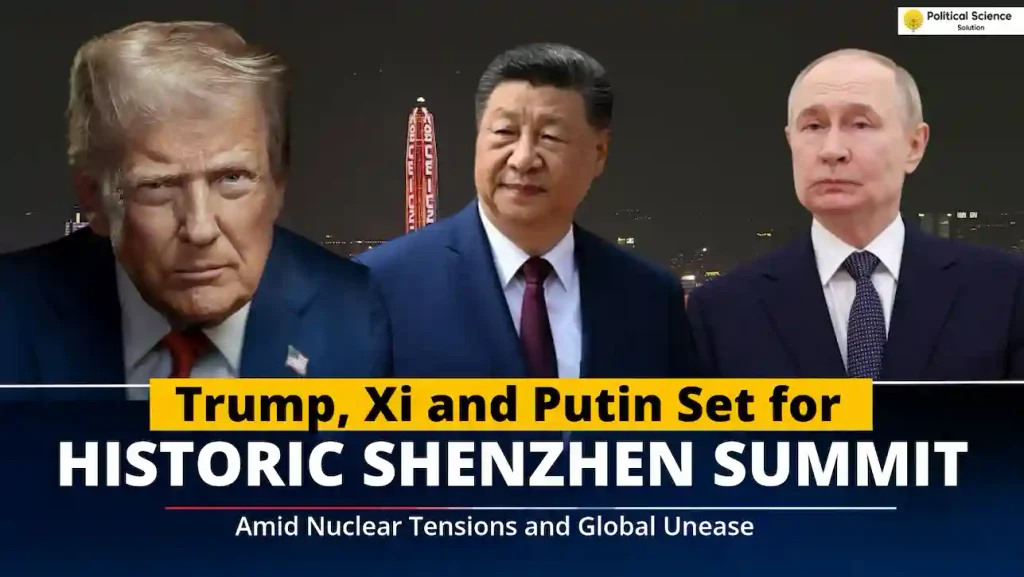
New Delhi: World leaders from the United States, China and Russia are preparing for an unprecedented three-way meeting in the southern Chinese city of Shenzhen later this week. The gathering is scheduled to take place on the sidelines of the Asia-Pacific Economic Cooperation forum, with the three presidents expected to sit down together around November 19. Officials from Washington and Moscow have confirmed the plan, while Beijing has described the encounter as carrying groundbreaking significance for major-power relations and the safeguarding of global stability.
The prospective summit brings together Donald Trump, Xi Jinping and Vladimir Putin at a moment of overlapping crises. Discussions are expected to touch on nuclear arms control following the expiration of the last major treaty between the United States and Russia, the ongoing conflict involving Iran, trade frictions, and the broader question of how the world’s three most heavily armed nuclear states manage their differences. Whether the war in Ukraine will feature prominently remains contested, with differing signals emerging from the three capitals.
Planning and Timing of the Rare Encounter
Planning for the meeting has been fluid. Negotiations over format and agenda continued until recently, according to people familiar with the discussions. Shenzhen, already hosting the larger APEC leaders’ gathering, provides a convenient backdrop. Trump is due to arrive in the region after first attending an Association of Southeast Asian Nations meeting in the Philippines. He is also expected to hold a separate bilateral session with Xi before the three-way encounter.
Distinct Priorities for Each Leader
Each leader arrives with distinct priorities. For Putin, the meeting offers a platform to elevate Russia’s standing alongside the United States and China. Russian nationalist voices have framed the talks as symbolic confirmation of a multipolar order. Some in Moscow have openly compared the prospect to the 1945 Yalta Conference, where the leaders of the United States, Britain and the Soviet Union shaped the postwar landscape. Kremlin spokesman Dmitry Peskov has described the planned session as extremely significant while cautioning that any understandings reached cannot simply be imposed on other nations. Putin has previously signaled interest in addressing the conflict in Ukraine, viewing the moment as an opportunity to secure terms favorable to Moscow after more than four years of fighting.
Trump has publicly emphasized nuclear risk reduction. White House statements have highlighted his intention to discuss limiting the global spread of nuclear weapons, which he regards as highly dangerous. The New Strategic Arms Reduction Treaty between Washington and Moscow expired in February 2026, removing the last formal numerical caps on the two largest arsenals for the first time in decades. Trump earlier rejected a simple extension and instead called for a modernized arrangement that would bring China into the framework. A senior administration official has indicated that while nuclear issues will open the conversation, no formal agreement is anticipated from this initial meeting. The same official noted that the United States sees value in China beginning to engage more directly on the subject.
China’s position has been more cautious. Beijing has long argued that the United States and Russia, each possessing more than five thousand nuclear warheads, must first make deeper reductions before China, whose stockpile is estimated in the range of five hundred to six hundred warheads and rising, joins formal constraints. Chinese academics and officials have described trilateral nuclear talks at this stage as neither fair nor realistic. Foreign ministry spokeswoman Mao Ning stated that the three leaders would hold in-depth exchanges on safeguarding world peace and promoting strategic stability in relations among major powers. She added that stronger communication among China, Russia and the United States, including better management of differences, serves the interests of all three and meets broader international expectations. Chinese state media initially focused on bilateral meetings on the margins of APEC rather than the trilateral session, reflecting Beijing’s careful messaging.
Iran Conflict Expected on the Table
The Iran conflict is another topic expected to surface. The United States and Israel launched military action against Iran earlier in the year. Although large-scale strikes have subsided, the situation remains deadlocked. The Strait of Hormuz has faced prolonged disruption, affecting energy flows. China, a major buyer of Iranian oil, has felt the economic impact through higher prices and interrupted supply routes. Russia has benefited from elevated energy prices and recent adjustments in Western sanctions policy. Trump has indicated interest in raising the Iran situation during the Shenzhen talks.
Mixed Signals on Ukraine Discussions
Reports have diverged on whether Ukraine will appear on the agenda. Earlier statements from U.S. officials suggested the president was unlikely to raise the issue in a three-way setting, noting that separate diplomatic channels involving American envoys were already active with both Kyiv and Moscow. China has described the conflict as a European matter in which Europeans should have a central role. German President Frank-Walter Steinmeier recalled that Xi expressed irritation when the possibility of including Ukraine arose in a recent conversation, stressing the need for European participation. Ukrainian President Volodymyr Zelenskiy has voiced clear concern that the meeting could evolve into a new version of Yalta, with major powers redistributing influence without the involvement of smaller states. Nevertheless, Trump told reporters shortly before departing that Ukraine would feature among the subjects discussed, describing it as a favorite topic and noting the heavy casualties on both sides.
Anxiety Among Smaller Nations Over a Possible New Yalta
The optics of the meeting have generated anxiety well beyond the three participants. Governments in Kyiv, Tokyo and elsewhere have expressed unease about the possibility of private understandings reached without their input. For Taiwan, the spectacle of the three leaders together carries additional sensitivity. China itself occupies an awkward position as host. Beijing was not present at the original Yalta Conference and has cultivated an image as a defender of the interests of developing nations. Hosting a gathering that some outsiders already label a potential “Yalta 2.0” risks undercutting that narrative even as it underscores China’s central role in contemporary diplomacy.
Domestic Pressures and Diplomatic Style
Trump’s domestic political context adds another layer. His party suffered significant losses in the recent midterm elections, leaving him facing a Democratic-controlled Congress. The Asia trip, including the high-profile Shenzhen sessions, offers an opportunity to project statesmanship and shift attention toward foreign policy achievements. Analysts note that Trump has long favored dramatic diplomatic encounters, from earlier meetings with Putin to outreach toward North Korean leader Kim Jong Un. Speculation has also circulated that a possible encounter with Kim could occur during the China visit, though no confirmation has been issued.
China and Russia have deepened practical cooperation in recent years, including energy trade and military-technical exchanges, particularly after Western sanctions followed Russia’s full-scale invasion of Ukraine. At the same time, Beijing has avoided fully endorsing Moscow’s maximalist goals in that conflict. The United States under Trump has pursued a more transactional approach toward both powers, including adjustments on energy sanctions and repeated bilateral meetings with Xi. Trade tensions between Washington and Beijing remain unresolved despite earlier tariff reductions and deals struck after previous encounters. Competition over advanced semiconductors and artificial intelligence continues to strain the relationship, as does the broader contest for technological leadership.
Modest Expectations for Concrete Outcomes
No one involved anticipates a comprehensive breakthrough in Shenzhen. U.S. officials have been explicit that the nuclear conversation is intended as a starting point rather than a concluding negotiation. Chinese reluctance on arms control remains firm. On Ukraine, the absence of the parties most directly affected and China’s stated preference for European involvement make substantive progress unlikely in a trilateral format. The Iran discussion may yield statements of concern over regional stability and energy security without producing an immediate settlement.
Symbolic Importance of the First Trilateral Face-to-Face
Still, the mere fact of the three leaders meeting face to face carries symbolic weight. It marks the first time the current occupants of the White House, Zhongnanhai and the Kremlin will sit together in one room. For Putin, the elevation alongside the other two powers serves domestic and international messaging. For Trump, it offers a stage on which to demonstrate engagement with the world’s other nuclear heavyweights. For Xi, hosting the session reinforces China’s position as an indispensable convening power even while managing the risks of an unpredictable American counterpart and an agenda that includes topics Beijing prefers to keep bilateral or limited.
The historical parallel to Yalta continues to resonate precisely because it captures the anxiety of those outside the room. In 1945 the decisions taken by three leaders shaped the political map of Europe and the architecture of the United Nations. Today’s version, if it materializes as planned, will not redraw borders in the same formal manner. Yet the perception that the most powerful states are once again deliberating the rules of the international system without broader consultation is already producing diplomatic friction. Zelenskiy’s public warning against repeated Yalta-style redistributions of influence reflects a wider sentiment shared in parts of Europe and Asia.
What Comes After the Shenzhen Meeting
As the leaders prepare to gather in Shenzhen, the practical outcomes may prove modest. Photo opportunities, carefully worded joint statements, and commitments to further dialogue are the more probable results. The deeper test will be whether the three governments can sustain communication on nuclear risk, regional conflicts and strategic stability after the cameras leave. With the previous U.S.-Russia arms control regime gone and China’s arsenal expanding, the absence of structured dialogue carries its own dangers. Whether this week’s meeting becomes the opening chapter of a new framework or simply another high-level encounter that yields limited follow-through will only become clear in the months ahead.
The international community will be watching closely. Smaller states, regional organizations and the United Nations have all signaled interest in any steps that reduce nuclear dangers or ease active conflicts. United Nations Secretary-General Antonio Guterres has indicated readiness to support denuclearization efforts that might emerge. For now, the focus remains on Shenzhen, where three leaders with sharply different styles and interests will attempt to navigate an agenda that touches some of the most sensitive security questions of the era.
FAQs
1. When and where will the Trump-Xi-Putin trilateral meeting take place?
The three leaders are scheduled to meet around November 19, 2026, in Shenzhen, China. The talks will occur on the sidelines of the Asia-Pacific Economic Cooperation (APEC) summit. U.S. President Donald Trump is expected to arrive after attending an ASEAN meeting in the Philippines and will also hold a separate bilateral discussion with Chinese President Xi Jinping before the three-way session.
2. What are the main topics expected to be discussed?
Nuclear arms control is a top priority, especially after the New START treaty between the United States and Russia expired in February 2026. Other subjects include the conflict involving Iran, trade and technology tensions, and broader strategic stability among major powers. Whether the war in Ukraine will be formally addressed remains unclear, with conflicting statements from the three sides.
3. Why is China hesitant about nuclear arms control talks?
China possesses a much smaller nuclear arsenal (estimated at roughly 500–600 warheads) compared with the more than 5,000 each held by the United States and Russia. Beijing has long maintained that Washington and Moscow must first make significant reductions before China joins any formal constraints. Chinese officials and analysts view early trilateral nuclear negotiations as unfair and unrealistic at this stage.
4. Will the Ukraine war be part of the agenda?
Official positions differ. Earlier U.S. statements indicated Trump was unlikely to raise Ukraine in the three-way format, noting that separate diplomatic channels were already active. China has described the conflict as a European issue requiring European participation. However, Trump later told reporters that Ukraine would be discussed. Ukrainian President Volodymyr Zelenskiy has publicly expressed concern that the meeting could become a new version of the 1945 Yalta Conference, where major powers decide outcomes without smaller nations at the table.
5. Why are some countries worried this could become a “new Yalta”?
The 1945 Yalta Conference saw the leaders of the United States, Britain, and the Soviet Union shape the postwar order, including spheres of influence. Smaller nations, including Ukraine, Japan, and others, fear a similar dynamic in which the United States, China, and Russia reach private understandings that affect their security or interests without their involvement. China, which was not present at the original Yalta meeting, faces particular sensitivity as the host of the current gathering.