

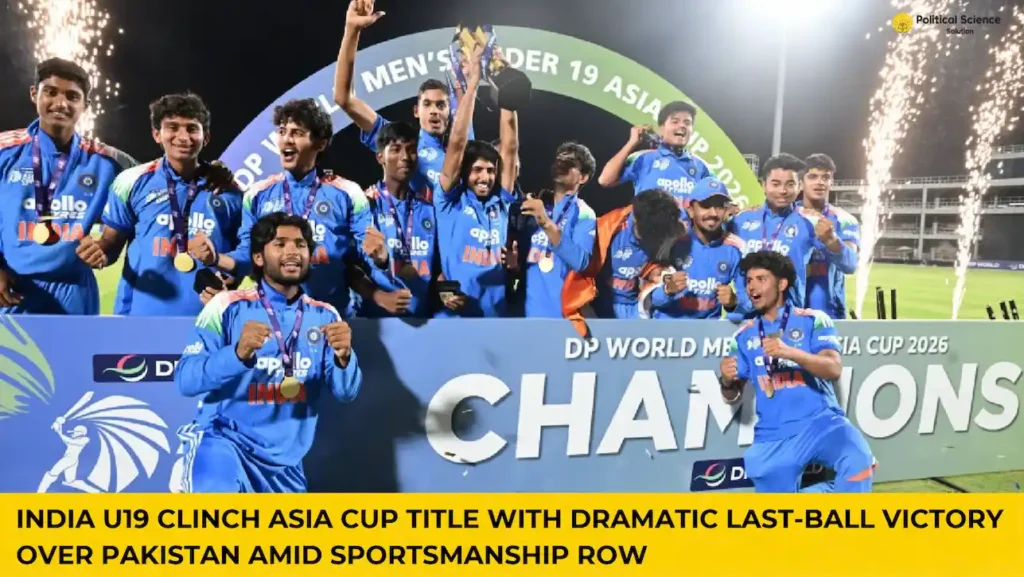
New Delhi: India’s Under-19 cricket team secured a record-extending ninth Asia Cup title with a thrilling one-wicket win over Pakistan in the final of the 2026 ACC Men’s U19 Asia Cup. The match took place at the Oman Academy Cricket Ground in Al Amerat on the outskirts of Muscat. Played on Saturday, it produced one of the most memorable finishes in recent junior international cricket as India chased down a target of 338 and finished on 339 for 9.
The result extended India’s dominance in the competition and marked their first title at this level since 2021. Yet the celebration was tempered by post-match scenes that drew sharp criticism and highlighted ongoing tensions between the two sides.
Pakistan Set a Formidable Target
Pakistan won the toss and chose to bat first on a surface that favoured stroke play. They posted 337 for 9 in their 50 overs. Opener Usman Khan played the anchoring role with a composed century, finishing on 107 off 111 balls. Abdul Qadir injected momentum with an aggressive 80 scored off only 54 deliveries. Captain Farhan Yousaf added a useful 63 off 60 balls.
India’s bowlers fought to restrict the total in the later stages. Kavya Patel emerged as the most successful with figures of four wickets for 68 runs. Chigurupati Venkata supported well, taking three wickets for 40 runs. The total of 337 presented a steep challenge, yet the flat nature of the pitch left the chase within reach for a determined batting side.
India Build a Platform Then Slip
India’s reply began on a solid note. Captain Lakshya Raichandani and Aaryavir Sehwag added 95 runs for the first wicket. Sehwag, the son of former India opener Virender Sehwag, scored 58 off 61 balls that included nine boundaries. He went on to finish as the tournament’s leading run-scorer with 361 runs in five innings at an average of 90.25 and was named Player of the Tournament. Raichandani provided the backbone of the innings with a patient 80 off 101 balls.
Middle-order wickets then began to fall at regular intervals. India slumped to 252 for 8 in the 42nd over, leaving the required rate looking increasingly difficult. At that point Pakistan held the clear upper hand. Anvay Dravid, son of former India captain and coach Rahul Dravid, contributed 19 runs during the innings.
Chauhan and Ulva Stage a Remarkable Recovery
The ninth-wicket partnership between Manal Chauhan and Mohit Ulva transformed the contest. The pair added 57 crucial runs. Chauhan scored a rapid 47 off 32 balls before being dismissed. Ulva, batting at number 10, remained not out on 49 from just 26 deliveries.
Chigurupati Venkata, appearing in his first match of the tournament, joined Ulva and finished unbeaten on 11 off eight balls. Together they added an unbroken 30 runs for the final wicket. With eight runs needed from the last over and only one wicket remaining, Ulva kept his composure. Three runs were required off the final ball. He stepped down the pitch and struck a boundary to complete the chase and secure the title.
After the match Ulva reflected that the tournament had not gone well for him until the final. He said he believed he could deliver when the moment arrived and credited Chauhan for the support during their partnership. He noted that batting at number 10 had proved fortunate and that the team kept telling itself that if Pakistan could post such a total on a flat pitch, India could chase it down.
Individual Honours and Team Achievement
Mohit Ulva was named Player of the Match for his decisive unbeaten 49. Aaryavir Sehwag’s consistent scoring across the tournament earned him the Player of the Tournament award. The victory avenged India’s earlier group-stage loss to Pakistan and confirmed the side’s status as the most successful team in Under-19 Asia Cup history with a ninth title.
Post-Match Scenes Draw Criticism
While the cricketing achievement drew praise for resilience and belief under pressure, the scenes after the final ball attracted widespread condemnation. Indian players were seen directing aggressive gestures and heated verbal exchanges toward Pakistani players. One player shouted and gesticulated directly in the face of Pakistan wicketkeeper Hamza Zahoor, who did not respond. Other members of the Indian side directed kicks toward the Pakistan dressing-room area while team management attempted to restrain them.
Both teams chose not to take part in the customary post-match handshake. The absence of handshakes has become a recurring feature in recent India-Pakistan encounters.
Reactions from Former Players and Fans
Former Pakistan captain Mohammad Yousuf underlined the wider responsibility that players carry. He stated that individuals represent not only their country but also the values and upbringing given by their families, and that true sportsmanship is shown through respect and composure whether in victory or defeat.
Many Indian supporters on social media described the behaviour as unnecessary and uncalled for. Comments characterised it as a reflection of a culture that at times elevates confrontation above dignity and reminded observers that a cricket match should not be treated as a form of conflict. Several posts noted that a country’s sporting culture is measured as much by how players treat opponents after a loss as by how they celebrate success.
Context of Recent India-Pakistan Encounters
The decision to skip handshakes continues a pattern established in senior and women’s cricket over the past year. In 2025 the India men’s side under then-captain Suryakumar Yadav declined handshakes during an Asia Cup fixture and later chose not to accept the trophy from Asian Cricket Council president Mohsin Naqvi, who also serves as Pakistan’s interior minister. The India women’s team followed similar practices during the ICC Women’s World Cup 2025 in Sri Lanka, the ICC Women’s T20 World Cup in England, the Women’s Asia Cup group stage, and the Women’s Asia Cup final in Dubai, where they also declined to accept the trophy from the same official.
A Result That Will Be Remembered for Two Reasons
In purely cricketing terms the final will be recalled for the last-ball boundary that completed an improbable chase, the ninth-wicket stand that revived India’s hopes, and the individual performances that defined both innings. Ulva’s composure under extreme pressure, Chauhan’s acceleration, and the contributions of openers Raichandani and Sehwag provided the backbone of the successful pursuit. On the other side, Pakistan’s total of 337 for 9, built around Usman Khan’s century and the supporting roles of Qadir and Yousaf, had set a target that tested every aspect of India’s batting depth.
The presence of young players with strong family connections to Indian cricket, including Aaryavir Sehwag and Anvay Dravid, added further interest for domestic audiences. For Pakistan the final represented a missed opportunity after a competitive batting display that took them close to a continental title.
As the young squads return home, the focus for coaches and administrators will include both recognition of a hard-fought championship and reflection on the conduct that followed the final ball. The victory itself demonstrated resilience and collective belief. The reaction that accompanied it served as a reminder that sportsmanship remains central to the identity of the game, particularly at the junior level where values can shape future careers.
The 2026 Under-19 Asia Cup final therefore delivered high drama, standout individual performances, and a sporting outcome that India will celebrate, while also underlining the continuing challenges that accompany the India-Pakistan rivalry on the field.
FAQs
1. What was the final result and how did India win the match?
India chased down Pakistan’s total of 337 for 9 and finished on 339 for 9 to win by one wicket. The match was decided on the last ball of the 50th over at the Oman Academy Cricket Ground in Al Amerat. Needing three runs off the final delivery, Mohit Ulva struck a boundary to complete the chase and secure the title.
2. Who were the standout performers for India in the final?
Mohit Ulva was the match-winner with an unbeaten 49 off 26 balls and was named Player of the Match. Manal Chauhan scored a quick 47 off 32 balls in a vital 57-run ninth-wicket partnership with Ulva. Captain Lakshya Raichandani made 80 off 101 balls and Aaryavir Sehwag scored 58 off 61 balls in an opening stand of 95. Chigurupati Venkata contributed an unbeaten 11 and also took three wickets earlier.
3. What individual awards were given after the tournament?
Mohit Ulva received the Player of the Match award for his decisive unbeaten 49. Aaryavir Sehwag was named Player of the Tournament after finishing as the leading run-scorer with 361 runs in five innings at an average of 90.25, which included one century and three half-centuries.
4. Why did the post-match scenes attract criticism?
After the win, several Indian players directed aggressive gestures and verbal outbursts toward Pakistani players. One player was seen shouting and gesticulating in the face of Pakistan wicketkeeper Hamza Zahoor. Others directed kicks toward the Pakistan dressing-room area. Both teams also skipped the customary handshake, continuing a recent pattern in India-Pakistan matches.
5. How significant is this title for India in the Under-19 Asia Cup?
The victory gave India a record-extending ninth Under-19 Asia Cup title and their first since 2021. It also avenged their earlier group-stage defeat to Pakistan in the same tournament and confirmed India’s position as the most successful side in the competition’s history.