

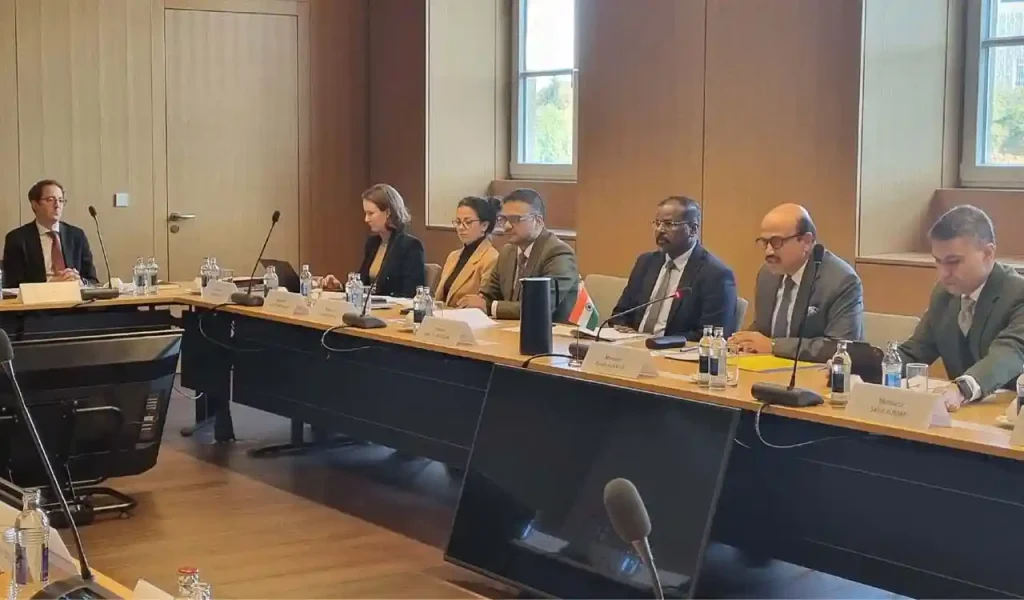
New Delhi: The 19th session of the India–Belgium–Luxembourg Economic Union Joint Economic Commission convened in Luxembourg on 29 October 2026, marking a significant step in advancing commercial and investment relations among the three partners. The meeting brought senior officials together to assess the current state of bilateral trade flows, review investment patterns and map concrete pathways for deeper collaboration across multiple high-potential sectors.
Commerce Secretary Rajesh Agrawal represented India and co-chaired the proceedings alongside H.E. Mr. Filip Vanden Bulcke, Director-General for Geo-Economy and Economic Diplomacy at Belgium’s Federal Public Service Foreign Affairs, Foreign Trade and Development Cooperation, and H.E. Mr. Henri Schumacher, Secretary General of Luxembourg’s Ministry of Foreign and European Affairs, Defence, Development Cooperation and Foreign Trade. Their joint leadership underscored the institutional continuity of the forum, which has operated since 1997 as the principal platform for structured economic engagement between India and the Belgium–Luxembourg Economic Union.
Participants examined existing trade and investment statistics and identified practical measures to increase two-way flows. Discussions spanned logistics, with particular attention to air connectivity and port infrastructure; renewable energy and clean technology; financial services and FinTech; digital transformation and information and communication technology; healthcare and life sciences; Ayurveda and traditional medicine; and agro-food processing. Officials also agreed to pursue expanded cooperation in aerospace, research and innovation, higher education and skill development. Market-access questions and other trade-related concerns featured prominently, reflecting a shared interest in removing barriers and creating more predictable conditions for businesses operating across the three economies.
Logistics and Connectivity Take Centre Stage
Logistics emerged as a central theme. Both air and maritime connectivity were flagged as areas where closer coordination could unlock measurable gains in trade efficiency. The conversation recognised that modern supply chains depend not only on physical capacity but also on seamless interfaces between ports, airports, customs procedures and digital systems. Officials noted that improved air links would support high-value, time-sensitive cargo such as pharmaceuticals and electronics, while enhanced port partnerships could facilitate bulk commodities and future energy carriers.
This focus builds directly on recent bilateral activity. In September 2026, Brussels Airport and Hyderabad International Airport signed a memorandum of understanding centred on cargo development, knowledge exchange and stronger commercial links between Belgium and India. The agreement leverages Brussels Airport’s established strengths in pharmaceutical logistics and Hyderabad’s expanding life-sciences manufacturing base. At the time of signing no scheduled direct air service connected the two airports; the memorandum therefore establishes a framework for exploring connectivity options and developing related commercial opportunities. Pharmaceutical shipments, which require specialised handling and reliable temperature-controlled chains, illustrate how transport infrastructure and industry needs can reinforce each other.
On the maritime side, earlier outreach by the Port of Antwerp-Bruges in 2026 engaged Indian energy and infrastructure stakeholders through a roadshow dedicated to future green-hydrogen and green-ammonia trade corridors. That initiative linked European port infrastructure with the prospective movement of renewable fuels between India and Europe, aligning closely with the Joint Economic Commission’s parallel interest in ports, renewable energy and clean technology. Such corridors would require coordinated development of production facilities, storage, shipping capacity and receiving terminals—elements that governments can help facilitate through policy dialogue and investment promotion.
Broader Sectoral Priorities and Investment Outreach
Beyond logistics, the session addressed the full spectrum of priority sectors. Renewable energy and clean technology discussions explored opportunities for technology transfer, joint projects and participation in global value chains supporting the energy transition. Financial services and FinTech received attention as Luxembourg’s specialised financial ecosystem and India’s rapidly expanding digital finance market present complementary strengths. Digital transformation and ICT cooperation were framed as enablers for productivity gains across manufacturing, services and public administration. Healthcare and life sciences, including Ayurveda and traditional medicine, were identified as areas where regulatory dialogue and research collaboration could expand market access and foster innovation. Agro-food processing was highlighted for its potential to add value to agricultural production and meet growing demand for processed products in both regions.
The three sides further resolved to deepen engagement in aerospace, research and innovation, higher education and skill development. These longer-horizon domains are expected to generate knowledge spillovers and skilled human capital that support industrial competitiveness on both sides.
Immediately after the formal session, Commerce Secretary Agrawal held a business interaction with chief executives of Luxembourg-based companies. He presented an overview of India’s economic growth trajectory and investment climate, emphasising openings in financial services, advanced manufacturing, logistics, clean energy, digital technologies, healthcare, and research and innovation. He encouraged Luxembourg firms to consider long-term capital commitments, technology partnerships and closer integration with Indian companies that already participate in global value chains. The interaction reinforced the message that government-to-government dialogue is most effective when paired with direct private-sector engagement.
Context from Earlier Ministerial Engagement
The Luxembourg meeting followed ministerial-level contacts in India in early September 2026. Luxembourg’s Deputy Prime Minister Xavier Bettel and Economy Minister Lex Delles visited India on 7–8 September. Bettel held discussions with External Affairs Minister S. Jaishankar and Commerce and Industry Minister Piyush Goyal. Delles conducted separate talks covering space cooperation and the decarbonisation of steel production. The visit also included business and research interactions in Chennai. These earlier exchanges placed logistics within a wider agenda that already encompassed finance, advanced industry and technology, demonstrating that infrastructure questions are being treated as integral to industrial and investment strategy rather than as isolated transport matters.
For companies evaluating market entry or expansion, the combination of policy dialogue and practical partnerships matters. Industrial projects require reliable infrastructure, access to capital and dependable supply chains before they can serve international markets. The Joint Economic Commission provides a structured setting in which these interconnected requirements can be examined systematically.
Institutional Continuity and the Path Ahead
The India–Belgium–Luxembourg Economic Union Joint Economic Commission has functioned since 1997 as the principal formal mechanism for commercial and economic discussions among the three countries. Its longevity reflects the sustained value both sides attach to regular, high-level exchange. The 19th session reaffirmed that the forum continues to serve as a venue for reviewing sectoral cooperation, addressing market-related issues and identifying new avenues for business engagement and investment partnerships.
Commercial progress, however, ultimately depends on follow-through. Identification of priority sectors creates the enabling environment; conversion of that environment into defined projects, investment proposals and operating partnerships determines tangible outcomes. The strongest near-term opportunities are those that connect a clear customer requirement with appropriate infrastructure and services. The Brussels Airport–Hyderabad International Airport memorandum of understanding offers one working example of this approach. Port and clean-energy discussions point toward longer-term possibilities that will require sustained coordination across production, logistics and financing.
The October 2026 meeting therefore renews a cooperation agenda that spans traditional trade facilitation and forward-looking domains such as clean technology and aerospace. Its practical impact will be measured by the subsequent volume of business engagement, the number of concrete partnerships formed, and the degree to which trade connectivity between India, Belgium and Luxembourg becomes more efficient and diversified. Officials on all three sides emphasised the importance of sustained dialogue in advancing mutually beneficial economic relations, signalling that the work of translating discussion into results will continue in the months ahead.
By placing ports, air connectivity, renewable energy, financial services, digital technology, healthcare and food processing at the centre of the conversation, the 19th Joint Economic Commission session has clarified the sectors in which closer India–BLEU cooperation is most likely to yield results. The combination of institutional continuity, recent ministerial visits, specific airport and port initiatives, and direct outreach to the business community provides a comprehensive foundation for the next phase of engagement.
FAQs
1. What is the India–BLEU Joint Economic Commission and when was its 19th session held?
The India–Belgium–Luxembourg Economic Union (BLEU) Joint Economic Commission is the principal institutional forum for structured discussions on trade, investment and economic cooperation between India and the Belgium–Luxembourg Economic Union. Established in 1997, it provides a regular platform for reviewing bilateral relations and identifying new areas of collaboration. The 19th session took place in Luxembourg on 29 October 2026.
2. Who co-chaired the 19th India–BLEU JEC meeting?
The session was co-chaired by three senior officials: Commerce Secretary Rajesh Agrawal of the Government of India; H.E. Mr. Filip Vanden Bulcke, Director-General for Geo-Economy and Economic Diplomacy at Belgium’s Federal Public Service Foreign Affairs, Foreign Trade and Development Cooperation; and H.E. Mr. Henri Schumacher, Secretary General of Luxembourg’s Ministry of Foreign and European Affairs, Defence, Development Cooperation and Foreign Trade.
3. Which key sectors were prioritised during the discussions?
Participants focused on logistics (especially ports and air connectivity), renewable energy and clean technology, financial services and FinTech, digital transformation and ICT, healthcare and life sciences, Ayurveda and traditional medicine, and agro-food processing. They also agreed to explore deeper cooperation in aerospace, research and innovation, higher education and skill development, while addressing market-access issues and trade concerns.
4. What business outreach took place after the formal session?
Following the Joint Economic Commission meeting, Commerce Secretary Rajesh Agrawal interacted with chief executives of Luxembourg-based companies. He highlighted India’s economic growth and investment potential and encouraged long-term investments, technology partnerships and closer collaboration with Indian firms in sectors such as financial services, advanced manufacturing, logistics, clean energy, digital technologies, healthcare, and research and innovation.
5. How does the October 2026 meeting connect with earlier India–Luxembourg engagements?
The Luxembourg session built on ministerial visits to India on 7–8 September 2026 by Luxembourg’s Deputy Prime Minister Xavier Bettel and Economy Minister Lex Delles. Those talks covered logistics, steel, finance, space and research, and included meetings with External Affairs Minister S. Jaishankar and Commerce and Industry Minister Piyush Goyal, as well as business and research interactions in Chennai. Related practical steps include a September 2026 memorandum of understanding between Brussels Airport and Hyderabad International Airport on cargo and pharmaceutical logistics, and earlier Port of Antwerp-Bruges outreach on green-hydrogen and green-ammonia trade corridors.