

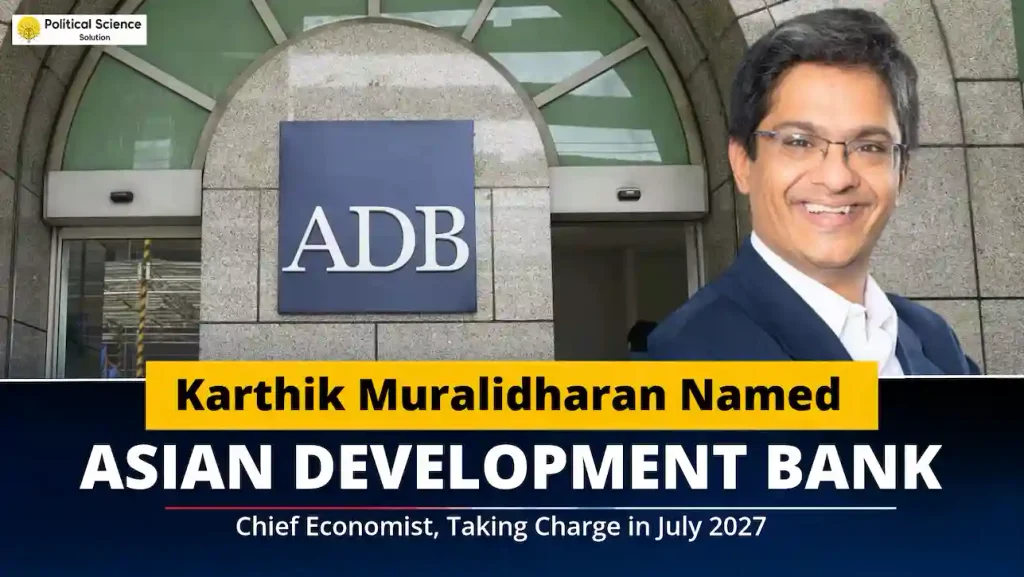
New Delhi: The Asian Development Bank has selected Indian developmental economist Karthik Muralidharan to serve as its next Chief Economist and Director General of the Economic Research and Development Impact Department. He will assume the dual role on 1 July 2027, succeeding Albert Park. The appointment places a researcher with deep experience in public finance, education, health systems, and state capacity at the centre of the bank’s analytical work across Asia and the Pacific.
Muralidharan currently holds the Tata Chancellor’s Professorship in Economics at the University of California, San Diego. His academic career has focused on questions that matter directly to governments seeking better results from public spending. He examines how large-scale data can be combined with close collaboration between researchers and officials so that evidence shapes the design and delivery of public services. His portfolio covers public expenditure efficiency, education quality, health outcomes, social protection programmes, governance reforms, and the broader challenge of building capable state institutions.
Academic Path and Research Focus
Muralidharan’s formal training began with a bachelor’s degree in economics from Harvard University, where he graduated summa cum laude. He later earned an MPhil in economics from the University of Cambridge and completed a PhD in economics at Harvard. These credentials underpin a research programme that moves fluidly between rigorous empirical analysis and practical engagement with policymakers.
His work consistently returns to a core set of themes: how governments can stretch limited budgets further, how education and health systems can deliver measurable gains for citizens, how social protection can reach the right people at the right time, and how administrative capacity inside state agencies can be strengthened so that policies survive the journey from design to implementation. Rather than treating these topics as separate silos, he studies the interactions among them. Better governance, for example, improves the returns to public expenditure in education and health; stronger data systems make social protection programmes more precise and less leaky.
Building Institutions That Improve Governance
Beyond university walls, Muralidharan co-founded and serves as scientific director of the Centre for Effective Governance of Indian States, known as CEGIS. The organisation partners with state governments across India to raise institutional capacity, improve the quality of public spending, and strengthen service delivery. CEGIS teams work inside government systems rather than standing outside them, helping officials diagnose bottlenecks, test solutions, and scale what works. This model of embedded, evidence-driven support has become a distinctive feature of his approach.
He also maintains formal affiliations with several leading research networks. He is connected to the National Bureau of Economic Research, the Abdul Latif Jameel Poverty Action Lab at the Massachusetts Institute of Technology, and the Global Education Evidence Advisory Panel. These platforms allow him to exchange findings with peers worldwide and to contribute to global conversations on what rigorous evidence can and cannot achieve in development policy.
In 2024 he published the book Accelerating India’s Development. The volume examines longstanding governance constraints that limit the effectiveness of public services in India and sets out concrete reform ideas aimed at improving delivery. The book reflects the same practical orientation visible in his research and in the work of CEGIS: diagnosis grounded in data, followed by actionable recommendations that governments can adapt to local conditions.
The Role at the Asian Development Bank
As Chief Economist and Director General of the Economic Research and Development Impact Department, Muralidharan will oversee the bank’s economic research agenda. The portfolio includes analysis of economic and development challenges facing ADB member economies, preparation of evidence-based policy advice for governments across Asia and the Pacific, regular economic forecasting and assessments, and leadership of the production of the Asian Development Outlook, the bank’s flagship annual publication on regional economic trends and prospects.
ADB President Masato Kanda welcomed the appointment by noting that Muralidharan brings the expertise and leadership the institution needs as its members confront increasingly complex development challenges. Kanda expressed confidence that Muralidharan will help the bank convert rigorous economic research into practical advice for members and into investments that improve lives across the region. The statement underscores the dual expectation of the role: intellectual leadership in research and the ability to translate findings into decisions that matter on the ground.
Context of the Asian Development Bank
The Asian Development Bank itself was established in 1966 as a multilateral development bank. Headquartered in Manila, Philippines, it works with economies throughout the Asia-Pacific region and with a range of development partners to promote sustainable and inclusive growth. Its Chief Economist occupies a central position in shaping the analytical foundation for lending, technical assistance, and policy dialogue. The Asian Development Outlook remains one of the most widely read products of that analytical work, offering forecasts and thematic assessments that policymakers, investors, and researchers consult throughout the year.
Muralidharan’s appointment continues a tradition of placing experienced development economists in the role. His background in both large-scale empirical research and direct collaboration with governments positions him to bridge the gap between academic insight and operational relevance—an ability the bank has highlighted as especially valuable given the evolving development landscape in Asia and the Pacific.
Significance of the Appointment
The selection of an Indian developmental economist with a record of working inside government systems carries particular resonance. Many ADB member countries face similar pressures: rising expectations for better public services, constrained fiscal space, and the need to build stronger administrative capacity. Muralidharan’s research and institutional experience address these pressures directly. His emphasis on evidence-based policy—decisions grounded in data and careful evaluation rather than assumption—aligns with the bank’s stated interest in turning research into practical recommendations and investments.
Key concepts that frame the appointment include the role of a chief economist as the senior official responsible for leading an institution’s economic research, analysis, and forecasting functions; the nature of a multilateral development bank as an international financial institution created by multiple countries to support development through financing and technical assistance; the principle of evidence-based policy; the importance of the Asian Development Outlook as a regional economic assessment; and the field of development economics itself, which focuses on improving economic, social, and institutional conditions in developing countries.
Muralidharan’s trajectory—from Harvard classrooms to Cambridge, back to Harvard for doctoral work, then to a professorship at UC San Diego, the founding of CEGIS, and now the ADB—illustrates a consistent commitment to connecting rigorous analysis with real-world governance challenges. His forthcoming responsibilities at the bank will expand that commitment from the Indian state level and the academic research community to the broader Asia-Pacific region.
The transition takes effect on 1 July 2027. Until then, Muralidharan continues in his current academic and institutional roles. Once he joins the ADB, the Economic Research and Development Impact Department will operate under his direction, with the Asian Development Outlook remaining a central output of the work. The bank’s leadership has made clear that it expects the new Chief Economist to help member economies navigate complex development challenges through research that is both intellectually robust and operationally useful.
This appointment adds another chapter to the evolving relationship between academic development economics and the practical work of multilateral institutions. By choosing a researcher whose career has been defined by the effort to improve public expenditure, education, health, social protection, and governance capacity, the Asian Development Bank has signalled the continued priority it attaches to evidence that can improve lives across the region.
FAQs
1. Who is Karthik Muralidharan and when will he join the Asian Development Bank as Chief Economist?
Karthik Muralidharan is an Indian developmental economist who currently serves as the Tata Chancellor’s Professor of Economics at the University of California, San Diego. The Asian Development Bank has appointed him Chief Economist and Director General of the Economic Research and Development Impact Department. He will take up the position on 1 July 2027, succeeding Albert Park.
2. What are Karthik Muralidharan’s academic qualifications?
He holds a bachelor’s degree in economics from Harvard University (graduated summa cum laude), an MPhil in economics from the University of Cambridge, and a PhD in economics from Harvard University.
3. What will be his main responsibilities as ADB Chief Economist?
He will lead economic research on development issues facing ADB member economies, provide evidence-based policy advice to governments across Asia and the Pacific, oversee economic assessments and forecasting, and direct the production of the bank’s flagship publication, the Asian Development Outlook.
4. What is the focus of Muralidharan’s research and professional work?
His research examines ways to improve public expenditure efficiency, education and health outcomes, social protection, governance, and state capacity. He combines large-scale data analysis with direct collaboration with governments. He is co-founder and scientific director of the Centre for Effective Governance of Indian States (CEGIS) and is affiliated with the National Bureau of Economic Research, J-PAL at MIT, and the Global Education Evidence Advisory Panel. In 2024 he published the book Accelerating India’s Development.
5. What is the Asian Development Bank and who currently leads it?
The Asian Development Bank is a multilateral development bank established in 1966 and headquartered in Manila, Philippines. It works with economies in the Asia-Pacific region to promote sustainable and inclusive development. Its current President is Masato Kanda, who stated that Muralidharan’s experience will help translate rigorous economic research into practical policy advice and investments that improve lives across the region.