

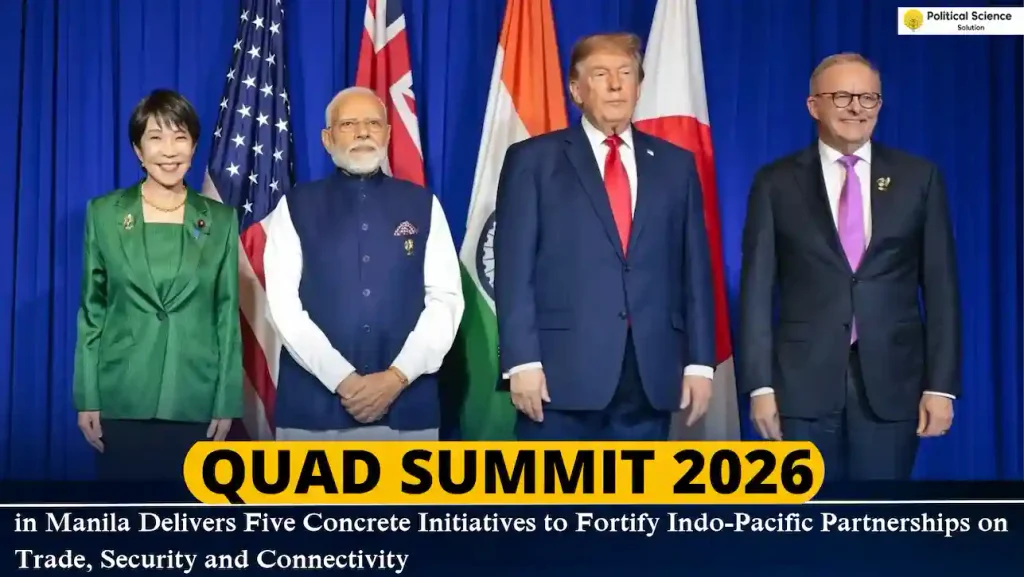
New Delhi: The seventh Quad Leaders’ Summit convened in Manila on 17 November 2026 and produced a focused package of practical measures designed to deepen cooperation among India, the United States, Australia and Japan. Hosted on the sidelines of the ASEAN-India Summit and East Asia Summit, the meeting brought together Prime Minister Narendra Modi, President Donald Trump, Prime Minister Anthony Albanese and Prime Minister Sanae Takaichi. For the first time the leaders’ gathering took place outside the four member countries, yet the choice of Manila carried historical weight: the Philippine capital was the site of the original 2007 official-level meeting and the 2017 revival of the grouping.
The summit yielded five primary outcomes that together address economic resilience, counter-terrorism, maritime domain awareness, undersea infrastructure and cybersecurity. These initiatives sit inside a broader reaffirmation of a free and open Indo-Pacific, opposition to unilateral changes of the status quo and rejection of economic coercion.
Quad Business Leaders’ Forum to Launch in Mumbai
India proposed and the other three partners endorsed the creation of a Quad Business Leaders’ Forum. The inaugural edition will be held in Mumbai in early 2027 and will bring together senior corporate executives, government officials and policy specialists from the four countries. Its stated purpose is to translate strategic alignment into commercial partnerships, encourage two-way investment, expand trade volumes and build more diverse and reliable supply chains, particularly in critical minerals and advanced manufacturing.
Prime Minister Modi highlighted a practical division of strengths that could strengthen these chains: Australia’s mining expertise, Japan’s recycling technologies, American industrial know-how and India’s manufacturing scale. When combined, he argued, these capabilities can reduce vulnerability to single-source dependence and support long-term economic security across the Indo-Pacific.
Shared Commitment Against Terrorism and Violent Extremism
The four leaders issued an unequivocal condemnation of all forms of terrorism and violent extremism, including transnational and cross-border terrorism. They pledged to intensify existing Quad counter-terrorism cooperation mechanisms so that information sharing, capacity building and joint responses become more effective. The statement positioned counter-terrorism as an enduring regional priority rather than a reactive agenda item.
Indo-Pacific Maritime Surveillance Collaboration
Building on earlier maritime domain awareness work, the Quad announced the Indo-Pacific Maritime Surveillance Collaboration. The initiative centres on improved real-time information sharing and joint aerial observation of maritime activity. In 2027 the four countries plan to fly their P-8 and P-3C maritime patrol aircraft together for the first time under a Quad banner. The exercise is scheduled to take place on the margins of the existing Sea Dragon exercise in Guam in March 2027 and will focus on shared challenges such as illegal, unreported and unregulated fishing and maritime trafficking. The leaders described the effort as a direct contribution to safer sea lanes and more transparent maritime transit corridors.
India separately proposed a Quad Sea Lanes Safety Initiative aimed at establishing a more robust international framework for the protection of seafarers, recognising that maritime security ultimately rests on the safety of the people who keep trade moving.
Expansion of the Cable Infrastructure Resilience Partnership
The existing Quad Partnership for Cable Connectivity and Resilience, previously focused on telecommunications cables, will now encompass undersea electricity and energy cables. Australia has increased its contribution in the energy-cable domain. The partners also welcomed forthcoming submarine cable projects in the Indian Ocean that are expected to improve both digital connectivity and energy security across the region. The expanded partnership seeks to harden critical undersea infrastructure against physical and cyber risks while supporting reliable regional power and data links.
Enhanced Cybersecurity Cooperation
Noting a rapid rise in the number and scale of cyber incidents affecting the Indo-Pacific, the four countries agreed to deepen cybersecurity collaboration. The goal is faster collective response, closer operational coordination and the creation of an open, secure and resilient cyber domain that protects both citizens and commercial activity. The announcement builds on earlier Quad work and aligns with parallel efforts on trusted artificial intelligence.
Broader Principles Reaffirmed in the Joint Statement
Beyond the five concrete initiatives, the leaders restated core principles. They reiterated support for a free and open Indo-Pacific and for ASEAN unity and centrality in the regional architecture. They strongly opposed any destabilising or unilateral actions that seek to alter the status quo by force or coercion. They expressed grave concern about economic coercion, including arbitrary export restrictions, and committed to strengthening critical supply chains so that no partner remains overly dependent on a single foreign supplier.
Freedom of navigation and overflight received renewed emphasis, as did cooperation on emerging technologies. The Quad affirmed the importance of the AI Accelerator announced earlier by the foreign ministers in Atlanta; the mechanism is intended to coordinate funding and technical assistance for trusted artificial intelligence access and deployment across the Indo-Pacific. The leaders also restated their readiness to deliver rapid humanitarian assistance and disaster relief when needed.
Leaders’ Perspectives
Prime Minister Modi described the Quad as a constructive and trusted partnership that functions as a partner in progress, a friend in crisis and a source of confidence for the future. He stressed that the grouping’s value lies in delivering practical solutions in maritime security, trusted supply chains, critical technologies and disaster response for the entire Indo-Pacific.
President Trump characterised the four nations as the four corners of a free, open, stable and prosperous Indo-Pacific and noted that communication among the leaders remains frequent and direct. He pointed to ongoing critical-mineral arrangements designed to reduce vulnerability to coercion and suggested that further initiatives over the coming twelve months would prove significant.
Prime Minister Takaichi emphasised the Quad’s role in helping regional partners strengthen resilience and preserve the freedom to make their own choices across maritime security, economic security, energy and emerging technologies. Prime Minister Albanese underlined the grouping’s contribution to a peaceful, secure, stable and prosperous Indo-Pacific that ultimately benefits global security.
Context and Continuity
The Manila summit was President Trump’s first Quad Leaders’ meeting and occurred shortly before his participation in the APEC gathering hosted by China and a planned trilateral engagement involving the United States, China and Russia. The short duration of the Manila session limited the scope for extended negotiation, yet the leaders still produced a clear set of forward-looking commitments. Manila’s historical association with the Quad’s origins added symbolic continuity to the practical agenda.
The meeting also formed part of a denser diplomatic calendar for India. On the same day Prime Minister Modi participated in the 23rd ASEAN-India Summit and the 21st East Asia Summit, reinforcing the message that India’s Act East Policy remains central to its regional engagement. Bilateral conversations with the leaders of Singapore and Thailand took place on the margins, while a separate meeting with Philippine President Ferdinand Marcos Jr. covered defence, security, trade and investment.
Significance for the Indo-Pacific
Taken together, the five initiatives and the accompanying principles illustrate an evolution of the Quad from a largely consultative forum into a partnership of action. The Business Leaders’ Forum seeks to convert strategic alignment into commercial outcomes. The maritime surveillance exercise and expanded cable partnership address tangible infrastructure and awareness gaps. The counter-terrorism and cybersecurity commitments respond to persistent and growing threats. Across all of these areas the four countries signalled that they intend to work with, rather than in competition against, regional partners, while maintaining a clear preference for a rules-based order free from coercion.
The Manila outcomes therefore provide both immediate operational tasks for 2027 and a longer-term framework for cooperation on the economic, security and technological challenges that define the Indo-Pacific. Implementation will determine how effectively the Quad translates the commitments made on 17 November 2026 into measurable improvements in regional resilience and prosperity.
FAQs on the Quad Summit 2026
1. What were the five major outcomes announced at the Quad Summit 2026 in Manila?
The leaders announced five key initiatives: the Quad Business Leaders’ Forum (to be hosted in Mumbai in early 2027 to boost trade, investment and supply-chain partnerships); stronger cooperation against terrorism and violent extremism; the Indo-Pacific Maritime Surveillance Collaboration (including joint aerial observation, information sharing and a 2027 maritime exercise with P-8 and P-3C aircraft); expansion of the Cable Infrastructure Resilience Partnership to cover undersea energy and electricity cables; and enhanced cybersecurity cooperation to address rising cyber incidents and build a more secure cyber domain.
2. Why was the Quad Business Leaders’ Forum proposed and when will it take place?
India proposed the forum to turn strategic cooperation into practical commercial partnerships. It will bring together business leaders, government officials and experts from the four countries to promote trade deals, investment, reliable supply chains and collaboration on critical minerals and manufacturing. The inaugural edition is scheduled for Mumbai in early 2027. Leaders highlighted complementary strengths—Australia’s mining, Japan’s recycling technology, U.S. expertise and India’s manufacturing base—as a way to build more resilient supply chains.
3. How will the Indo-Pacific Maritime Surveillance Collaboration improve security?
The initiative focuses on better Maritime Domain Awareness through joint aerial observation and real-time information sharing among the four countries. In 2027, Quad partners plan to conduct their first joint maritime exercise using P-8 and P-3C patrol aircraft (on the sidelines of Exercise Sea Dragon in Guam in March). The goal is to monitor maritime activity more effectively, address illegal fishing and trafficking, and make sea lanes safer across the Indo-Pacific.
4. What stance did Quad leaders take on economic coercion and unilateral actions?
The leaders strongly opposed any destabilising or unilateral actions that seek to change the status quo by force or coercion. They also expressed grave concerns about economic coercion, including arbitrary export restrictions. They reaffirmed commitments to strengthen critical supply chains, protect freedom of navigation and overflight, and ensure that no partner remains overly dependent on a single foreign supplier.
5. What is the Quad and why does the 2026 Manila summit matter?
The Quad (Quadrilateral Security Dialogue) is a strategic forum of India, the United States, Japan and Australia focused on a free, open, peaceful and prosperous Indo-Pacific. It works on maritime security, economic resilience, critical technologies, infrastructure, health and disaster relief. The 2026 summit was the seventh leaders’ meeting and the first held outside the member countries. Manila holds historical significance as the site of the original 2007 official-level meeting and the 2017 revival. The summit delivered concrete, action-oriented initiatives rather than only statements of principle, signalling the grouping’s evolution into a partnership that delivers practical solutions.