

New Delhi: The 31st United Nations Climate Change Conference, held in Antalya, Turkey, concluded without a consensus political agreement after extending a record 48 hours into overtime. What was intended as an “implementation COP” focused on advancing prior commitments instead exposed deep fractures over the future of fossil fuels, adaptation finance, and equity between developed and developing nations. The failure to adopt a cover decision—often called the Antalya Pact—marks the first major COP without a central political outcome since 2009 and raises fresh questions about the viability of the multilateral climate process at a time when global temperatures are already on track to overshoot the 1.5°C Paris Agreement threshold.
The Core Dispute: Fossil Fuels and the Cover Text
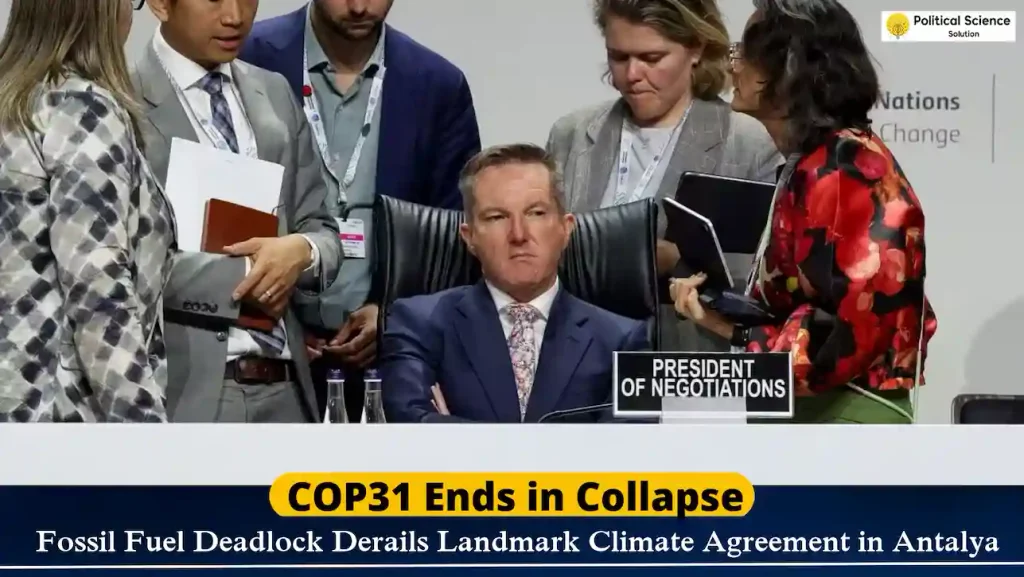
At the heart of the breakdown was the draft cover text presented by COP31 President Murat Kurum. Cover decisions serve as overarching political statements that frame the results of a conference. They require unanimous consensus among more than 190 parties. The final draft circulated early on Sunday, November 22, 2026, contained no explicit reference to fossil fuels—the primary driver of greenhouse gas emissions—and placed notable emphasis on carbon capture, utilization, and storage technologies.
The European Union, speaking through Ireland’s Climate Minister Darragh O’Brien, led the opposition. Representing a coalition of approximately 130 countries that included many small island states, Latin American nations, and other climate-vulnerable parties, the EU declared it would not endorse a text that failed to respond to scientific urgency, ignored the growing implementation gap, and risked “greenwashing” continued fossil fuel use. Panama’s chief climate negotiator, Ana Aguilar, formally objected, describing the draft as a setback and a rollback from earlier agreements. She argued that the text repeated prior commitments without closing the gap between reality and what science demands, over-relied on unproven technologies, and weakened previously agreed language.
On the opposing side stood Saudi Arabia, China, India, and other members of the Like-Minded Developing Countries group. These nations viewed explicit fossil-fuel phase-out language as unacceptable. They stressed that energy transitions must remain nationally determined, just, and equitable, supported by finance, technology transfer, and capacity-building. Indian Environment Minister Bhupendra Yadav noted that India’s positions had influenced language on food security, livelihoods, and cultural practices related to methane action. Speaking for the LMDC, Amandeep Garg indicated willingness to move forward despite discomfort with certain elements, while criticizing the draft for insufficient reflection of equity and common but differentiated responsibilities. The group questioned whose historical and ongoing emissions had exhausted the remaining global carbon budget and argued that the text failed to connect responsibility with the imminent prospect of exceeding 1.5°C.
Saudi Arabia and fellow OPEC members have long resisted language targeting fossil fuels, maintaining that oil, gas, and coal will remain part of the global energy mix for the foreseeable future. Negotiators from Europe, small island states, Latin America, Asia, and Africa reported that Saudi officials enjoyed regular access to the Turkish and Australian co-presidency offices, while representatives from other groups struggled to secure meetings. One Asian delegate described Riyadh’s positions as framed in non-negotiable, even existential terms. The Turkish presidency rejected claims of preferential treatment. Fossil fuels had been explicitly referenced in the Glasgow (2021) and Dubai (2023) outcomes; their absence in Antalya became a flashpoint.
Geopolitical Context and Process Failures
The talks unfolded against a backdrop of heightened geopolitical tension and diminished great-power coordination. The absence of active U.S. engagement and the lack of close U.S.-China collaboration that had previously helped broker compromises left the boundaries of negotiation less defined, according to Singapore’s Environment Minister Grace Fu. Australia’s Chris Bowen, co-leading the process, described the pre-conference environment as the most complicated and fraught in living memory.
Expectations entering the summit were modest. Turkey promoted a global electrification pledge and positioned the meeting as focused on implementation of existing agreements. Divisions sharpened after the presidency released a revised draft omitting fossil-fuel references. Germany convened meetings with the High Ambition Coalition, producing a letter backed by roughly 130 countries that insisted any deal must address the transition away from fossil fuels. That letter was largely ignored in the Sunday text, which retained strong language promoting carbon capture.
As the closing plenary began on Sunday afternoon, President Kurum acknowledged the absence of agreement and declined to advance new text. Delegates began departing to catch flights. The collapse left many with the sense that producers of fossil fuels had exercised disproportionate influence compared with those seeking accelerated transition.
Partial Progress Amid Broader Disappointment
Not every agenda item failed. Negotiators resolved 164 items on the formal agenda. Among the agreements reached: revenues from the global carbon-credit system will support adaptation in developing countries, and work advanced on a just-transition framework intended to protect workers and communities during the shift to cleaner energy. Several outstanding issues, including the work programme on mitigation, were deferred to COP32.
The summit took place in the first year after the UN confirmed that the world is on course to exceed 1.5°C of warming. Draft language had acknowledged this overshoot and called for keeping it as limited and temporary as possible, while introducing carbon-dioxide removal as a potential tool. Without consensus, that recognition and the associated calls for urgency were lost. Scientific assessments continue to highlight the differences between 1.5°C and 2°C outcomes, including greater sea-level rise, ocean acidification, and more widespread extreme heat.
Adaptation Finance and Equity Tensions
Finance remained another unresolved fault line. Developed countries had previously committed to tripling adaptation finance by 2035 from a $40 billion baseline, yet interpretation of that pledge remains contested, and no new quantified figure emerged in Antalya. Developing-country groups continued to press for greater clarity on means of implementation and for developed nations to meet historical responsibility obligations. Russian delegates accused the European Union of providing climate finance primarily as loans rather than grants, characterizing the approach as a continuation of colonial patterns under a new banner.
Implications for the COP Process and the Energy Transition
The failure has intensified debate about whether the annual COP format remains fit for purpose. Early conferences built the architecture of the Paris Agreement, the global stocktake cycle, loss-and-damage funding, the fossil-fuel transition language of Dubai, and successive finance goals. The emphasis has shifted toward implementation. Some observers suggest future COPs could dispense with a high-stakes cover text altogether, focusing instead on procedural and technical work. Others note that the process functions as a mirror reflecting the political will of governments; when outcomes disappoint, the primary responsibility lies with those governments rather than the mirror itself.
Outside the negotiating rooms, structural forces continue to reshape the energy landscape. The International Energy Agency’s latest outlook points to energy-security concerns—exacerbated by supply disruptions—and rapidly improving economics of solar, batteries, and electric vehicles as powerful drivers of change independent of formal agreements. New investment announcements under the Action Agenda, centered on electrification, reinforced the view that the world has entered an age of electricity. Business groups stress that while many clean technologies are already cost-competitive, policy barriers around infrastructure and permitting still require government action.
Looking Ahead
Antalya will be remembered as the longest COP in history and the first to end without a consensus cover decision in the era of 1.5°C overshoot. The European Union and its allies framed rejection of the draft as necessary to protect the scientific credibility of the Paris Agreement. Supporters of the text argued that ambition without finance, technology, and equity is hollow. Both sides left Antalya with unresolved grievances and with the knowledge that the next round of national climate plans and the next global stocktake will occur against a backdrop of rising temperatures and persistent political division.
The absence of a political agreement does not erase technical progress made on carbon markets or just transition frameworks, nor does it halt the underlying momentum of renewable energy deployment. Yet it underscores a difficult truth: when parties cannot agree even to reaffirm language previously accepted, the capacity of multilateral diplomacy to keep pace with the physical realities of climate change is under severe strain. The road to COP32 will test whether governments can narrow the gap between scientific necessity and political possibility.
FAQs on the Failed COP31 Climate Talks
1. Why did COP31 fail to reach a consensus agreement?
The talks in Antalya, Türkiye, collapsed primarily over the absence of explicit language on transitioning away from fossil fuels in the final “cover text” (the overarching political decision known as the Antalya Pact). The European Union, Panama, and roughly 130 other parties refused to accept a text they said “greenwashes” fossil fuels and weakens previous commitments. India, China, Saudi Arabia and other Like-Minded Developing Countries were willing to accept the draft, arguing for nationally determined, equitable energy transitions backed by finance and technology. After record overtime (about 48 hours), COP31 President Murat Kurum confirmed there was no agreement and did not advance a new text.
2. What role did Saudi Arabia and other oil-producing states play?
Multiple negotiators from Europe, small island states, Latin America, Asia and Africa accused Saudi Arabia of exercising disproportionate influence. Saudi officials reportedly had regular access to the Turkish and Australian presidency while other groups struggled to secure meetings. Riyadh and fellow OPEC members consistently opposed any mention of fossil fuels and pushed for stronger language promoting carbon-capture technologies. Ireland’s climate minister (speaking for the EU) described the process as having been “hijacked by some oil states.” The Turkish presidency denied preferential treatment.
3. How does this outcome compare with previous COPs?
Explicit references to fossil fuels appeared in the Glasgow (COP26, 2021) and Dubai (COP28, 2023) texts. COP31 was the first major political cover decision since then that omitted them, and the first COP held after the UN warned that the world is expected to overshoot the 1.5 °C Paris Agreement threshold. It was also the longest UN climate conference in history and the first since 2009 to end without a political cover agreement.
4. Were there any positive outcomes despite the failure of the cover text?
Yes. Negotiators resolved or advanced 164 other agenda items. Notable agreements included directing revenue from the global carbon-credit market toward adaptation in developing countries and progressing a just-transition framework to protect workers and communities. Work on the emissions-mitigation work programme and several other issues was deferred to COP32. Outside the formal negotiations, the “Action Agenda” highlighted continued momentum in electrification and renewable energy investment.
5. What does the failure mean for the future of the COP process?
Many observers see COP31 as evidence that the annual conferences are shifting from architecture-building (the Paris Agreement and subsequent landmark decisions) to the harder task of implementation. The absence of a cover text is not unprecedented—earlier COPs often operated without one—but the deep geopolitical divisions, the inability to reaffirm prior commitments, and the open questioning of whether consensus-driven multilateralism can still deliver have intensified calls for reform. Critics argue the process is now limited by the lowest common denominator; supporters maintain it remains a necessary annual mirror that reflects the actual willingness of governments to act.