

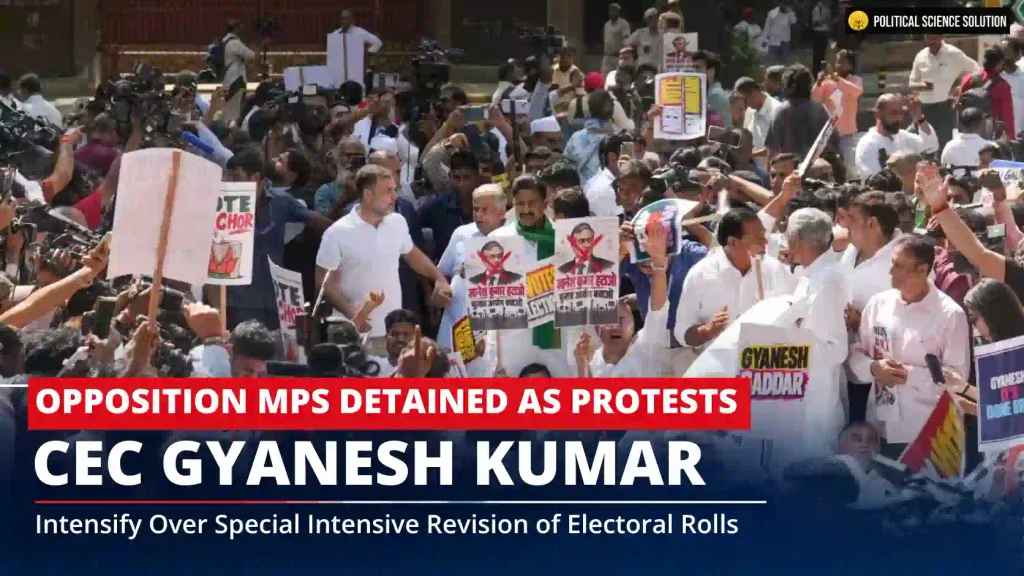
New Delhi: A major confrontation unfolded in the national capital on Tuesday when police detained around 260 people, including Leader of the Opposition in the Lok Sabha Rahul Gandhi, Congress MP Priyanka Gandhi Vadra, and several other Members of Parliament from the INDIA bloc. The detentions occurred during a protest march from Parliament House toward the Election Commission of India headquarters and a subsequent sit-in inside the Akashvani Bhawan premises. The demonstrators demanded the resignation of Chief Election Commissioner Gyanesh Kumar and an immediate halt to the Special Intensive Revision of electoral rolls, an exercise that has deleted nearly 13.3 crore names from voter lists across the country.
The march began under heavy security deployment and multi-layered barricading around Parliament, Raisina Road, Vijay Chowk, and the Election Commission complex. Delhi Police stated that no formal application seeking permission for the march had been submitted to the Deputy Commissioner of Police, New Delhi District. Consequently, no permission was granted. Traffic diversions and congestion affected key stretches including Connaught Place, Patel Chowk, Rafi Marg, Parliament Street, Motilal Nehru Marg, Teen Murti Marg, Prithviraj Road, Windsor Place, Ashoka Road, and Jantar Mantar Road. Commuters reported delays of over an hour in several places.
According to participants, 237 MPs from 19 parties of the INDIA bloc joined the protest. Samajwadi Party chief Akhilesh Yadav, Trinamool Congress leaders Abhishek Banerjee and Derek O’Brien, CPI(M) MP John Brittas, and others were among those detained early and taken away in buses before later release. Congress president Mallikarjun Kharge left the site after feeling unwell. Biju Janata Dal MPs also participated at the direction of party president Naveen Patnaik. MPs from DMK and AAP did not join.
Rahul Gandhi and Priyanka Gandhi Vadra were briefly detained but exited the police bus and proceeded to Akashvani Bhawan, located next to the Election Commission office. Inside the premises they, along with K.C. Venugopal, Pawan Khera, Deepender Hooda, Amrinder Singh Raja Warring and others, staged a day-long sit-in. Gandhi told those present that the group of opposition MPs from both Houses simply wanted to meet the three Election Commissioners to ask questions about the deletion of millions of names. He stated that millions of people had voted for them and that the Commission appeared unwilling to provide answers.
Police later moved into Akashvani Bhawan. Body cameras were worn by personnel during the operation, a measure noted days after earlier allegations of harassment against journalists at a different protest site. Congress leaders described the forcible removal of Rahul Gandhi from a peaceful sit-in as evidence of a regime sensing its imminent exit. Priyanka Gandhi Vadra said the nation had never seen such a cowardly government and insisted that staging protest remained a fundamental right. Congress leader Imran Pratapgarhi, speaking from detention, claimed the manner of removal showed an intent to extinguish remaining hopes of democracy.
All detained leaders, including the Gandhi siblings, were taken to New Police Lines at Kingsway Camp in North Delhi and released later in the evening. Delhi Police confirmed the detentions were carried out to maintain public order and safety. Congress announced the releases around 10:31 pm.
The Election Commission issued a detailed response. It stated that no political party had sought an appointment through authorised representatives for a meeting until 4 pm. Later, after 4 pm, a request arrived for a meeting involving 240 MPs at the Parliament House Annexe. The Commission described the proposed venue as unusual and outside established protocol, which requires such meetings to be held inside Election Commission premises. It offered to send its senior-most officer to the Annexe, an offer the MPs rejected. The Commission maintained that meetings follow set procedures.
Background of the Special Intensive Revision Controversy
The protests form part of a broader wave of demonstrations that began after investigative reports highlighted internal disagreements within the Election Commission over the Special Intensive Revision exercise. SIR is a periodic administrative process that existed long before 2014. In the current round it has resulted in the removal of approximately 13.3 crore names, with 90 million categorised as absent, shifted or others. Over 22 lakh appeals were filed against exclusions after more than 91 lakh names were purged in one phase alone.
Opposition parties and civil society groups argue that the deletions disproportionately affect the poor and Muslim voters. They claim the process forces daily-wage earners to make multiple visits to polling officers at the cost of livelihood. Allegations include mass submission of pre-printed Form 7 applications by political workers seeking deletion of specific community names, particularly in constituencies such as Goshamahal in Hyderabad. AIMIM president Asaduddin Owaisi stated that a BJP sympathiser submitted such forms against 122 voters, though the Booth Level Officer rejected them. He called for intervention by the Election Commission and the Telangana Chief Minister.
Shiv Sena (UBT) leader Sanjay Raut asserted that Gyanesh Kumar had no moral right to continue after the Supreme Court clarified it had never approved changes to voter registration forms. Raut alleged the Chief Election Commissioner misled the court and altered procedures without consensus.
The Supreme Court, in a hearing on October 5, distanced itself from alterations made to Form 6 used for registering new voters. It sought responses from the Election Commission and the Centre on petitions challenging unilateral decisions and post-retirement immunity provisions for the Chief Election Commissioner that exceed those available even to judges.
Global Media Attention and Domestic Political Reactions
International outlets have closely tracked the developments. Coverage has focused on whether the world’s largest democracy retains the electoral credibility long admired both domestically and abroad, including by observers in neighbouring countries. Reports noted that nearly a billion citizens are being required to produce documents to retain voting rights, with the poorest sections bearing the heaviest burden. Analysts quoted in these reports linked the scale of deletions to questions about the integrity of past elections and the intentions behind upcoming state polls in Uttar Pradesh and Gujarat in 2027, as well as the national election in 2029.
Former Chief Election Commissioner S.Y. Quraishi has been cited observing that the Commission’s reputation is being damaged despite its official motto of leaving no voter behind. Coverage has also referenced a 2023 law that altered the process of appointing Election Commissioners, allowing greater government influence in nominations.
Domestically, the BJP rejected the opposition narrative. Spokesperson Sambit Patra accused Rahul Gandhi of misquoting the Supreme Court and attempting to create confusion and anarchy. He said the court had merely issued notices and that no hearing on the merits of Form 6 changes had yet taken place. Another BJP leader described the march as an attempt to relaunch Rahul Gandhi’s politics by any means. The party maintains that the Election Commission continues to function independently and that opposition claims lack substance.
Student organisations and the youth-led Cockroach Janta Party have announced further protests. Five left student groups plan a joint march to Jantar Mantar on October 10 demanding Kumar’s resignation, revocation of SIR, and structural reform of the Election Commission. Cockroach Janta Party founder Abhijit Dipke alleged that activists in Maharashtra were receiving police notices and questions about travel funding intended to discourage participation in the Delhi protest. He described the actions as dictatorial pressure.
All India Students’ Association national president Neha Bora was photographed climbing a police barricade near Ashoka Road on October 4 during an earlier attempt by student activists to reach Jantar Mantar. Police used tear gas, water cannons and detentions in several states during the wider protest wave.
Statements from Key Leaders and Continuing Demands
Rahul Gandhi, speaking inside Akashvani Bhawan, declared that Prime Minister Narendra Modi, Home Minister Amit Shah, the RSS leadership and Gyanesh Kumar had destroyed democracy through what he termed “vote chori.” He said the actions amounted to treason and that none of those responsible would be spared. Congress general secretary Jairam Ramesh described the West Bengal assembly election process as a textbook case of mass manipulation overseen by the Chief Election Commissioner, arguing that both the “puppet” and the “puppeteers” must be held accountable.
Congress MP Dharamveer Gandhi called the deletion of 13 crore votes the biggest fraud in Indian political history. Akhilesh Yadav stated that the Election Commission appeared to treat only BJP members as full citizens entitled to vote and referenced earlier instances of alleged force in Uttar Pradesh and West Bengal.
The opposition has framed the agitation as a defence of universal adult franchise secured after Independence. The government and the Election Commission maintain that SIR is a routine, necessary cleansing of rolls and that due process for appeals remains available.
As of late Tuesday the live coverage of the day’s events closed after the release of the detained leaders. Further protests are scheduled, including the October 10 gathering at Jantar Mantar. The episode adds to a series of public actions that earlier forced the resignation of a Union education minister over examination paper leaks. Attention now turns to whether the Election Commission will engage the opposition through formal channels and how the pending Supreme Court matters will shape the next phase of the Special Intensive Revision process.
The developments continue to draw scrutiny both inside India and from international observers watching the institutional health of the world’s largest democracy ahead of critical state elections next year.
FAQs
1. What is the Special Intensive Revision (SIR) of electoral rolls and why has it sparked protests?
The Special Intensive Revision is a periodic administrative exercise conducted by the Election Commission of India to update and clean voter lists by identifying and removing names of voters who are absent, shifted, deceased, or otherwise ineligible. In the latest round, it has led to the deletion of nearly 13.3 crore names, including around 90 million categorised as “absent, shifted and others.” Opposition parties, student groups, and the Cockroach Janta Party allege that the process has disproportionately affected the poor and Muslim voters, forcing daily-wage earners to make multiple visits to officials and resulting in large-scale exclusions. Over 22 lakh appeals were filed after more than 91 lakh names were purged in one phase. Protesters demand the resignation of Chief Election Commissioner Gyanesh Kumar and a halt to the exercise, claiming it undermines the right to vote.
2. Why were Rahul Gandhi and other opposition leaders detained on 6 October 2026?
On 6 October 2026, approximately 260 people, including Leader of the Opposition Rahul Gandhi, Priyanka Gandhi Vadra, K.C. Venugopal, Deepender Hooda, Amrinder Singh Raja Warring, Akhilesh Yadav, Abhishek Banerjee and other INDIA bloc MPs, were detained by Delhi Police. The leaders were part of a march from Parliament House to the Election Commission headquarters demanding Gyanesh Kumar’s resignation. When stopped by barricades, several entered Akashvani Bhawan and staged a sit-in. Police stated no prior permission had been sought for the march and that detentions were necessary to maintain public order. The leaders were taken to New Police Lines, Kingsway Camp, and later released the same evening.
3. What has the Election Commission said about the demand for a meeting with opposition MPs?
The Election Commission stated that no political party sought an appointment through authorised representatives until 4 p.m. on 6 October. After that time, a request was received for a meeting of about 240 MPs at the Parliament House Annexe. The Commission described the proposed venue as unusual and contrary to protocol, which requires such meetings to be held inside Election Commission premises. It offered to send its senior-most officer to the Annexe, but the opposition MPs rejected the offer. The Commission maintains that all meetings follow established procedures.
4. How have global media outlets covered the controversy surrounding Gyanesh Kumar and the voter-list revisions?
International publications including The New York Times, The Economist, BBC and Financial Times have reported on the protests and the scale of deletions. Coverage has highlighted that nearly a billion citizens are being asked to produce documents to retain voting rights, with the poorest sections facing the greatest hardship. Reports have noted concerns that the exercise could affect electoral outcomes in upcoming state elections in Uttar Pradesh and Gujarat, as well as the 2029 national election. Former Chief Election Commissioner S.Y. Quraishi has been quoted on the damage to the Commission’s reputation. Outlets have also referenced the 2023 law that changed the process of appointing Election Commissioners.
5. What further protests are planned and what are the main demands?
Left student organisations and the Cockroach Janta Party have announced a joint march to Jantar Mantar on 10 October 2026. Their demands include the immediate resignation of Chief Election Commissioner Gyanesh Kumar, revocation of the Special Intensive Revision exercise, and structural reform of the Election Commission. The Cockroach Janta Party has described its call as a broader youth mobilisation. Separate allegations of police notices being issued to activists in Maharashtra to discourage participation have also been raised by the group’s founder.