

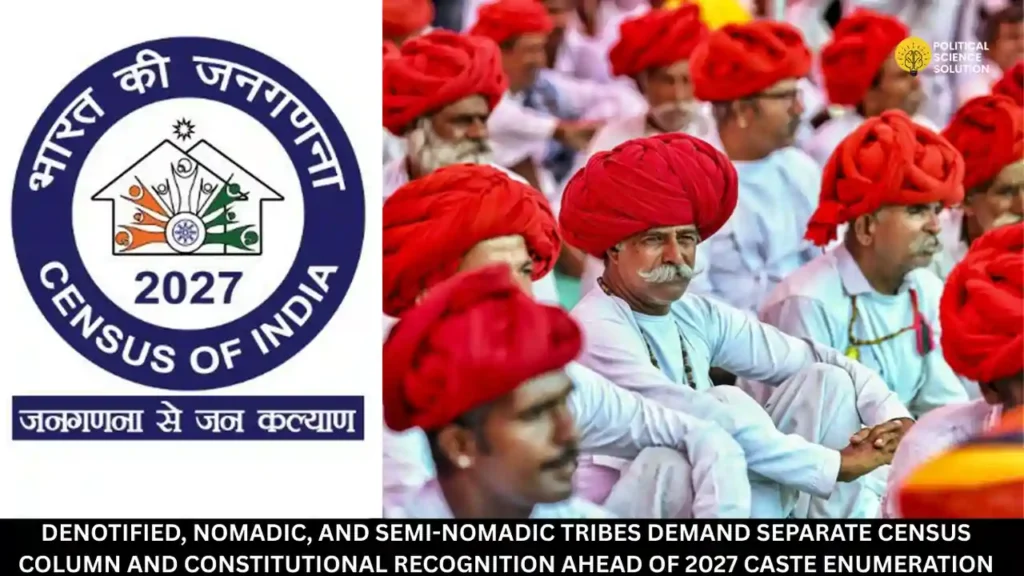
New Delhi: With India’s landmark caste-based census scheduled for February 2027 marking the first such nationwide exercise since 1931, communities historically labeled as “criminal tribes” during British colonial rule are intensifying their call for distinct recognition. Denotified, Nomadic, and Semi-Nomadic Tribes (DNTs) are advocating fiercely for a dedicated “separate column” in the census questionnaire, along with a unique code for accurate identification. This demand extends to seeking formal constitutional status through a new Schedule, placing them on equal footing with Scheduled Castes (SCs), Scheduled Tribes (STs), and Other Backward Classes (OBCs).
The urgency stems from decades of perceived administrative oversight and political misclassification that have left these groups marginalized despite existing welfare frameworks. Community organizers warn that without precise enumeration, their specific challenges—rooted in colonial-era stigma and ongoing socio-economic exclusion—will remain unaddressed, perpetuating cycles of poverty and discrimination.
Historical Context: From Criminal Tribes Act to Denotification
The story begins with the Criminal Tribes Act of 1871, enacted by the British colonial administration. This legislation targeted certain communities, particularly nomadic and semi-nomadic groups, branding entire tribes, gangs, or classes as inherently “addicted” to non-bailable offenses. It mandated registration, constant surveillance, and severe restrictions on movement. Many of these communities had resisted colonial expansion or maintained traditional nomadic lifestyles incompatible with British notions of settled society.
Amendments in 1924 expanded its scope, but the Act faced growing criticism. It was finally repealed on August 31, 1952, following independence. The repeal led to the “denotification” of affected groups, giving rise to the term Denotified Tribes (DNTs). Despite this legal shift, the legacy persists—local police practices often continue treating members with suspicion under habitual offender pretexts.
Census documentation of these communities last occurred in 1911 and 1931, the final pre-independence counts providing detailed insights. No equivalent targeted enumeration has taken place in independent India until the forthcoming 2027 exercise.
Current Push for Inclusion in 2027 Census
The Ministry of Social Justice and Empowerment recently recommended including DNTs in the upcoming census. The Office of the Registrar General of India (RGI) accepted this proposal, assuring community leaders from northern states during a virtual meeting on January 30, 2026, that enumeration would occur in the second phase.
However, ambiguity surrounds implementation. Leaders like B.K. Lodhi, a Uttar Pradesh-based organizer and former Deputy Secretary/Director (Research) for the Idate Commission, voiced frustration: “We have no idea how they will do this.” Without a separate column or code, individuals risk being merged into broader SC, ST, or OBC categories, rendering their distinct identity invisible once more.
Balak Ram Sansi, a 63-year-old organizer from Karnal affiliated with the All India Denotified Nomadic Tribes Development Council, echoed this sentiment. He stressed that accurate counting is essential for advocacy before courts, governments, and political bodies. Mohit Tanwar, during a recent virtual gathering, highlighted how the absence of population figures weakens demands across institutions.
Estimates suggest massive numbers—Lodhi proposed up to seven crore in Uttar Pradesh alone—but reliable nationwide figures remain elusive without dedicated census data.
Misclassification and Graded Backwardness Within Categories
The Idate Commission (2014–2017), chaired by Bhiku Ramji Idate, identified around 1,200 DNT communities. Most have been absorbed into SC, ST, or OBC lists over the past seven decades. Yet, approximately 267–268 communities stayed completely unclassified. The Anthropological Survey of India (AnSI) later categorized these 268 groups, suggesting appropriate inclusions in existing lists, though implementation has lagged.
Leaders argue assimilation has resulted in “political misclassification.” Within SC or OBC frameworks, highly marginalized DNTs struggle to access benefits due to competition from more politically empowered subgroups. Sansi noted northern communities qualifying culturally for ST status—based on traditional lifestyles, customs, food habits, and community laws—yet excluded due to high thresholds.
This has fueled calls for sub-classification, inspired by the Supreme Court’s August 2024 judgment allowing sub-categorization in SCs and STs. Lodhi emphasized “graded backwardness”: settled DNTs accessed resources like land for partial progress since the 1960s, while nomadic groups lag severely in education, economy, and politics. Some Haryana nomadic communities reportedly have no members completing 10th-grade education yet remain overshadowed in SC lists.
A separate Schedule, leaders contend, would better recognize the unique stigma from the “criminal tribes” label—tied to anti-colonial resistance—and enable targeted quotas and schemes.
Persistent Challenges: Stigma, Welfare Gaps, and Certificate Issues
Stigma endures beyond denotification. Police harassment continues, with communities labeled habitual offenders. Welfare initiatives from the Ministry of Social Justice and Empowerment include:
- Scheme for Economic Empowerment of DNTs (SEED): Provides educational aid, health insurance, livelihood support, and housing.
- Dr. Ambedkar Pre-Matric & Post-Matric Scholarship for DNTs (launched 2014–15).
- Nanaji Deshmukh Scheme of Construction of Hostels for DNT Boys and Girls (2014–15).
Despite these, benefits reach only a minuscule percentage. The SEED scheme, budgeted at ₹200 crore, expended just ₹69.3 crore over five years (as of December 2025). The core issue: states and Union Territories rarely issue DNT-specific certificates, despite central directives.
Institutional Efforts and Ongoing Advocacy
Key bodies have addressed DNT concerns:
- Renke Commission (2008): First national effort to identify and list communities.
- Idate Commission (2014–17): Produced state-wise lists, recommended welfare, and urged classification.
- National Commission for DNTs (2014): Focused on lists and measures.
- Development and Welfare Board for Denotified, Nomadic, and Semi-Nomadic Communities (DWBDNC): A registered society monitoring programs.
Advocacy now centers on the 2027 census as a pivotal moment. Leaders seek not just enumeration but mechanisms ensuring visibility, uniform certification, and special attention. Figures like linguist G.N. Devy have warned that failing to count DNTs properly risks alienating over 10 crore people, deepening historical injustice.
As preparations advance—with caste questions to be finalized before the second phase and preparatory work by July 2026—the demand underscores a broader quest for equity. For DNTs, accurate representation in the census could finally translate colonial wrongs into constitutional justice, targeted development, and restored dignity.
FAQs
1. Who are Denotified, Nomadic, and Semi-Nomadic Tribes (DNTs)?
DNTs refer to communities that were historically labeled as “criminal tribes” under the British colonial Criminal Tribes Act of 1871. This law targeted entire groups—often nomadic or semi-nomadic peoples engaged in traditional livelihoods like pastoralism, trading, acrobatics, or artisanal work—branding them as inherently criminal by birth. They faced registration, surveillance, and movement restrictions. The Act was repealed in 1952, after which these groups became known as “denotified” tribes. Many are still nomadic or semi-nomadic, while others have settled over time. Today, they face ongoing social stigma, economic backwardness, educational gaps, and occasional police profiling as “habitual offenders.”
2. Why are DNT communities demanding a separate column in the 2027 Census?
The 2027 Census will be India’s first comprehensive caste enumeration since 1931 and will include DNTs for the first time in decades (following assurances from the Office of the Registrar General of India after a Ministry of Social Justice recommendation). Leaders fear that without a dedicated “separate column” or unique code in the census forms, DNT individuals will simply be recorded under existing Scheduled Castes (SCs), Scheduled Tribes (STs), or Other Backward Classes (OBCs) categories. This would make their distinct population invisible, preventing accurate data on their numbers and specific needs. Activists like B.K. Lodhi and Balak Ram Sansi argue this “erasure” has happened before, hindering advocacy, welfare access, and political representation. Figures suggest millions (possibly up to seven crore in Uttar Pradesh alone), but no reliable nationwide count exists without targeted enumeration.
3. What is the demand for constitutional recognition or a separate Schedule for DNTs?
Beyond census counting, DNT leaders seek formal constitutional recognition through a new Schedule, similar to those for SCs, STs, and OBCs. This would provide a dedicated legal framework for targeted reservations, quotas, schemes, and protections. Most of the roughly 1,200 DNT communities (identified by the Idate Commission) have been assimilated into SC/ST/OBC lists, but leaders call this “political misclassification”—they often cannot compete effectively within these broader groups due to extreme marginalization. Around 267–268 communities remain unclassified entirely. A separate Schedule would address their unique historical stigma (from anti-colonial resistance) and enable uniform benefits, including easier issuance of DNT certificates by states.
4. What challenges do DNTs face despite existing welfare schemes?
DNTs remain among India’s most backward groups socially, economically, educationally, and politically. Key issues include persistent stigma (police treatment as suspects), low education levels (some communities have no members with 10th-grade completion), and limited access to benefits. Government programs exist, such as the Scheme for Economic Empowerment of DNTs (SEED) (covering education, health insurance, livelihoods, and housing), Dr. Ambedkar scholarships, and Nanaji Deshmukh hostels. However, uptake is minimal—SEED spent only ₹69.3 crore out of a ₹200 crore allocation over five years (as of late 2025)—mainly because states rarely issue DNT-specific certificates despite central reminders. “Graded backwardness” also exists: settled DNTs have advanced somewhat, while nomadic ones lag severely.
5. What institutional efforts and historical commissions have addressed DNT issues?
Several bodies have worked on DNT welfare: The Renke Commission (2008) was the first national effort to identify and list communities. The Idate Commission (2014–2017) produced state-wise lists, identified unclassified groups, and recommended welfare measures and proper categorization (with Anthropological Survey of India support). A National Commission for DNTs (2014) focused on similar goals. The Development and Welfare Board for Denotified, Nomadic, and Semi-Nomadic Communities (DWBDNC) now monitors programs as a registered society. The Supreme Court’s 2024 ruling on sub-classification within SCs/STs has inspired calls for internal grading (e.g., between settled and nomadic DNTs). Activists, including figures like G.N. Devy, warn that failing to count them properly could alienate vast populations and perpetuate policy confusion. The government has not yet committed to a separate constitutional category, emphasizing integration into existing lists.