

New Delhi: In an unprecedented display of judicial efficiency and people-centric justice, the Fourth National Lok Adalat of 2025 successfully resolved a staggering 2.59 crore cases across India in one day, marking it as one of the largest mass dispute resolution exercises ever conducted in the world.
This mega event, organized simultaneously from the Supreme Court to taluk-level courts, has once again proved that consensual justice through Lok Adalats remains the fastest, cheapest, and most harmonious way to deliver justice to the common man.
Between the financial years 2022-23 and 2024-25, Lok Adalats across the country have collectively disposed of more than 23.5 crore cases, offering permanent closure to millions of families, businesses, and individuals who would otherwise have remained trapped in prolonged litigation.
With more than 4.7 crore cases still pending before various courts as per the National Judicial Data Grid (NJDG), the Lok Adalat model has emerged as the most powerful weapon to fight judicial backlog and restore faith in the system.
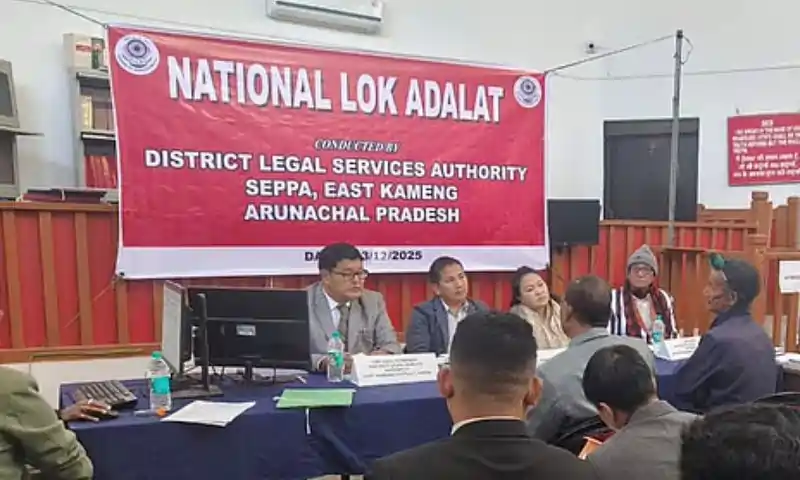
Lok Adalat: The People’s Court That Never Sleeps
Born out of the Legal Services Authorities Act, 1987, Lok Adalats function as a parallel, voluntary, and non-adversarial justice delivery system. They are organized under the aegis of the National Legal Services Authority (NALSA), with the Chief Justice of India as its Patron-in-Chief.
The beauty of a Lok Adalat award lies in its finality — it is deemed to be a decree of a civil court, is fully binding on both parties, and allows no appeal. This eliminates the fear of endless litigation and gives immediate relief.
Lok Adalats handle both pre-litigation matters and pending court cases, except non-compoundable criminal offences and divorce petitions. From motor accident claims to land disputes, bank recoveries to labour issues, almost every civil and compoundable criminal matter can find closure here — at zero court fee.
Different Faces of Lok Adalat
The system has evolved into multiple formats to suit different needs:
- National Lok Adalats (NLA): Held on a single day across the entire country at all court levels, these are mega events designed for maximum impact. The fourth NLA of 2025 will be remembered for settling 2.59 crore cases.
- Permanent Lok Adalats (PLA): Exclusively for public utility services (transport, electricity, water supply, telephone, etc.) with a pecuniary jurisdiction up to ₹1 crore.
- E-Lok Adalats: Conducted entirely online, these have become a game-changer post-pandemic, allowing parties to join from home.
- Mobile Lok Adalats: Traveling vans that take justice to remote villages, tribal areas, and far-flung regions.
Jammu & Kashmir Shines Bright in National Effort
The Union Territory of Jammu & Kashmir scripted its own success story in this national campaign.
Under the patronage of Hon’ble Mr. Justice Arun Palli, Chief Justice of High Court of Jammu & Kashmir and Ladakh (Patron-in-Chief, J&K Legal Services Authority) and the able guidance of Hon’ble Mr. Justice Sanjeev Kumar, Executive Chairman, J&K Legal Services Authority, the fourth National Lok Adalat was organized across every district of the UT on December 15, 2025.
A total of 186 benches were constituted from the High Court level down to tehsil courts. These benches took up more than 1 lakh 5 thousand cases during the day-long sitting.
In a remarkable show of commitment, 91,750 cases were settled amicably on the spot, involving a whopping settlement amount of ₹76 crore 65 lakh.
The cases covered a wide spectrum — Motor Accident Claims Tribunal (MACT) matters, matrimonial disputes, cheque dishonour cases under Section 138 of the Negotiable Instruments Act, money recovery suits, commercial disputes, and compoundable criminal cases.
From families reuniting after years of matrimonial discord to accident victims receiving compensation without further delay, from small traders recovering dues to neighbours burying long-standing property disputes — the Lok Adalat benches worked tirelessly to restore peace and dignity to thousands of lives in Jammu & Kashmir.
Why This Matters More Than Ever
In a nation where justice delayed is justice denied, the 2.59 crore settlements in a single day is not just a statistic — it is a revolution.
It means 2.59 crore families did not have to return to court again.
It means lakhs of accident victims received compensation immediately.
It means senior citizens, women, and marginalized sections got justice without spending a single rupee on court fees or lawyers.
Most importantly, it means enemies shook hands, neighbours became friends again, and society healed itself through dialogue rather than confrontation.
The cumulative disposal of over 23.5 crore cases in the last three years shows that India has quietly built the world’s largest working model of consensual justice delivery — a model that many countries are now studying.
As the year 2025 draws to a close, the Fourth National Lok Adalat has sent out a clear message: when the judiciary, bar, legal services authorities, and citizens come together with sincerity, even the mountain of 4.7 crore pending cases can be moved — one amicable settlement at a time.
The people of India have spoken through their participation: they want quick, affordable, dignified justice. And Lok Adalat has delivered it — yet again — in record-breaking style.
Frequently Asked Questions (FAQs)
1. What is a National Lok Adalat, and how is it different from regular Lok Adalats?
A National Lok Adalat (NLA) is a special, large-scale event organized simultaneously across India on a single designated day, involving courts at all levels—from the Supreme Court to taluk courts. It aims to dispose of a massive number of cases in one go through amicable settlements. Regular Lok Adalats are held more frequently at state or district levels, while National Lok Adalats are nationwide mega drives. The fourth National Lok Adalat of 2025, held on December 15, resolved a record 2.59 crore cases in a single day.
2. How many cases were settled in the Fourth National Lok Adalat of 2025, and what is the overall impact?
The Fourth National Lok Adalat of 2025 successfully settled 2.59 crore cases across the country. From 2022-23 to 2024-25, Lok Adalats nationwide have collectively resolved more than 23.5 crore cases, significantly reducing the burden on the judiciary, where over 4.7 crore cases remain pending as per the National Judicial Data Grid (NJDG).
3. What types of cases can be settled in a Lok Adalat?
Lok Adalats handle both pre-litigation and pending court cases, including Motor Accident Claims Tribunal (MACT) matters, matrimonial disputes, cheque bounce cases under Section 138 of the Negotiable Instruments Act, money recovery suits, commercial disputes, labour issues, land disputes, and compoundable criminal cases. They do not cover non-compoundable criminal offences or divorce matters.
4. What happened in Jammu & Kashmir during the Fourth National Lok Adalat 2025?
In Jammu & Kashmir, the event was held under the patronage of Justice Arun Palli (Chief Justice, High Court of J&K and Ladakh) and the guidance of Justice Sanjeev Kumar (Executive Chairman, J&K Legal Services Authority). A total of 186 benches were set up across the Union Territory. More than 1 lakh 5 thousand cases were taken up, out of which 91,750 cases were amicably settled, involving a settlement amount of ₹76 crore 65 lakh.
5. Why are Lok Adalat awards special, and what are the different types of Lok Adalats available?
Lok Adalat awards are final and binding, equivalent to a civil court decree, with no provision for appeal, ensuring immediate and permanent closure. There are several types:
- National Lok Adalats (nationwide mega events)
- Permanent Lok Adalats (for public utility services up to ₹1 crore)
- E-Lok Adalats (conducted online for remote participation)
- Mobile Lok Adalats (travel to rural and remote areas)
These formats make justice speedy, cost-free, and accessible to everyone.