
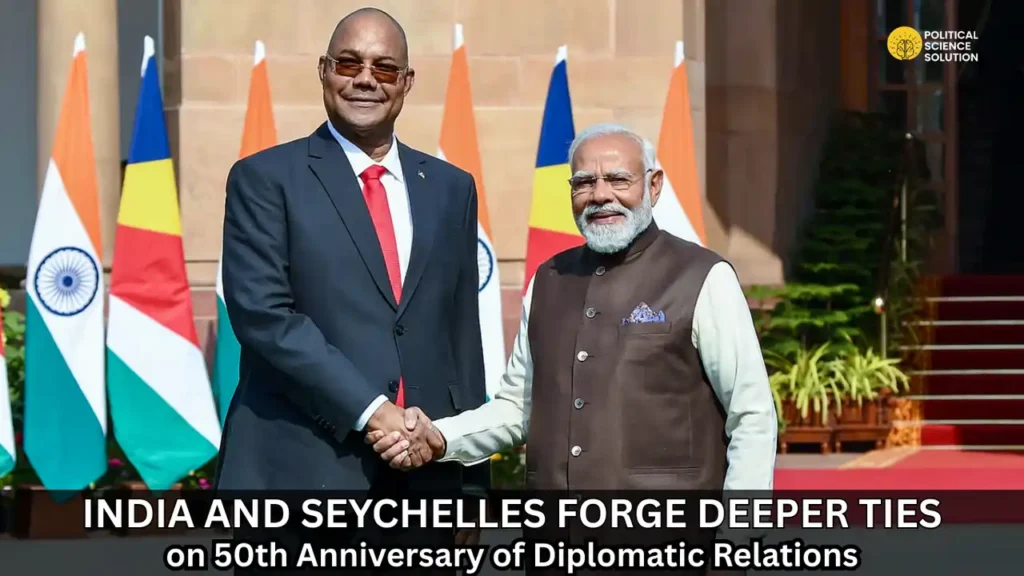
New Delhi: The Republic of Seychelles and India have elevated their bilateral relationship to new heights following the successful state visit of Seychelles President Dr. Patrick Herminie to India from February 5 to 10, 2026. This landmark engagement, coinciding with the 50th anniversary of Seychelles’ independence and 50 years of diplomatic relations between the two nations, delivered concrete outcomes in development assistance, regional security, health, digital infrastructure, and maritime cooperation.
President Herminie’s visit—his first to India since taking office—came approximately 100 days after his inauguration and underscored the mutual commitment to deepening multifaceted ties rooted in shared democratic values, cultural affinities, and oceanic proximity.
Warm Reception at Rashtrapati Bhavan
On February 9, 2026, President of India Smt. Droupadi Murmu formally received President Herminie at Rashtrapati Bhavan and hosted a ceremonial banquet in his honor. In her welcoming address, President Murmu highlighted the foundation of trust, respect, and pluralism that defines the relationship. She emphasized the symbolic importance of the timing, noting how the Indian Ocean’s waves and deep cultural connections bind the peoples of both countries together.
President Murmu described Seychelles as a vital component of India’s Vision MAHASAGAR (Mutual and Holistic Advancement for Security and Growth Across Regions), an evolution of the earlier SAGAR initiative. She reaffirmed India’s readiness to support Seychelles’ developmental and security priorities through focused pillars: trade-driven development, capacity building for sustainability, and collaborative security for a shared future.
Both leaders expressed optimism about the future, agreeing that immense potential exists to intensify cooperation for the benefit of their populations and regional stability.
Landmark Joint Vision Document Adopted
The centerpiece of the visit was the adoption of the India–Seychelles Joint Vision for Sustainability, Economic Growth, and Security through Enhanced Linkages (referred to as SESEL). This comprehensive framework outlines priorities in sustainability, economic advancement, and security, providing a structured roadmap for enhanced bilateral engagement in the coming years.
The document positions Seychelles as a central pillar in India’s broader strategic outreach in the Indian Ocean, reinforcing commitments to mutual prosperity and peace.
USD 175 Million Special Economic Package Announced
Prime Minister Narendra Modi announced a Special Economic Package valued at USD 175 million during discussions with President Herminie. Comprising USD 125 million in rupee-denominated Lines of Credit and USD 50 million in grant assistance, the package targets key sectors including social housing, e-mobility, vocational training, health infrastructure, defense capabilities, and maritime security enhancements.
This financial commitment aims to generate employment opportunities, build skills—particularly among Seychellois youth—and accelerate progress on Seychelles’ national development agenda.
Key Sectoral Advancements and Agreements
Several practical steps emerged to translate the joint vision into action:
- Regional Security Integration: Seychelles accepted full membership in the Colombo Security Conclave (CSC), a platform uniting India, Sri Lanka, Mauritius, Maldives, and Bangladesh to counter transnational threats and promote collective maritime stability.
- Disaster Resilience Commitment: Seychelles joined the Coalition for Disaster Resilient Infrastructure (CDRI), aligning with international efforts to strengthen infrastructure against natural hazards.
- Healthcare Cooperation: Seychelles agreed to recognize the Indian Pharmacopoeia as a standard for pharmaceuticals, enabling access to affordable, high-quality medicines from India and improving public health outcomes.
- Digital Public Infrastructure: India committed to comprehensive support for building Digital Public Infrastructure (DPI) in Seychelles, modernizing governance, service delivery, and economic systems.
- Maritime Hydrography Enhancement: Seychelles will establish a dedicated Hydrographic Unit with Indian technical assistance to improve nautical charting, oceanographic data, and navigational safety.
Additional memorandums of understanding covered areas such as meteorology, electronics, IT, good governance, capacity building, and civil service training.
Strategic Importance of Seychelles in India’s Ocean Vision
Seychelles holds immense geostrategic value for India due to its location near critical sea lines of communication, including the Mozambique Channel. This positioning supports monitoring of vital shipping routes and bolsters maritime domain awareness.
India’s initiatives—such as developing facilities on Assumption Island and installing Coastal Surveillance Radar Systems—reflect efforts to enhance regional security cooperation. These measures contribute to maintaining balance amid evolving dynamics in the Indian Ocean, including various external infrastructure and influence strategies.
Seychelles has consistently backed India’s candidature for permanent membership in the United Nations Security Council, further solidifying political alignment.
Defense collaboration remains strong, highlighted by the recurring joint maritime exercise LAMITYE, which builds interoperability and preparedness between the armed forces of both nations.
Path Forward for Mutual Prosperity
As the visit concluded, both sides expressed confidence in translating agreements into tangible benefits. The outcomes reinforce India’s role as a reliable development partner and underscore Seychelles’ strategic significance in fostering a stable, inclusive Indian Ocean Region.
With shared priorities in sustainability, economic growth, and security now formalized, India and Seychelles are set to advance a people-centric partnership that promotes regional peace and collective progress in the years ahead.
FAQs
1. What was the main purpose and timing of Seychelles President Patrick Herminie’s visit to India?
President Dr. Patrick Herminie undertook a state visit to India from February 5 to 10, 2026, at the invitation of Prime Minister Narendra Modi. This was his first official trip to India since assuming the presidency in October 2025 (approximately 100 days prior). The visit held special significance as it coincided with the 50th anniversary of Seychelles’ independence (celebrated in 2026) and the 50th anniversary of the establishment of diplomatic relations between India and Seychelles. Discussions focused on strengthening bilateral ties across development, security, sustainability, and regional cooperation in the Indian Ocean.
2. What is the India–Seychelles Joint Vision document, and what does it cover?
During the visit, both countries formally adopted the India–Seychelles Joint Vision for Sustainability, Economic Growth, and Security through Enhanced Linkages (commonly abbreviated as SESEL). This comprehensive framework serves as a roadmap for future cooperation, emphasizing people-centric priorities such as trade for development, capacity building for sustainable progress, and mutual security for shared stability. It positions Seychelles as a central pillar in India’s Vision MAHASAGAR (Mutual and Holistic Advancement for Security and Growth Across Regions), an evolution of the SAGAR initiative. The document highlights enhanced linkages in sectors like health, infrastructure, digital transformation, maritime security, and regional peace.
3. What financial support did India announce for Seychelles during the visit?
Prime Minister Narendra Modi announced a Special Economic Package worth USD 175 million to support Seychelles’ developmental priorities. This package includes USD 125 million in rupee-denominated Lines of Credit and USD 50 million in grant assistance. The funds target key areas such as social housing, e-mobility and public transport, vocational training and skill development (especially for youth), health infrastructure, defense capabilities, maritime security enhancements, and other infrastructure projects. The assistance aims to create jobs, build local capacity, and align with Seychelles’ national development goals.
4. What were the major sectoral agreements and commitments made during the visit?
The visit produced several practical outcomes and MoUs in strategic areas:
Assistance was committed for establishing a Hydrographic Unit in Seychelles to improve nautical charting and maritime safety. Additional MoUs covered meteorology, electronics and IT, good governance, civil service training, cultural exchanges (2026–2030), ocean observation, maritime research, data sharing, and procurement cooperation.
Seychelles joined the Colombo Security Conclave (CSC) as a full member to address transnational threats and boost regional maritime security alongside India, Sri Lanka, Mauritius, Maldives, and Bangladesh.
Seychelles committed to join the Coalition for Disaster Resilient Infrastructure (CDRI) for better disaster preparedness.
Seychelles agreed to recognize the Indian Pharmacopoeia to access affordable, quality medicines from India.
India pledged support for building Digital Public Infrastructure (DPI) in Seychelles to modernize governance and services.
5. Why is Seychelles strategically important to India, and how does this visit fit into broader regional goals?
Seychelles occupies a critical geostrategic position in the Indian Ocean near vital sea lines of communication, including the Mozambique Channel, enabling monitoring of key shipping routes. It serves as a key partner in India’s maritime vision for a free, open, and inclusive Indo-Pacific. Initiatives like developing Assumption Island facilities and deploying Coastal Surveillance Radar Systems enhance maritime domain awareness and counterbalance external influences in the region. Seychelles supports India’s bid for permanent UN Security Council membership and participates in joint exercises like LAMITYE. The visit reinforces mutual security, counters transnational challenges, and promotes stability, sustainability, and prosperity across the Indian Ocean Region through enhanced bilateral and multilateral linkages.