

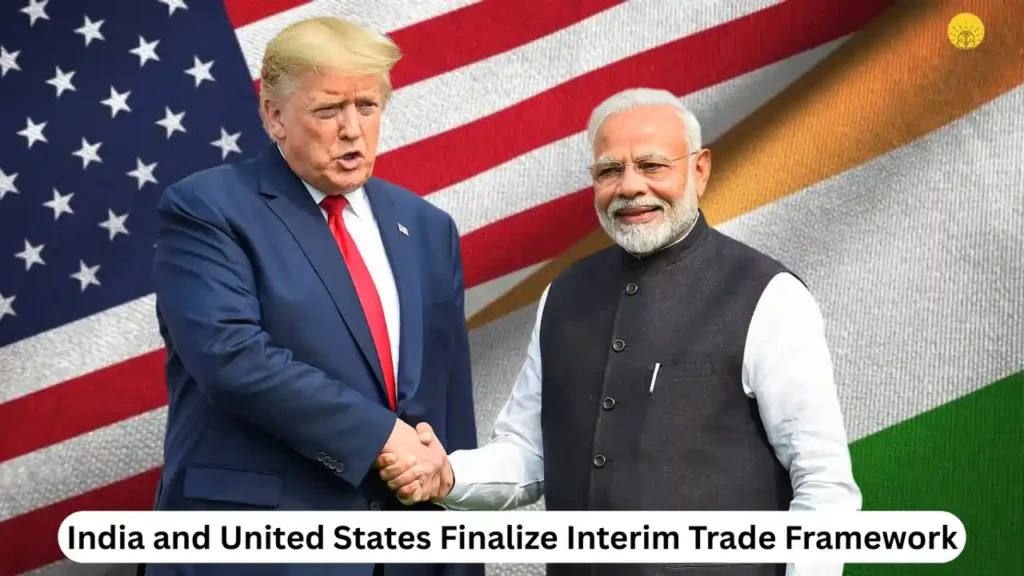
New Delhi: In a development with far-reaching consequences for global commerce, manufacturing, and geopolitical alignments, India and the United States formally released the details of an interim trade framework on February 6, 2026. The arrangement significantly reduces American duties on Indian merchandise, commits New Delhi to large-scale purchases of American products, resolves several long-standing market-access disputes, and establishes the groundwork for a comprehensive bilateral trade treaty expected within months.
The interim accord arrives at a moment when both capitals are actively seeking to fortify economic ties, diversify critical supply networks, and reduce exposure to concentrated production sources. Officials on both sides describe the framework as balanced and reciprocal, although domestic critics in India have already labeled portions of the deal as disproportionately favoring Washington.
Core Tariff Adjustments Deliver Immediate Export Relief
The single most visible change affects U.S. import duties levied on goods originating from India. Previously, certain categories faced punitive rates reaching 50 percent—half of that level having been introduced specifically to penalize continued purchases of Russian crude. Following India’s undertaking to cease sourcing oil from Russia (directly or indirectly), President Trump rescinded the additional 25 percent levy via executive order, bringing the effective rate down to a uniform 18 percent across a wide spectrum of Indian exports.
Sectors that stand to benefit immediately include textiles, ready-made garments, footwear, leather articles, rubber and plastic goods, organic chemicals, home furnishings, handcrafted items, and selected machinery lines. Commerce and Industry Minister Piyush Goyal characterized the reduction as a breakthrough that suddenly makes Indian products far more price-competitive inside the $30 trillion U.S. consumer economy.
Looking slightly further ahead, once the interim measures are fully executed, several of India’s highest-value export verticals will enjoy duty-free entry into the American market. The list encompasses generic medicines and their raw materials (contingent upon conclusions from an ongoing U.S. Section 232 national-security review), cut and polished diamonds, gems, certain aircraft components, and designated categories of auto parts (covered by preferential tariff-rate quotas). These zero-tariff windows are viewed as powerful accelerators for “Make in India” ambitions in knowledge-intensive and employment-heavy industries.
Massive Five-Year Purchase Commitment Anchors Energy & Technology Cooperation
Balancing the tariff concessions, India has pledged to acquire $500 billion worth of United States-origin goods during the coming five years. The shopping list is deliberately broad and strategic:
- crude oil, liquefied natural gas, and coking coal
- commercial aircraft, engines, and spare parts
- precious metals
- high-performance computing hardware—most notably graphics processing units critical for artificial-intelligence training and inference
- equipment used in large-scale data centers
The energy portion of the commitment is especially meaningful. It formalizes a reorientation of India’s import basket away from Russian supplies toward American and other non-Russian sources (Venezuela has been explicitly mentioned). Although the joint communiqué avoids direct reference to the Russian-oil question, the tariff rollback is unambiguously conditioned on New Delhi honoring that shift, with U.S. agencies instructed to watch compliance closely and advise reinstatement of penalties if necessary.
India Opens Doors Wider to American Industrial and Farm Products
In return for the tariff relief and quota benefits described above, India has agreed to phase out or sharply lower import duties on virtually the entire range of U.S. industrial merchandise. A parallel package of duty concessions covers numerous American agricultural and processed-food items, among them:
- dried distillers grains and red sorghum used in animal feed
- almonds, pistachios, walnuts, and other tree nuts
- fresh apples, cherries, grapes, and various processed fruit preparations
- soybean oil
- wines and distilled spirits
Crucially, politically sensitive agricultural domains remain untouched. The government has repeatedly stressed that wheat, rice, coarse cereals, milk and dairy products, poultry, eggs, and many vegetables stay fully protected. No provision exists in the framework for automatic entry of genetically modified food crops. Apples and certain other fruits will enter only within negotiated tariff-rate quotas, preserving safeguards for domestic growers.
Regulatory Alignment to Reduce Non-Tariff Friction
Beyond duties, the two governments have targeted persistent non-tariff obstacles that have frustrated traders for more than a decade. India has committed to examining—and within six months deciding whether to accept—U.S. or internationally recognized standards, testing protocols, and conformity-assessment procedures in three priority areas:
- medical devices and healthcare equipment
- information and communication technology hardware
- food-safety and plant-health requirements for agricultural imports
The goal is to cut duplicative certification burdens, shorten lead times, and create greater regulatory predictability for companies on both sides of the transaction.
Digital Rules, Supply-Chain Security, and Export-Control Alignment
The framework also signals intent to tackle emerging policy domains in future phases. Both capitals pledge to curb digital-trade practices deemed discriminatory or unnecessarily restrictive, setting the stage for more detailed digital-trade disciplines in the eventual full bilateral agreement.
Further cooperation is planned in investment screening, coordinated export controls on dual-use technologies, and joint responses to “non-market” economic strategies pursued by third countries. Rules-of-origin provisions will ensure that tariff preferences primarily benefit firms genuinely producing in India or the United States rather than merely routing goods through one or the other.
Domestic Reception: Praise, Cautious Optimism, and Sharp Criticism
Prime Minister Narendra Modi welcomed the framework as evidence of deepening strategic trust between the two democracies. He underlined its potential to expand opportunities for Indian farmers, fishers, women entrepreneurs, young innovators, startups, and MSMEs while reinforcing resilient supply chains and technology collaboration.
Minister Goyal echoed that message, framing the arrangement as a gateway to massive job creation and export growth without compromising core rural interests.
Opposition voices, led by the Congress party, took a starkly different view. Party spokespersons described the interim pact as a “one-sided capitulation” that exposes vulnerable sections of Indian agriculture and small trade to unfair competition while offering insufficient reciprocal benefits.
Timeline and Larger Horizon
Implementation of the interim commitments is expected to begin swiftly. Formal signature of the interim agreement itself—together with the first wave of tariff movements—is targeted for March 2026. Negotiators will simultaneously press forward on the full Bilateral Trade Agreement, which is likely to encompass deeper provisions on services, intellectual-property standards, digital governance, labor, environment, and additional supply-chain coordination mechanisms.
Whether measured by immediate export gains, long-term positioning in artificial-intelligence hardware ecosystems, reduced dependence on any single energy supplier, or strengthened strategic convergence, the February 2026 interim framework ranks among the most consequential economic understandings between Washington and New Delhi in recent memory.
FAQs
1. What exactly is the India-US interim trade framework, and how does it relate to a full trade deal?
The interim framework is a reciprocal agreement that delivers immediate tariff relief, market access improvements, and commitments on energy and technology while serving as a bridge to a comprehensive Bilateral Trade Agreement (BTA). Negotiations for the full BTA began in February 2025 between President Donald Trump and Prime Minister Narendra Modi. The interim pact focuses on quick wins like tariff reductions and non-tariff barrier fixes, with both sides aiming to finalize and sign the broader deal soon—potentially by March 2026. It emphasizes balanced trade, supply chain resilience, and cooperation against non-market practices.
2. How much have US tariffs on Indian goods been reduced, and which sectors benefit the most right away?
US tariffs on many Indian-origin goods have dropped from as high as 50% (including a 25% punitive layer tied to Russian oil purchases) to a uniform reciprocal rate of 18%. This change took effect quickly after the framework announcement, with an executive order removing the extra 25% portion. Key sectors seeing immediate gains include textiles and apparel, leather and footwear, plastics and rubber, organic chemicals, home decor, artisanal products, and certain machinery. These categories support millions of jobs in India, especially in MSMEs, and the lower duties make Indian products far more competitive in the US market—the world’s largest consumer economy, valued at roughly $30 trillion in annual GDP.
3. Which Indian exports will eventually enjoy zero tariffs in the US, and what conditions apply?
Upon full implementation of the interim agreement, the US plans to remove reciprocal tariffs entirely on several high-value Indian export categories. These include generic pharmaceuticals and their ingredients (subject to the outcome of an ongoing US Section 232 national security investigation), gems and diamonds, aircraft and aircraft parts, and certain auto parts (which will benefit from preferential tariff-rate quotas under US national security rules). Commerce Minister Piyush Goyal highlighted that these zero-duty windows will strengthen “Make in India,” boost export competitiveness in knowledge-based sectors, and support clusters like Gujarat’s diamond industry and nationwide generic drug manufacturing.
4. What has India committed to in return, including the $500 billion purchase pledge?
India has agreed to eliminate or substantially reduce tariffs on all US industrial goods and a wide range of US agricultural and food products. This covers items like dried distillers’ grains (DDGs) and red sorghum for animal feed, tree nuts (almonds, walnuts, etc.), fresh and processed fruits, soybean oil, wine, and spirits. India also pledged to purchase $500 billion worth of US goods over the next five years, focusing on energy products (oil, gas, coking coal), aircraft and parts, precious metals, technology hardware (especially graphics processing units for AI and data center equipment), and related items. Additionally, India committed to addressing non-tariff barriers—reviewing and potentially accepting US or international standards for medical devices, ICT goods, and agricultural imports within six months—and to shifting away from Russian oil imports toward US and other sources.
5. Are Indian farmers and sensitive agricultural sectors protected under this deal?
Yes—Union Commerce Minister Piyush Goyal and the government have repeatedly assured that the agreement fully safeguards farmers and rural livelihoods. Sensitive products such as wheat, rice, maize, dairy, poultry, eggs, and many vegetables remain completely protected with no tariff concessions or unrestricted access granted. There is no provision allowing imports of genetically modified agricultural products. Only selected non-sensitive items (mainly animal feed components, certain nuts, fruits under quota limits, and processed goods) gain preferential entry. The framework explicitly preserves protections for politically and economically vital domestic agriculture while opening opportunities for Indian agricultural exports in other areas.