

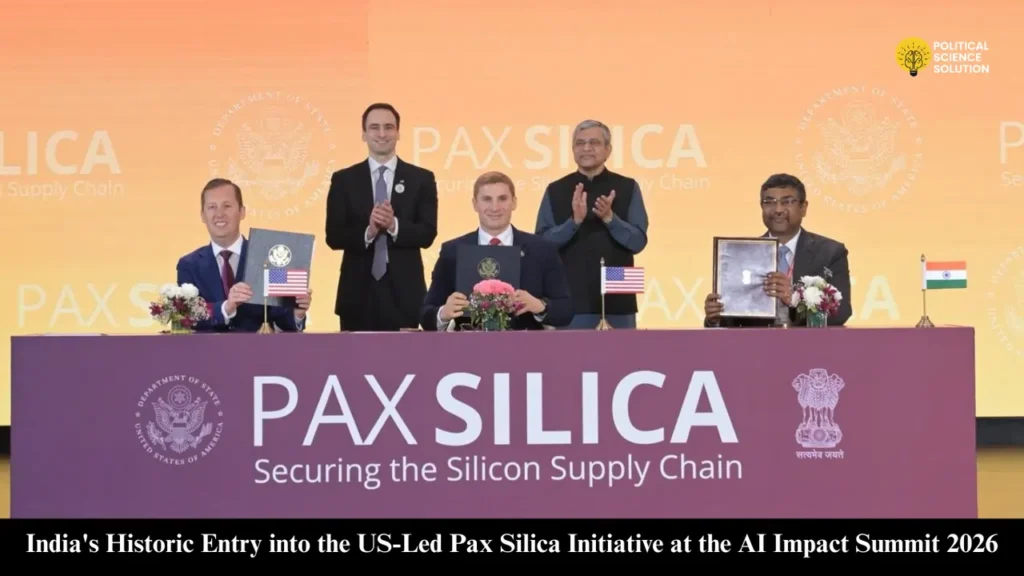
New Delhi: On February 20, 2026, during the India AI Impact Summit 2026, India officially became the tenth member of the Pax Silica initiative, a flagship US Department of State-led coalition dedicated to building secure, resilient, and innovation-driven supply chains for technologies powering the AI era. This strategic partnership, formalized through the signing of the Pax Silica Declaration and a bilateral addendum, underscores deepening Indo-US cooperation in semiconductors, artificial intelligence infrastructure, critical minerals, and advanced manufacturing amid global efforts to reduce coercive dependencies and enhance economic security.
What is the Pax Silica Initiative?
Launched in December 2025, Pax Silica represents a coordinated international framework to secure the entire “silicon stack”—from critical mineral extraction and energy inputs to advanced manufacturing facilities, semiconductor fabrication, AI compute infrastructure, data centers, and logistics networks. The name combines “pax,” Latin for peace, stability, and prosperity, with “silica,” the foundational compound refined into silicon for chips and computing systems.
The US-led effort aims to foster trusted ecosystems among democratic partners, promote pro-innovation regulations, encourage private-sector leadership in AI development, and enable joint investments. It seeks to protect foundational AI capabilities from undue control by adversarial actors, ensuring aligned nations can deploy transformative technologies at scale while minimizing vulnerabilities in global supply chains.
Prior to India’s accession, the coalition included Australia, Greece, Israel, Japan, South Korea, Qatar, Singapore, the United Kingdom, and the United Arab Emirates. These partners bring complementary strengths in mining, processing, design, fabrication, and deployment, creating a robust network to counter overconcentration risks.
Landmark Signing Ceremony in New Delhi
The agreement was inked on the summit’s sidelines in the presence of India’s Union Minister for Electronics and Information Technology Ashwini Vaishnaw. Key signatories included Secretary of the Ministry of Electronics and Information Technology (MeitY) S. Krishnan for India, US Ambassador to India Sergio Gor, and US Under Secretary of State for Economic Affairs Jacob Helberg.
Ambassador Gor described India’s inclusion as “strategic and essential,” stating that Pax Silica will define the 21st-century economic and technological order. He emphasized the coalition’s focus on whether free societies will control the commanding heights of the global economy, choosing freedom, partnership, and strength over weaponized dependencies.
Under Secretary Helberg called the declaration a “roadmap for a shared future,” rejecting economic blackmail and affirming that economic security equals national security. He highlighted securing the full technology stack—from earth minerals to silicon wafers and intelligence unleashing human potential—declaring the future belongs to builders.
Minister Vaishnaw highlighted India’s compounding growth since independence and its emerging semiconductor leadership, noting Indian engineers now design advanced two-nanometer chips. He projected the sector requiring one million skilled professionals, presenting vast opportunities for talent development and job creation.
A fireside chat followed, featuring S. Krishnan, Sergio Gor, Micron Technology CEO Sanjay Mehrotra, and Tata Electronics CEO Randhir Thakur. Discussions centered on resilient collaboration, secure supply chains, and advancing AI for societal benefit, driven by materials, innovation, and compute power.
Strategic Benefits for India
Experts describe India’s entry as structurally positive for long-term economic expansion, particularly in semiconductors, AI, electronics manufacturing, and critical minerals. It strengthens domestic programs like the India Semiconductor Mission and Production-Linked Incentive (PLI) schemes by improving access to chip design expertise, fabrication technology, and equipment supply chains.
This accelerates high-value manufacturing, boosts exports, and reduces import dependence. Geopolitically, India positions itself as a trusted alternative hub in global diversification, attracting foreign direct investment, high-skilled employment, and technology transfer.
Over 5–10 years, the partnership could elevate manufacturing’s GDP contribution, fortify exports, stabilize the rupee, and enhance technological autonomy. It may draw hyperscale data centers, deepen R&D collaboration, and shift India upward from IT services to advanced digital infrastructure, yielding productivity gains in manufacturing, healthcare, logistics, and finance.
Improved access to critical minerals like lithium and rare earths supports electric vehicles, batteries, and electronics while bolstering supply security.
Market Implications and Stock Recommendations
Analysts anticipate positive long-term effects on the Indian stock market, with mining, metals, technology, and related sectors poised to benefit most from supply chain diversification and export growth.
Seema Srivastava, Senior Research Analyst at SMC Global Securities, noted the initiative’s role in positioning India within a secure AI ecosystem amid global shifts.
Recommended stocks expected to gain include:
- Tech and IT Services: Tata Elxsi, Persistent Systems, HCL Tech
- Mining and Minerals: GMDC, NALCO, NMDC
- Electronics Manufacturing: Dixon Tech, CG Power, Avalon Tech
- Automotive and Components: Tata Motors, Bajaj Auto, M&M, Bharat Forge
- Defense and Exports: BEL, Gokaldas Exports
These firms align with enhanced domestic capabilities, critical mineral access, and potential surges in high-tech manufacturing and exports.
Broader Geopolitical Context
India’s joining follows an invitation last month and coincides with progress in bilateral ties, including a framework for an interim trade deal. Discussions addressed India’s diversification from Russian oil purchases—Ambassador Gor noted observed progress and a “commitment”—and ongoing talks on Venezuelan oil and tariff reductions (though recent US court rulings impacted certain levies).
The move signals a reset after earlier frictions, aligning New Delhi with Washington’s vision for trusted technology ecosystems. With prominent summit attendees like Sundar Pichai and Sam Altman, it highlights India’s growing role in the global AI and semiconductor landscape.
As the India AI Impact Summit 2026 unfolds, this development reinforces a deliberate commitment to resilient, value-aligned tech partnerships. By joining Pax Silica, India secures its stake in the AI-driven future while contributing to rules ensuring open, democratic governance of transformative technologies for free societies worldwide.
This alliance positions India to leverage its engineering talent, policy frameworks, and strategic ties, accelerating its ascent as a semiconductor powerhouse and AI innovator for sustained technological and economic resilience.
FAQs
1. What exactly is the Pax Silica initiative?
Pax Silica is a flagship initiative led by the US Department of State to build a secure, resilient, and innovation-driven global supply chain for silicon-based technologies essential to artificial intelligence (AI) and advanced computing. Launched in December 2025, it covers the entire “silicon stack”—from critical mineral extraction and refining, energy inputs, advanced manufacturing, semiconductor design and fabrication, AI infrastructure (including data centers and compute), to logistics. The name combines “pax” (Latin for peace, stability, and prosperity) with “silica” (the compound refined into silicon for chips). The goal is to reduce coercive dependencies, prevent economic coercion by adversarial actors, promote pro-innovation regulations, encourage private-sector leadership in AI, and ensure democratic nations control key technology ecosystems for mutual security and prosperity.
2. Why did India join Pax Silica, and what does it mean for India?
India became the tenth signatory (joining Australia, Greece, Israel, Japan, Qatar, Republic of Korea, Singapore, the United Arab Emirates, the United Kingdom, and others) to strengthen strategic technology cooperation with the United States and trusted partners. The move aligns with India’s India Semiconductor Mission and Production-Linked Incentive (PLI) schemes, improving access to chip design expertise, fabrication technology, equipment, and critical minerals like lithium and rare earths. It positions India as a trusted alternative manufacturing hub amid global supply chain diversification, attracting foreign direct investment (FDI), high-skilled jobs, technology transfer, and hyperscale data centers. Long-term benefits include boosting high-value exports, reducing import dependence, enhancing technological autonomy, elevating manufacturing’s GDP share, and driving productivity gains in sectors like manufacturing, healthcare, logistics, and finance. Geopolitically, it signals deeper Indo-US alignment on economic security equaling national security.
3. Who signed the agreement, and what key statements were made during the event?
The Pax Silica Declaration and a bilateral addendum were signed by India’s Secretary of the Ministry of Electronics and Information Technology (MeitY) S. Krishnan, US Ambassador to India Sergio Gor, and US Under Secretary of State for Economic Affairs Jacob Helberg. Union Minister for Electronics and Information Technology Ashwini Vaishnaw represented India. Ambassador Gor called India’s entry “strategic and essential,” stating Pax Silica will define the 21st-century economic and technological order and ensure free societies control the global economy’s commanding heights. Under Secretary Helberg described it as a “roadmap for a shared future,” rejecting weaponized dependency and affirming the future belongs to builders. Minister Vaishnaw highlighted India’s compounding growth since 1947 and its engineers designing advanced two-nanometer chips, projecting the need for one million skilled professionals.
4. How will this impact the Indian stock market and which sectors/stocks could benefit?
Experts view the development as structurally positive for long-term growth, particularly in semiconductors, AI, electronics manufacturing, critical minerals, mining, and metals. It supports supply chain resilience, export growth, and domestic capabilities under existing incentives. Seema Srivastava from SMC Global Securities noted it strengthens India’s role in secure AI ecosystems and attracts R&D collaboration. Recommended stocks expected to gain include tech/IT services (Tata Elxsi, Persistent Systems, HCL Tech), mining/minerals (GMDC, NALCO, NMDC), electronics manufacturing (Dixon Tech, CG Power, Avalon Tech), automotive/components (Tata Motors, Bajaj Auto, M&M, Bharat Forge), and defense/exports (BEL, Gokaldas Exports). While immediate GDP effects may be limited, the partnership promises sustained benefits over 5–10 years.
5. What is the broader geopolitical context surrounding India’s joining Pax Silica?
The initiative counters overconcentration in global supply chains (often linked to China) by uniting democratic partners for trusted, coercion-free technology ecosystems. India’s inclusion follows an invitation last month and coincides with progress in bilateral ties, including a framework for an interim trade deal and discussions on diversifying energy sources (e.g., reduced reliance on Russian oil, with Ambassador Gor noting India’s “commitment” and ongoing talks on Venezuelan oil). It marks a reset after earlier frictions over tariffs and energy purchases. The signing occurred amid the India AI Impact Summit 2026, with participation from figures like Sundar Pichai and Sam Altman, underscoring India’s rising stature in AI and semiconductors. Overall, it reinforces a shared Indo-US vision under frameworks like the TRUST initiative, prioritizing freedom, partnership, and resilience in the AI-driven era.