

New Delhi: In a landmark moment for India’s green mobility revolution, Union Minister for Ports, Shipping and Waterways, Shri Sarbananda Sonowal, flagged off the country’s first completely indigenous hydrogen fuel cell passenger vessel at Namo Ghat on the banks of the sacred River Ganga. Christened FCV Pilot-01, the 24-meter catamaran marks the beginning of commercial hydrogen-powered passenger services on National Waterway-1 and positions India among a select group of nations operating hydrogen vessels, including Norway, Japan, China, and the Netherlands.
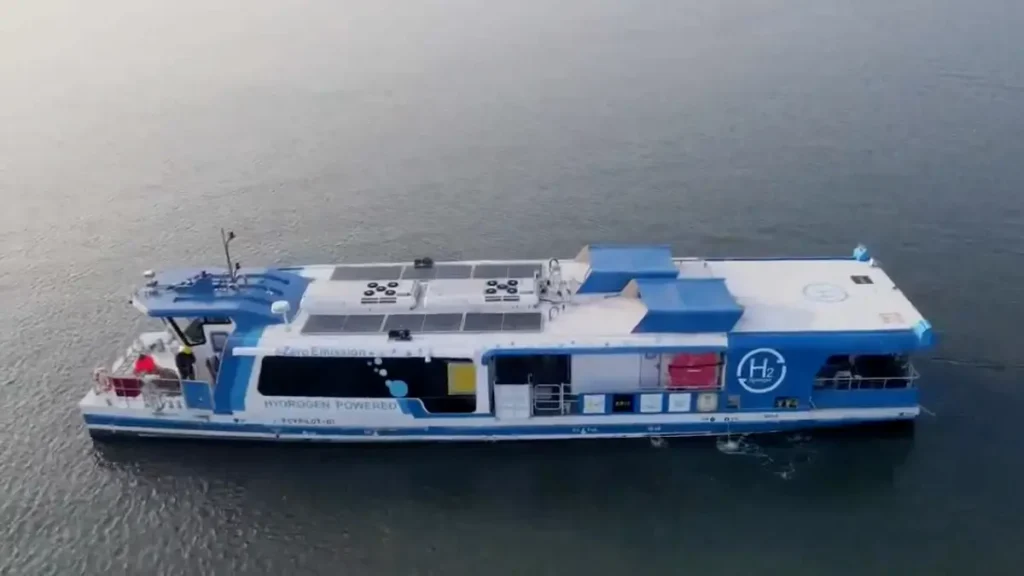
Revolutionary Low-Temperature PEM Fuel Cell Technology – 100% Made in India
At the heart of the vessel lies a fully indigenous Low Temperature Proton Exchange Membrane (LT-PEM) fuel cell system, the first of its kind developed and deployed for marine applications in India. Unlike traditional diesel engines, the LT-PEM technology generates electricity through an electrochemical reaction without any combustion.
The process is elegantly simple yet highly efficient:
- Hydrogen stored in four onboard cylinders enters the anode.
- A catalyst splits hydrogen molecules into protons (H⁺) and electrons (e⁻).
- Protons pass through the proton exchange membrane while electrons travel through an external circuit, producing electricity.
- At the cathode, protons, electrons, and atmospheric oxygen combine to form pure water and a small amount of heat.
The only emission? Water vapour. No CO₂, no NOx, no particulate matter – truly zero-emission propulsion.
Key Advantages that Make Hydrogen Fuel Cells Ideal for River Transport
The LT-PEM technology offers multiple benefits that are perfectly suited for daily inland waterway operations:
- Zero emissions – only water as a byproduct, preserving the ecological sanctity of River Ganga.
- High power density with low weight and volume compared to other fuel cell types.
- Rapid start-up capability due to low operating temperature, ideal for frequent urban ferry services.
- Completely silent operation with no moving parts, ensuring a serene ride for pilgrims and tourists.
- Superior energy efficiency compared to internal combustion engines.
- Up to eight hours of continuous operation on a single hydrogen fill.
Vessel Specifications and Passenger Experience
Designed as a modern 24-meter catamaran (some reports mention 28-meter length including platform), the air-conditioned vessel offers seating for 50 passengers and is operated by a 10-member crew. Key technical highlights include:
- Service speed: 6.5–9 knots (12–20 km/h)
- Hybrid energy system combining hydrogen fuel cells, lithium-ion batteries, and rooftop solar panels
- Four high-pressure hydrogen cylinders for primary power
- Battery backup for redundancy and peak loads
- Certified by the Indian Register of Shipping (IRS)
- Top speed during trials reached up to 20 km/h
- Fully air-conditioned cabin for passenger comfort
The maiden commercial voyage covered a picturesque 5-kilometre stretch from Namo Ghat to Lalita Ghat, carrying dignitaries and marking the official start of scheduled services.
Ticket Price and Hydrogen Refueling Infrastructure
Passengers can now experience this futuristic ride at an affordable fare of just ₹50 per ticket. A dedicated green hydrogen refueling station has been commissioned at the Multi-Modal Terminal in Ralhupur, Ramnagar, Varanasi, ensuring seamless operations.
Tripartite Agreement Ensures Smooth Pilot Operations
To operationalise FCV Pilot-01, a comprehensive tripartite agreement has been signed between:
- Inland Waterways Authority of India (IWAI) – Owner and regulatory authority
- Cochin Shipyard Limited (CSL) – Designer and builder of the vessel
- Inland and Coastal Shipping Ltd. – Operator
The agreement covers technical support, safety protocols, financial terms, monitoring mechanisms, and periodic inspections throughout the pilot phase.
Dignitaries Present at the Historic Launch
The flag-off ceremony witnessed the presence of an august gathering:
- Shri Sarbananda Sonowal, Union Minister for Ports, Shipping & Waterways
- Shri Ravindra Jaiswal, Minister of State (Independent Charge), Uttar Pradesh
- Shri Dayashankar Singh, Transport Minister, Uttar Pradesh
- Dr. Daya Shankar Mishra ‘Dayalu’, Minister of State (Independent Charge), Uttar Pradesh
- Several MLAs including Awadhesh Singh, Neelkanth Tiwari, Dr. Sunil Patel, Saurabh Srivastava, Anil Rajbhar, Neel Ratan Singh, and Tribhuvan Ram
- Shri Ashok Kumar Tiwari, Mayor of Varanasi
- Shri Vijay Kumar, IAS, Secretary, Ministry of Ports, Shipping & Waterways
- Shri Sunil Paliwal, IAS, Chairman, IWAI
Alignment with National Green Missions
The project is a direct outcome of Prime Minister Narendra Modi’s vision for clean, sustainable, and Atmanirbhar Bharat. Speaking at the event, Minister Sonowal emphasised:
“Under the dynamic leadership of Prime Minister Shri Narendra Modi ji, India is witnessing a transformative shift toward clean, sustainable and self-reliant transportation systems. This indigenous hydrogen vessel is a shining example of Make in India and green mobility. It strengthens our mission to rejuvenate and preserve Maa Ganga while ensuring development and ecology go hand in hand.”
The launch perfectly aligns with:
- India’s commitment to achieve net-zero emissions by 2070
- Maritime India Vision 2030
- Maritime Amrit Kaal Vision 2047
- National Green Hydrogen Mission
- Harit Nauka Initiative for cleaner inland waterways
Challenges Acknowledged, Solutions Underway
While celebrating the achievement, experts recognise the challenges associated with LT-PEM technology:
- High cost of precious-metal catalysts (platinum)
- Need for clean, green hydrogen production
- Long-term durability of the proton exchange membrane under varying loads
The Ministry and IWAI are already working on scaling green hydrogen production and reducing catalyst dependency through research collaborations.
Broader Impact on Varanasi and Inland Waterways
The hydrogen ferry brings multiple benefits to the temple city:
- Noise-free, smoke-free travel experience for pilgrims visiting ghats
- Reduced road congestion by shifting short-distance commuters to waterways
- Boost to religious and cultural tourism
- Creation of skilled jobs in green maritime technology
- Positioning Varanasi as one of the world’s first cities with commercial hydrogen-powered passenger transport
The Road Ahead: Scaling Hydrogen Across India’s Waterways
Following successful trials of hybrid electric vessels, the hydrogen catamaran is the latest addition to IWAI’s green fleet. The Ministry has announced plans to expand hydrogen-powered services to other National Waterways, including NW-2 (Brahmaputra), NW-16 (Barak), and coastal routes.
With this launch, India has not only demonstrated technological capability but also sent a strong message: the future of inland water transport is green, silent, and completely indigenous.
As the sleek white catamaran glided silently through the calm waters of the Ganga, leaving only ripples and a trail of pure water vapour, it symbolised more than just a new ferry service – it heralded the arrival of a cleaner, greener, and self-reliant maritime India.
FAQs
1. What is the hydrogen fuel cell vessel and how does it work?
The vessel is India’s first fully indigenous passenger boat powered by a Low Temperature Proton Exchange Membrane (LT-PEM) fuel cell system, developed and built entirely in the country by Cochin Shipyard Limited (CSL) for IWAI. Unlike diesel boats, it generates electricity through an electrochemical reaction: Hydrogen from onboard cylinders enters the anode, where a catalyst (like platinum) splits it into protons and electrons. Protons pass through the membrane to the cathode, while electrons flow through an external circuit to produce electricity. At the cathode, protons, electrons, and oxygen from air combine to form water and heat as the only byproducts—zero emissions, no combustion. It’s a hybrid system with batteries and solar panels for backup, ensuring silent, efficient operation at 6.5-9 knots (12-20 km/h). The 24-meter (or 28-meter including platform) catamaran seats 50 passengers in an air-conditioned cabin and runs up to 8 hours on one hydrogen fill from four cylinders.
2. Where and when was it launched, and who was involved?
It was flagged off for commercial operations on December 11, 2025, by Union Minister Sarbananda Sonowal at Namo Ghat in Varanasi, Uttar Pradesh. The maiden voyage was a 5-km trip to Lalita Ghat. Dignitaries included UP ministers Ravindra Jaiswal, Dayashankar Singh, Dr. Daya Shankar Mishra ‘Dayalu’, MLAs like Awadhesh Singh and Saurabh Srivastava, Varanasi Mayor Ashok Kumar Tiwari, MoPSW Secretary Vijay Kumar, and IWAI Chairman Sunil Paliwal. A tripartite agreement between IWAI (owner), CSL (builder), and Inland and Coastal Shipping Ltd. (operator) covers technical support, safety, finances, and monitoring for the pilot phase. It’s certified by the Indian Register of Shipping and aligns with PM Narendra Modi’s Make in India, net-zero by 2070, Maritime India Vision 2030, and Harit Nauka initiatives. India joins Norway, Japan, China, and the Netherlands in operating such vessels.
3. What are the key benefits and environmental impact?
The boat offers zero emissions (only water vapor), noise-free rides (no moving parts), high efficiency over combustion engines, quick startup at low temperatures, and high power density with low weight/volume. It reduces road congestion by promoting waterway travel for pilgrims and tourists, boosts Varanasi tourism, creates green jobs, and aids Ganga rejuvenation. As part of green mobility, it supports urban transit with faster, pollution-free mobility. A refueling station at Multi-Modal Terminal, Ralhupur, Ramnagar, ensures operations. It’s expected to position Varanasi as a pioneer in hydrogen transport globally.
4. How much does a ticket cost, and what are the operational details?
Tickets are priced at ₹50 per passenger for commercial rides, making it affordable for daily commuters and visitors. The 10-crew vessel operates on National Waterway-1, with hydrogen supplied from a dedicated station (sourced potentially from Bengaluru partners). It runs 8 hours per fill, with service speeds of 6.5 knots and top trial speeds up to 20 km/h. Initial routes include Namo Ghat to Lalita Ghat or Ravidas Ghat, with plans for expansion. Refueling is quick at the Ramnagar terminal. Note: One social media post mentioned ₹800, but official sources confirm ₹50—verify with IWAI for updates.
5. What challenges does the technology face, and what’s next?
Challenges include high costs of platinum catalysts, producing clean green hydrogen (energy-intensive), and PEM membrane durability under stress. Solutions involve R&D for cheaper catalysts and scaling green hydrogen under the National Green Hydrogen Mission. Future plans: Expand to other waterways like NW-2 (Brahmaputra) and coastal routes; more vessels under Maritime Amrit Kaal Vision 2047. This pilot follows trials and builds on earlier electric catamarans, aiming for full decarbonization of inland transport. For bookings or details, contact IWAI or check official portals.