

New Delhi: India and New Zealand have achieved a major breakthrough in bilateral relations by finalizing negotiations for a comprehensive Free Trade Agreement (FTA). This forward-thinking deal emphasizes human development alongside economic growth, creating pathways for increased trade, job creation, skill enhancement, and stronger ties in the Indo-Pacific region.
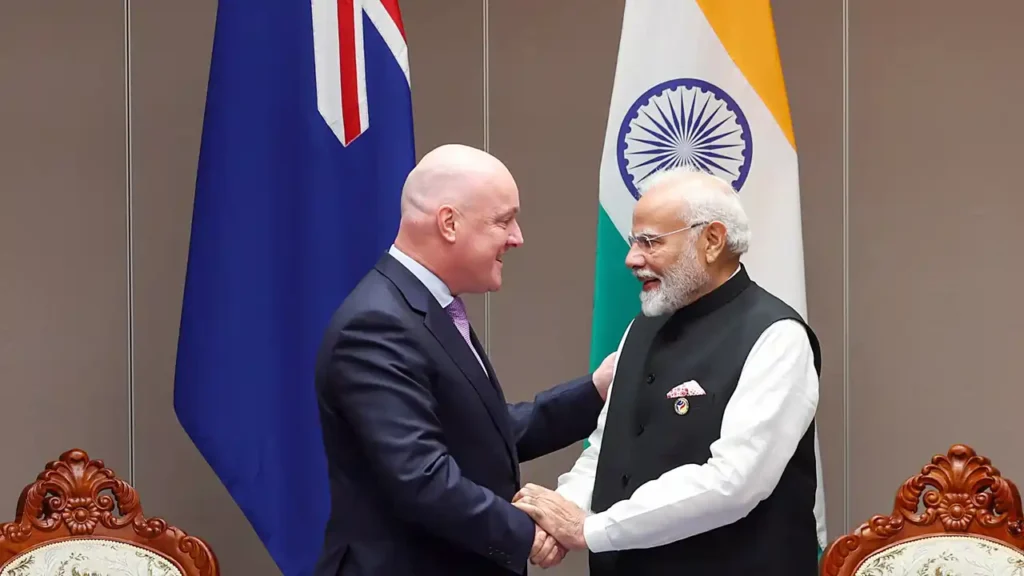
The successful conclusion was revealed after Prime Minister Narendra Modi spoke with New Zealand Prime Minister Christopher Luxon over the phone on December 22, 2025. Both leaders highlighted the rapid progress, noting that talks wrapped up in just nine months following the official start on March 16, 2025. This involved dedicated efforts through five official rounds of talks plus numerous additional sessions, both virtual and in-person.
Current two-way merchandise trade stands at around USD 1.3 billion for 2024-25, with overall goods and services exchange reaching about USD 2.4 billion last year. Services dominate, particularly in areas like information technology, tourism, and professional consulting. The new FTA sets the stage for potentially doubling trade volumes in the coming five years, bolstered by New Zealand’s pledge to channel USD 20 billion in investments toward India across the next 15 years.
Major Trade Advantages: Full Duty Elimination for Indian Goods
One of the most significant outcomes is New Zealand granting complete duty-free entry for every Indian product across all tariff categories. This opens up competitive opportunities for key Indian sectors that rely heavily on labor, including clothing and fabrics, clothing items, leather goods, shoes, seafood, precious stones and jewelry, handmade crafts, machinery products, vehicles, and medicines. These industries support vast numbers of employees, skilled craftsmen, female workers, young people, and small-scale enterprises, helping them connect better with international markets.
On the other side, India has agreed to reduce duties on roughly 70% of its tariff categories, which accounts for about 95% of the value of goods currently traded from New Zealand. Important raw materials for Indian production, such as timber logs, certain types of coal, and recycled metals, will enter without duties.
New Zealand has provided its most extensive services openings ever in an FTA, covering 118 areas like technology services, expert consulting, media content, communication networks, building projects, and hospitality. Additionally, preferential treatment applies in around 139 specific sub-areas, creating fresh avenues for Indian providers in high-skill fields such as digital services, learning programs, money management, and commercial operations.
Focused Agricultural Collaboration with Strong Protections
Agriculture remains a vital yet delicate area, so the FTA introduces targeted partnerships to raise output without compromising local interests. Special centers of excellence will be set up for products like apples, kiwifruit, and honey, involving shared research, technology exchange, better quality standards, training for growers, improved handling after harvest, stronger supply networks, and safety compliance. These efforts aim to increase yields and earnings for Indian growers through better practices and sustainable methods.
Any entry for these items is carefully controlled with volume limits and floor prices to prevent disruption to local markets. Crucially, no concessions were made on highly sensitive categories, including all dairy items (such as milk, cream, cheese, yogurt, whey, and casein), coffee, onions, sugar, certain spices, cooking oils, and rubber products, ensuring full protection for Indian producers.
Streamlined Access for Pharmaceuticals and Devices
Exporters of medicines and health equipment from India will benefit from quicker approval processes. The agreement allows recognition of inspection reports from trusted international bodies like the US FDA, European EMA, and UK MHRA for manufacturing and clinical standards. This avoids repeated checks, cuts expenses, and accelerates market entry.
The pact also tackles barriers beyond tariffs through better coordination on regulations, clearer processes, efficient border procedures, plant and animal health rules, and technical standards. Special expedited paths guarantee that essential production inputs get real benefits from the duty reductions.
Strengthening Investments and Intellectual Property
New Zealand’s planned USD 20 billion commitment over 15 years will support growth in areas like production facilities, infrastructure development, service industries, new ideas, and job opportunities, directly contributing to initiatives like Make in India. Businesses from India can also expand operations in New Zealand and reach further into Pacific regions.
Regarding protected designations, New Zealand will update its regulations to simplify registration for Indian wines, alcoholic beverages, and various other products – a privilege previously limited mainly to European partners – with clear deadlines for completion.
Expanded Pathways for Education, Work, and Cultural Exchange
The agreement includes robust provisions for movement of people, enhancing connections between citizens. Indian learners gain unlimited post-graduation work rights: three years for those completing bachelor’s or master’s in science, technology, engineering, or math fields, and four years for PhD holders. This allows turning academic knowledge into real-world skills.
A specific temporary work entry program reserves up to 5,000 spots at any time for qualified Indian workers, with permits lasting up to three years. This includes roles in technology, engineering, health services, teaching, building, traditional healing practices, yoga teaching, Indian cooking specialists, and cultural performers.
Separately, 1,000 annual spots are available for working holiday arrangements, promoting youthful exchanges and experiences.
Additional Areas of Joint Efforts
Cooperation extends to promoting Indian systems of medicine and wellness, cultural activities, fishing industries, media production, travel promotion, forest management, fruit growing, and preservation of traditional practices. A unique addition is New Zealand’s first dedicated section on health and traditional healing services, supporting global recognition of these approaches, health tourism, and India’s role as a center for holistic well-being.
Broader Significance in a Changing Global Landscape
Commerce Minister Piyush Goyal described the FTA as centered on individuals: it creates avenues for growers to improve output, business owners to expand, learners and experts to gain international exposure, and creators to thrive. He emphasized advancements in farming techniques alongside global integration for enterprises and young talent.
Commerce Secretary Rajesh Agrawal highlighted the modern nature of the deal, combining duty reductions, farming improvements, capital flows, and human resource movement, where each country’s advantages complement the other – India’s export capabilities, job-intensive expansion, and service expertise paired with New Zealand’s entry to a dynamic large market.
This represents India’s third such agreement in 2025, adding to recent pacts with others, and continues a series of strategic economic linkages. It aids in spreading export destinations, incorporating smaller businesses into worldwide networks, enabling professional movement, enhancing product pricing power through reduced duties, and advancing India’s standing in international relations.
With negotiations complete, the text will undergo legal verification before expected signing early next year and implementation shortly thereafter. This partnership promises sustained benefits, fostering inclusive progress and resilience for both economies in an evolving world.
Frequently Asked Questions (FAQs)
1. What are the key benefits for Indian exporters under the India-New Zealand FTA?
Indian exporters gain complete zero-duty market access for 100% of their products to New Zealand, covering all tariff lines. This applies to major sectors like textiles, apparel, leather goods, footwear, marine products, gems and jewellery, handicrafts, engineering goods, automobiles, and pharmaceuticals. Additionally, duty-free entry for critical manufacturing inputs such as wooden logs, coking coal, and metal scraps will reduce production costs and boost competitiveness.
2. How does the FTA protect sensitive Indian sectors, especially agriculture and dairy?
The agreement fully excludes sensitive items from any tariff concessions, including dairy products (milk, cream, cheese, yoghurts, whey, caseins), coffee, onions, sugar, spices, edible oils, and rubber. For apples, kiwifruit, and honey, market access is restricted through quotas and minimum import prices, ensuring domestic farmers and industries remain protected while allowing technology and productivity cooperation.
3. What opportunities does the FTA create for Indian professionals, students, and youth?
The deal introduces a dedicated Temporary Employment Entry visa quota of 5,000 professionals at any time, with stays up to three years, covering fields like IT, engineering, healthcare, education, construction, AYUSH practitioners, yoga instructors, Indian chefs, and music teachers. Students get uncapped post-study work rights—up to 3 years for STEM bachelor’s/master’s graduates and 4 years for PhD holders. There is also an annual quota of 1,000 Work and Holiday Visas for youth.
4. What investment commitments have been made, and in which areas?
New Zealand has committed to facilitating USD 20 billion in investments into India over the next 15 years. These funds are expected to support manufacturing, infrastructure, services, innovation, and employment generation, aligning with India’s Make in India initiative. Indian companies also gain better opportunities to invest in New Zealand and access broader Pacific markets.
5. How does the FTA support agricultural productivity and services trade?
It establishes Agricultural Productivity Partnerships with Centres of Excellence for apples, kiwifruit, and honey, focusing on technology transfer, research, quality improvement, capacity building, and sustainable practices to raise farmer incomes. In services, New Zealand offers its most ambitious commitments ever, covering 118 sectors including IT, professional services, telecommunications, tourism, construction, and education, with Most-Favoured-Nation status in 139 sub-sectors.