

New Delhi: In a defining moment for global artificial intelligence governance, Prime Minister Narendra Modi introduced the MANAV Vision during the India AI Impact Summit 2026. Held at Bharat Mandapam from February 16 to 20, this high-profile event positioned India as a forceful advocate for responsible, inclusive, and sovereign AI development. The acronym MANAV — meaning “human” in Hindi — symbolizes a deliberate shift toward placing people at the heart of technological progress rather than allowing AI to evolve unchecked by ethical boundaries.
Prime Minister Modi delivered the keynote address on February 19, stressing that AI should never reduce individuals to mere data inputs. Instead, he argued, it must serve as an extension of human dignity, aspirations, and collective welfare. Drawing on India’s demographic strengths — home to one-sixth of the world’s population, the largest youth cohort, and a burgeoning tech talent ecosystem — he positioned the country as both a major creator and adopter of emerging technologies with a corresponding duty to influence worldwide standards.
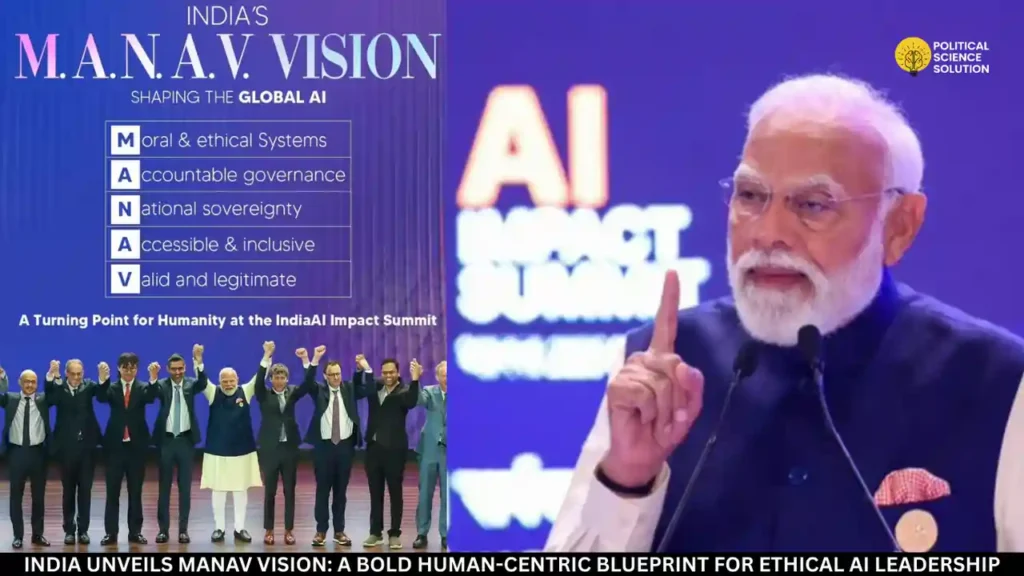
Breaking Down the Five Pillars of MANAV
The MANAV Vision rests on five interconnected pillars, each addressing critical dimensions of AI deployment in the modern era.
M – Moral and Ethical Systems
This foundation insists that AI development remains anchored in fairness, transparency, and continuous human oversight. To embed these values early, India’s National Education Policy 2020 incorporates digital literacy and ethical AI awareness into school curricula. By familiarizing young minds with responsible data practices and bias awareness, the policy aims to cultivate a generation equipped to navigate and shape AI responsibly.
A – Accountable Governance
Transparency, strong regulatory mechanisms, and well-defined institutional accountability form the core of this pillar. The IndiaAI Mission, backed by an investment surpassing ₹10,300 crore, enhances national capabilities in compute infrastructure, datasets, skill development, and startup innovation. Complementing this, dedicated AI governance guidelines prioritize trust, equity, and fairness, creating structured oversight that builds public confidence in deployed systems.
N – National Sovereignty
Emphasizing the principle of “whose data, his right,” this pillar safeguards India’s control over critical datasets, computational resources, and algorithmic frameworks. Through efforts like the India Semiconductor Mission, the country reduces external dependencies on hardware while pursuing strategic autonomy. This approach enables fruitful international cooperation without compromising long-term independence in an increasingly data-driven world.
A – Accessible and Inclusive AI
AI must function as a broad societal enabler rather than an exclusive privilege. To achieve this, India leverages public digital infrastructure such as the MeghRaj GI Cloud, IndiaAI Compute Portal, IndiaAI Kosh, and the National Supercomputing Mission. These shared platforms lower entry barriers, making high-performance computing, quality datasets, and advanced tools affordable and available to researchers, startups, and public-sector initiatives across diverse regions and sectors.
V – Valid and Legitimate Systems
Trust, safety, and legal compliance stand central here, especially as synthetic media and deepfakes threaten social cohesion and democratic integrity. The Information Technology (Intermediary Guidelines and Digital Media Ethics Code) Amendment Rules, 2026, establish formal definitions and oversight for AI-generated content. Meanwhile, the Safe and Trusted AI component within the IndiaAI Mission focuses on bias reduction, robust privacy measures, and regular algorithmic evaluations to maintain verifiable and lawful systems.
Landmark Achievements and Global Commitments
The summit achieved widespread recognition when India secured more than 2.5 lakh public pledges supporting responsible AI practices, earning a Guinness World Record. This grassroots momentum transformed ethical AI principles into a genuine national movement. Looking ahead, the next major AI gathering is scheduled for 2027 in Geneva, Switzerland, extending the dialogue on inclusive global frameworks.
Union Minister for Electronics and Information Technology Ashwini Vaishnaw launched the New Delhi Frontier AI Impact Commitments, a voluntary initiative uniting prominent frontier AI developers and Indian innovators. Focused on equitable progress, particularly for the Global South, the commitments highlight two priority areas.
The first encourages comprehensive, evidence-based studies of AI’s real-world effects on employment patterns, workforce skills, productivity levels, and broader economic shifts. Such insights will help governments craft targeted policies that maximize benefits while addressing disruptions.
The second commitment promotes stronger multilingual and culturally attuned evaluation methods. Collaborations with governments and regional partners will build specialized datasets, testing benchmarks, and localized expertise to ensure AI performs reliably across underrepresented languages and diverse social contexts.
Why MANAV Matters on the Global Stage
India’s framework arrives at a pivotal juncture when AI governance remains fragmented internationally. By championing sovereignty alongside inclusivity, MANAV offers a balanced counterpoint to models that concentrate power in a few hands. It underscores the need to democratize AI benefits, protect cultural and linguistic diversity, and maintain human oversight amid rapid advancement.
Experts observe that the vision moves decisively from theory to execution, linking high-level principles to concrete national programs in education, infrastructure, semiconductor self-reliance, and safe deployment. This integrated strategy positions India to contribute meaningfully to humanity’s long-term welfare in an AI-dominated century.
As Prime Minister Modi emphasized, true progress lies in transforming disruption into shared opportunity. Through MANAV, India not only safeguards its own interests but also extends an invitation to the world to build technology that uplifts rather than divides. In doing so, the nation reaffirms its role as a bridge between innovation and enduring human values.
FAQs
1. What does MANAV stand for in the context of India’s AI framework?
MANAV is a Hindi word meaning “human,” and it serves as an acronym for India’s human-centric AI vision. It represents five core pillars:
- M – Moral and Ethical Systems (AI grounded in fairness, transparency, and human oversight)
- A – Accountable Governance (transparent rules, robust oversight, and clear institutional responsibility)
- N – National Sovereignty (securing data rights with the principle “whose data, his right,” building domestic compute capacity, and promoting indigenous AI development)
- A – Accessible and Inclusive AI (ensuring AI acts as a societal multiplier rather than an elite monopoly, democratizing access through shared infrastructure)
- V – Valid and Legitimate Systems (prioritizing trust, safety, legality, verifiability, and safeguards against risks like deepfakes and synthetic media)
This framework aims to make AI an extension of human dignity, ethics, and welfare rather than a purely machine-driven force.
2. When and where was the MANAV Vision officially unveiled?
Prime Minister Narendra Modi formally introduced the MANAV Vision during his keynote address on February 19, 2026, at the India AI Impact Summit held at Bharat Mandapam in New Delhi. The summit, running from February 16 to 20, 2026, brought together global tech leaders, policymakers from over 100 countries, and industry representatives to discuss responsible AI development. It positioned India as a leader in shaping ethical, inclusive, and sovereign AI norms, especially for the Global South.
3. How does India plan to implement the MANAV Vision in practice?
The MANAV Vision moves beyond theory by linking each pillar to existing and ongoing national initiatives:
- Moral and Ethical Systems → Integrated through the National Education Policy 2020, which embeds digital and AI literacy, ethical principles, and data-driven decision-making from early education levels.
- Accountable Governance → Supported by the IndiaAI Mission (with over ₹10,300 crore investment) for compute, data, skilling, and innovation, plus dedicated AI Governance Guidelines focused on trust, equity, and fairness.
- National Sovereignty → Advanced via the India Semiconductor Mission (reducing hardware import dependence) and trusted data governance frameworks for strategic autonomy.
- Accessible and Inclusive AI → Enabled by public digital infrastructure like MeghRaj GI Cloud, IndiaAI Compute Portal, IndiaAI Kosh, and the National Supercomputing Mission, which provide affordable, shared high-performance resources to startups, researchers, and public sectors.
- Valid and Legitimate Systems → Reinforced by the Information Technology (Intermediary Guidelines and Digital Media Ethics Code) Amendment Rules, 2026 (regulating synthetic content), and the IndiaAI Mission’s Safe and Trusted AI pillar (bias mitigation, privacy safeguards, algorithmic audits).
These coordinated policies translate the five pillars into actionable outcomes across education, healthcare, governance, and innovation.
4. What major achievements or commitments came out of the India AI Impact Summit 2026 related to MANAV?
The summit achieved a Guinness World Record with over 2.5 lakh (250,000+) public pledges supporting responsible AI practices, turning ethical AI into a nationwide movement. Union Minister Ashwini Vaishnaw launched the New Delhi Frontier AI Impact Commitments, a voluntary framework involving leading global frontier AI companies and Indian innovators. It emphasizes democratizing access, innovation, and benefits for the Global South through two key commitments:
- Advancing real-world AI usage analysis (data-driven studies on impacts to jobs, skills, productivity, and economic transformation to inform government strategies).
- Strengthening multilingual and contextual evaluations (collaborating on datasets, benchmarks, and expertise for underrepresented languages and cultural contexts to ensure AI effectiveness globally).
The next major AI summit is planned for 2027 in Geneva, Switzerland.
5. Why is the MANAV Vision considered significant for India and the world?
India leverages its unique strengths — representing one-sixth of the global population, the world’s largest youth cohort, and a fast-growing tech talent base — to carry “scale-based responsibility” in shaping AI norms. MANAV positions India as a bridge between rapid innovation and human values, offering a balanced alternative to concentrated or unregulated AI models. It champions sovereignty alongside global collaboration, inclusivity over monopoly, and ethics over unchecked speed. By prioritizing people (Sarvajan Hitaya, Sarvajan Sukhaya – welfare and happiness for all), the framework aims to guide the international AI ecosystem toward equitable, safe, and humanity-first progress in the 21st century, ensuring AI becomes a tool for empowerment rather than division.