

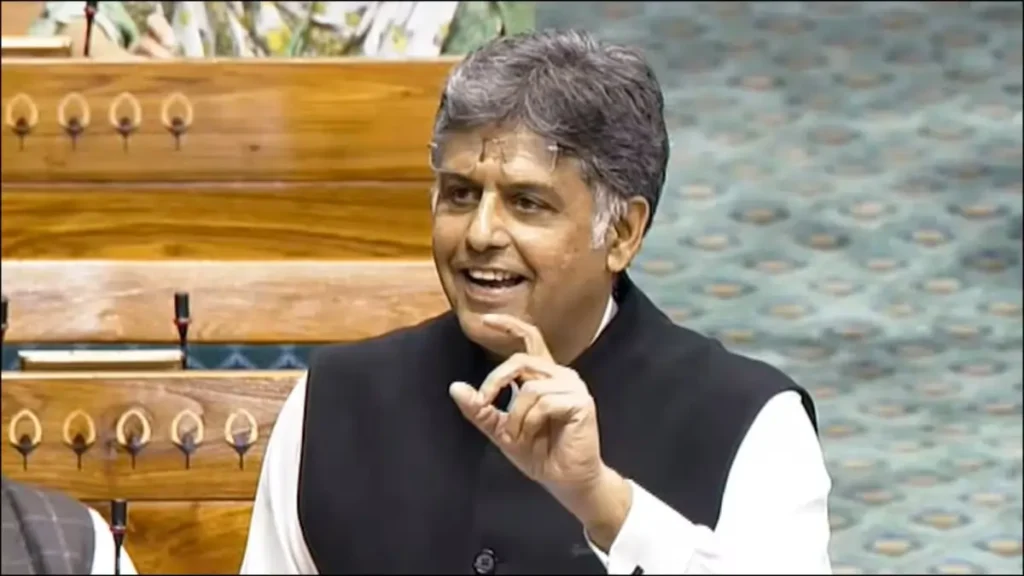
New Delhi: In a bold move to restore the soul of Indian parliamentary democracy, senior Congress MP Manish Tewari has, for the third time, introduced a Private Member’s Bill in the Lok Sabha that seeks to fundamentally overhaul the Tenth Schedule of the Constitution (the Anti-Defection Law) and free Members of Parliament from what he terms “whip-driven tyranny”.
Introduced on December 5, 2025, during the ongoing Winter Session, the Constitution (Amendment) Bill proposes that MPs can be disqualified for defying the party whip only on five specific occasions that directly affect the survival of the government:
- Confidence motions
- No-confidence motions
- Adjournment motions
- Money Bills
- Financial matters concerning the government
On all other legislation, motions, and resolutions, lawmakers would be allowed to vote according to their conscience, constituency interest, or independent judgement — without fear of losing their seat.
Speaking exclusively on the objective of the bill, Tewari told reporters, “This legislation asks a fundamental question: Who has primacy in a democracy — the voter who stands in the blazing sun for hours to elect a representative, or the political party that reduces that representative to a helot of the whip? The time has come to return conscience, constituency and common sense to the highest echelons of the legislature.”
From “Aaya Ram–Gaya Ram” to “Mega Mall Defections”
The Tenth Schedule was inserted through the 52nd Constitutional Amendment in 1985 under then Prime Minister Rajiv Gandhi to curb rampant floor-crossing famously known as “Aaya Ram–Gaya Ram” politics. Before 1985, party whips existed but carried no legal punishment. The 1985 law made defying the whip on any vote a ground for disqualification.
Tewari argues that forty years later, the cure has become worse than the disease.
“Defections were retail business in the 1960s. After the anti-defection law, they became wholesale in the 1990s. By the 2000s, especially post-2014, defections have turned into mega-mall activity — entire political parties are being bought and sold lock, stock and barrel,” the Chandigarh MP said.
He cited recent political crises, including the 2022 Maharashtra government collapse, as proof that the Tenth Schedule has failed to deliver political stability while simultaneously killing inner-party democracy and legislative deliberation.
How the Present Whip System Stifles Parliament
Tewari painted a grim picture of the current state of law-making:
- Laws are drafted by joint secretaries in ministries
- Ministers read out prepared statements
- Discussion is pro forma
- Treasury benches vote “yes” and opposition votes “no” because of the whip
- Individual research, global best practices, and genuine scrutiny have “become history”
The result, he said, is chronic absenteeism: “When Parliament assembles at 2 pm for government business, there is often no quorum. There is an unspoken pact between treasury and opposition not to ring the quorum bell — because MPs feel they have no real role left in law-making.”
Key Provisions of Manish Tewari’s 2025 Bill
The bill proposes the following concrete amendments to the Tenth Schedule:
- Disqualification only when a member votes or abstains against party direction on confidence/no-confidence motions, adjournment motions, money bills, or financial matters that affect government stability.
- In all other cases, members shall have complete freedom to vote as per conscience.
- Any whip issued on the five critical categories must be formally communicated to the Speaker/Chairman, who will announce it in the House and explicitly warn members that violation will lead to automatic cessation of membership.
- A disqualified member will have the right to appeal to the Speaker/Chairman within 15 days, and the appeal must be decided within 60 days.
- The bill also reiterates earlier demands for shifting defection adjudication from Speakers (widely criticised for partisanship) to independent judicial tribunals.
Tewari emphasised that the limited whip will protect government stability (the original intent of 1985 law) while liberating ordinary legislation from party coercion — a system he claims is unique to India and absent in any major democracy.
Echoes of Past Recommendations
The Congress MP reminded that the 170th Law Commission Report (1999) had recommended that whips should be restricted only to motions where the survival of the government is at stake — a suggestion that has gathered dust for over 25 years.
The National Commission to Review the Working of the Constitution (2002) and the Dinesh Goswami Committee (1990) had also favoured a narrower application of the anti-defection law.
Third Time’s the Charm? History of the Bill
This is not Tewari’s first attempt:
- First introduced in 2010 (15th Lok Sabha)
- Re-introduced in 2021 (17th Lok Sabha)
- Now tabled again in 2025 (18th Lok Sabha)
Like almost all Private Member’s Bills, the previous versions lapsed without discussion. In the history of independent India, only 14 Private Member’s Bills have ever become law — the last one in 1970.
Yet Tewari remains optimistic that growing public frustration with mechanical voting and declining parliamentary standards may finally force a debate.
Other Private Member’s Bills Introduced on the Same Day
During the same sitting on December 5, several other MPs introduced notable bills:
- Krishna Prasad Tenneti (TDP) – Right of Children to Free and Compulsory Education (Amendment) Bill, 2025
- Rajiv Pratap Rudy (BJP) – Reptile Bite (Prevention and Treatment) and Reptile Conservation Bill, 2025
- Supriya Sule (NCP-Sharad Pawar) – Paternity and Paternal Benefit Bill, 2025
- Supriya Sule also introduced the much-discussed Right to Disconnect Bill, 2025 and Code on Social Security (Amendment) Bill for gig workers
- Shashi Tharoor (Congress) – Bill to limit working hours and enforce Right to Disconnect under the Occupational Safety Code
Will the Bill Spark a National Debate on Parliamentary Reform?
Political analysts say that even if the bill has near-zero chance of passage in its current form, it has already achieved its larger purpose: reigniting a long-pending conversation on whether India’s anti-defection law, in its present avatar, has ended up hollowing out representative democracy.
As Tewari put it, “Parliament sometimes sits as a jury, sometimes decides privilege motions against its own members, sometimes approves financial grants running into lakhs of crores. How can all these functions be subjected to a whip? That reduces the highest legislative body to a farce.”
With Parliament’s effectiveness, falling attendance, and declining public trust in lawmakers becoming talking points across the country, the “End Whip Tyranny Bill”, as it is already being called on social media, may well become the catalyst for the most significant parliamentary reform debate in decades.
Whether the Treasury or Opposition benches are ready to surrender the iron grip of the whip remains to be seen. But for the first time in years, the question is firmly on the table: In a democracy, who should an elected representative truly represent — the voter, or the party high command?
FAQs
1. What exactly does Manish Tewari’s new Private Member’s Bill propose?
The bill seeks to amend the Tenth Schedule (Anti-Defection Law) so that an MP or MLA can be disqualified only if they defy the party whip on five specific matters:
- Confidence motion
- No-confidence motion
- Adjournment motion
- Money Bill
- Any financial matter that affects the stability of the government
On all other bills, resolutions, and motions, MPs and MLAs will have complete freedom to vote according to their conscience, constituency interest, or independent judgment without risking disqualification.
2. Will this bill completely abolish the party whip?
No. The party whip will remain fully in force for the five categories listed above because they directly affect the survival of the government. For everything else (normal legislation, private member bills, cut motions, privilege motions, etc.), the whip will have no legal or disqualification consequences.
3. Why is Manish Tewari calling the current system “whip-driven tyranny”?
According to Tewari, the 1985 Anti-Defection Law has turned elected representatives into “lobotomised numbers and dogmatic ciphers” who simply press YES or NO buttons as directed by party leadership. He argues this has killed genuine debate, research, and law-making in Parliament, leading to poor-quality laws and chronic absenteeism of MPs.
4. Has this idea been recommended before?
Yes, multiple times:
Dinesh Goswami Committee (1990) and the National Commission to Review the Working of the Constitution (2002) made similar suggestions. Tewari’s bill is the first serious legislative attempt in Parliament to implement these long-pending recommendations.
The 170th Law Commission Report (1999) recommended whips only when government survival is at stake.
5. Can a Private Member’s Bill like this actually become law?
Historically, the chances are extremely low — only 14 Private Member’s Bills have become law since 1952, the last one in 1970. However, even if the bill does not pass, it forces a national debate and puts pressure on the government. Tewari has already introduced the same bill in 2010 and 2021; the repeated introduction shows he is using it as a tool to keep the issue alive until public and political opinion forces reform.