
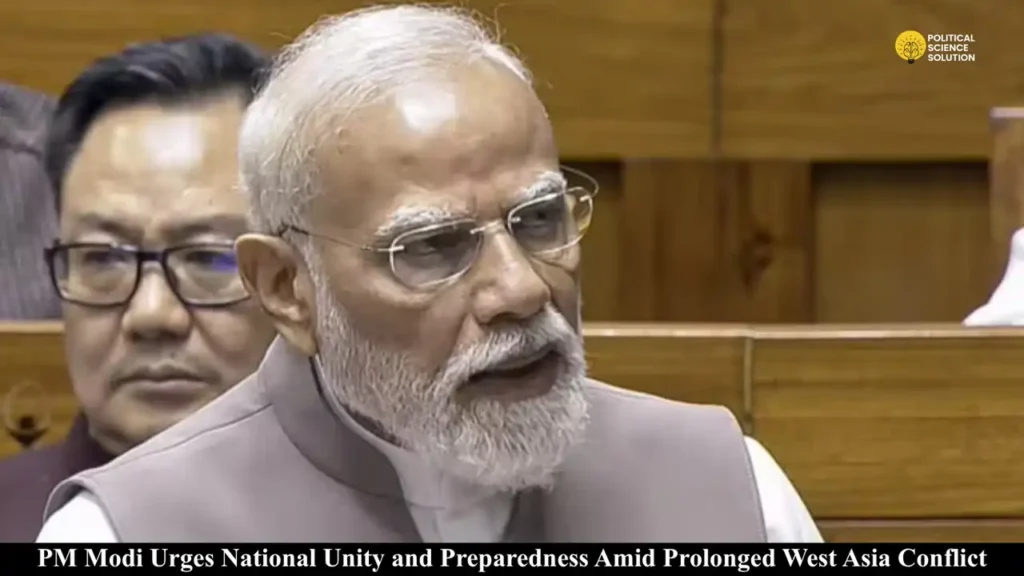
New Delhi: Prime Minister Narendra Modi on March 23, 2026, delivered a wide-ranging statement in the Lok Sabha, calling upon the nation to remain alert, united, and ready to face the long-term challenges arising from the ongoing conflict in West Asia. Comparing the current global situation to the difficult times of the COVID-19 pandemic, the Prime Minister emphasized collective resilience, patience, and perseverance as India’s core strength.
PM Modi’s Call for Unity Similar to COVID-19 Response
In his address during the second part of the Budget Session, Prime Minister Narendra Modi warned that the difficult circumstances created worldwide by the West Asia conflict are expected to persist for a long time. He urged every citizen and every state government to stand ready and united, just as the country had done during the COVID-19 pandemic.
“The effects of these difficult circumstances around the world due to this ongoing conflict are expected to last a long time. Therefore, we have to stay ready, we have to stay united. We stood united and faced such circumstances during the COVID pandemic also. In the same manner, we have to stay ready this time around as well. We have to face every challenge with patience and perseverance. This is our identity, our strength,” said PM Modi.
He stressed that when every government and every citizen of the country moves together, India can overcome every challenge.
Security Alerts and Action Against Disruptive Elements
Prime Minister Modi highlighted the internal security risks that emerge during such crises. He cautioned that certain elements try to take undue advantage of the situation by spreading lies, indulging in hoarding, or black marketing.
To counter these threats, all agencies responsible for maintaining law and order have been put on high alert. Coastal security, border security, cyber security, and the protection of strategic installations are being further strengthened.
The Prime Minister specifically requested state governments to strongly monitor and take strict action against people who spread fake news or engage in hoarding and black marketing during these demanding times.
“If every government and every citizen of the country moves together, then we can overcome every challenge,” he added.
Economic and Trade Challenges Facing India
PM Modi admitted that the West Asia crisis has created significant economic, national security, and humanitarian challenges for India. The conflict has already lasted more than three weeks and is adversely affecting the global economy and people’s lives.
The region is crucial for India because a large part of the country’s crude oil and gas requirements is met from West Asia. It is also an important trade route, particularly the Strait of Hormuz, through which nearly 20 per cent of the world’s energy is transported. Attacks on commercial ships and obstruction of international waterways are “wholly unacceptable,” the Prime Minister said.
India has extensive trade relations with the countries involved in or affected by the conflict. Additionally, nearly one crore Indians live and work in the Gulf countries, and a large number of Indian crew members serve on commercial ships in these seas. These factors make India’s concerns naturally greater.
India’s Diplomatic Efforts and Stance on the Conflict
Prime Minister Modi reaffirmed that India’s position has been clear from the beginning: expressing deep concern, advocating de-escalation, and opposing attacks on civilians and on energy and transport infrastructure.
He personally spoke with the heads of state of most West Asian countries in two rounds and urged them to reduce tensions and end the conflict. India is making continuous diplomatic efforts for the safe passage of Indian ships even in the war environment. Several Indian ships stuck in the Strait of Hormuz have reached India safely in recent days.
The Prime Minister emphasized that dialogue and diplomacy remain the only path to resolution. India’s effort is directed at encouraging all parties to arrive at a peaceful solution as soon as possible. He called for a unanimous voice from India’s Parliament on this crisis to send a strong message to the world.
Humanitarian Assistance and Evacuation of Indians
Since the war began, the government has provided necessary assistance to every Indian in the affected countries. All missions in the region are continuously engaged in helping workers, tourists, and others.
Tragically, some Indians have lost their lives and others have been injured. Families of the deceased are being provided necessary support, and the injured are receiving the best possible treatment.
The scale of the evacuation operation is significant. More than 3,75,000 Indians have safely returned to India since the conflict started, including approximately 1,000 from Iran, of whom over 700 are young medical students.
Energy Security and Diversification Strategy
One of the most reassuring aspects highlighted by PM Modi was India’s strengthened energy security. Over the past 11 years, the country has expanded its energy import sources from 27 countries to 41 countries, thereby reducing dependence on any single region.
India currently holds more than 5.3 million metric tonnes of strategic petroleum reserves and is working on arrangements for more than 6.5 million metric tonnes of additional storage. Domestic oil companies also maintain their own reserves.
Refining capacity has increased significantly. The government remains in constant touch with suppliers from different countries to ensure continued supplies of oil and gas. The Prime Minister noted that the energy diversification steps taken in the last decade have proven their worth in the current crisis.
Preparedness in Food, Fertiliser, and Power Sectors
On the agriculture front, PM Modi said the country is well prepared for food security because farmers have filled the food grain reserves. Adequate arrangements have been made for fertilisers to ensure smooth Kharif sowing even in an emergency.
In the power sector, despite rising summer demand, all power plants have adequate coal stock. India has produced more than 1 billion tonnes of coal for the second consecutive year. The country has also taken major steps towards renewable energy in the last decade.
The government is working with a comprehensive short-term, medium-term, and long-term strategy, supported by an Inter-Ministerial Group that meets daily to resolve every difficulty in the import-export chain.
Rahul Gandhi Criticizes Modi Government’s Foreign Policy
On March 24, 2026, Leader of Opposition in the Lok Sabha Rahul Gandhi sharply criticized the government. He described India’s foreign policy as “Prime Minister Narendra Modi’s personal policy” and called it a “universal joke.”
Gandhi said the Prime Minister seemed to have forgotten the tragedies the country witnessed during the COVID-19 pandemic and questioned the comparison between the pandemic and the West Asia crisis. He also attacked the Centre over reports that Pakistan may mediate between Iran and the United States. Rahul Gandhi further announced that he would miss the all-party meet on West Asia due to poll events in Kerala.
Government’s Commitment to Minimize Hardship for Citizens
Prime Minister Modi assured the House that the government is taking every possible step to ensure that ordinary families face as little trouble as possible. Strong economic fundamentals, sector-specific stakeholder consultations, and daily monitoring are helping India navigate the crisis effectively.
The Prime Minister expressed full confidence that through the joint efforts of the government and industry, the country will be able to face these circumstances successfully.
As the West Asia conflict continues, PM Modi’s detailed Lok Sabha address serves as both a realistic assessment of the long-term challenges and a strong call for national solidarity, vigilance, and proactive preparedness across all sectors.
FAQs
1. What did PM Modi say about the West Asia conflict in Lok Sabha?
Prime Minister Narendra Modi urged the nation to stay ready, united, and alert, comparing the long-term challenges of the West Asia conflict to the COVID-19 pandemic. He called for patience and perseverance to overcome economic, security, and humanitarian issues.
2. How is India preparing for the economic impact of the West Asia crisis?
India has diversified energy imports from 27 to 41 countries, built strategic petroleum reserves of over 5.3 million metric tonnes, ensured sufficient coal stocks, and maintained strong food grain reserves to minimize impact on fuel, power, and agriculture.
3. What security measures has the government announced amid the West Asia conflict?
All security agencies have been placed on high alert. Coastal, border, cyber, and strategic installation security is being strengthened. State governments have been asked to strictly monitor and act against fake news, hoarding, and black marketing.
4. How many Indians have been evacuated from the West Asia conflict zone?
More than 3,75,000 Indians have been safely brought back home since the war began, including around 1,000 from Iran, of whom over 700 are young medical students.
5. What was Rahul Gandhi’s reaction to PM Modi’s statement on the West Asia crisis?
Rahul Gandhi criticized India’s foreign policy as “Modi’s personal policy” and called it a “universal joke.” He questioned the comparison with the COVID-19 pandemic and announced he would miss the all-party meet due to poll events in Kerala.