

New Delhi: Prime Minister Narendra Modi concluded a highly productive two-day official visit to Malaysia from February 7 to 8, 2026, at the invitation of Malaysian Prime Minister Dato’ Seri Anwar Ibrahim. The visit, marking Prime Minister Modi’s third trip to Malaysia since 2015, delivered substantial momentum to the India-Malaysia Comprehensive Strategic Partnership (CSP), elevated in August 2024. The leaders held in-depth discussions across political, defence, economic, technological, cultural, and regional domains, culminating in the issuance of a detailed joint statement and the exchange of multiple bilateral instruments.
The visit underscored the enduring civilizational bonds, shared democratic values, and vibrant people-to-people connections between the two nations. With diplomatic relations dating back to 1957, India and Malaysia have cultivated a multi-dimensional relationship enriched by historical links, cultural heritage, and a significant Indian diaspora in Malaysia.
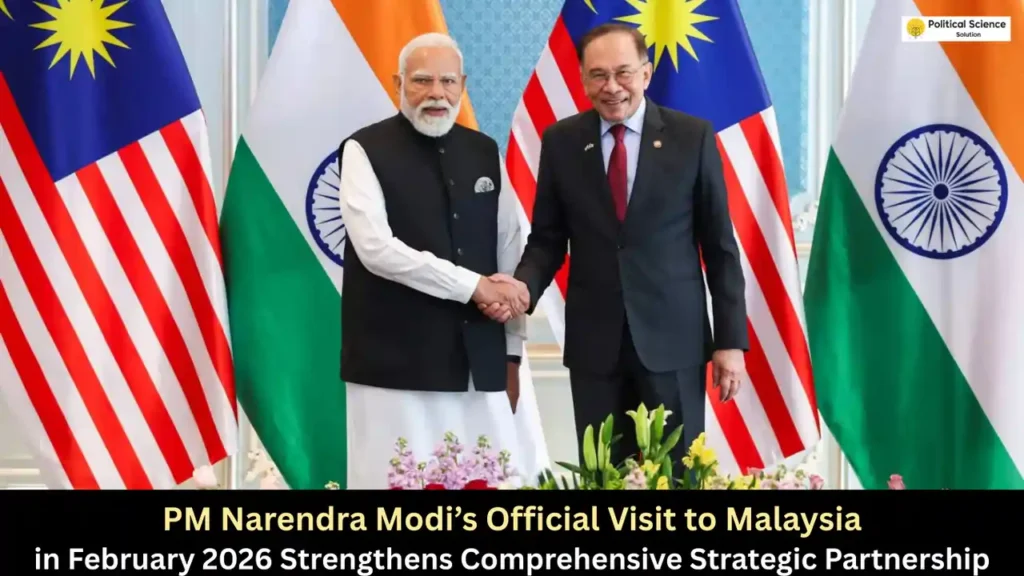
Warm Welcome and Ceremonial Reception
Upon arrival in Kuala Lumpur on February 7, Prime Minister Modi received a special welcome from Prime Minister Anwar Ibrahim, accompanied by senior Malaysian officials including the Minister of Human Resources and Deputy Foreign Minister. This gesture highlighted the importance Malaysia attached to the engagement.
On February 8, Prime Minister Modi was accorded a ceremonial welcome at the Perdana Putra Complex in Putrajaya, featuring a Guard of Honour. The leaders then engaged in official bilateral meetings at the Seri Perdana Complex, followed by an official luncheon hosted by Prime Minister Anwar Ibrahim in honor of his Indian counterpart. The atmosphere during the talks was described as warm, cordial, and productive, covering the entire spectrum of bilateral ties.
Prime Minister Modi expressed profound gratitude for the exceptional hospitality, noting that the welcome would remain etched in memory. He also met with Persons of Indian Origin (PIO) leaders, including ministers, MPs, and senators, appreciating their role in bolstering bilateral relations and Malaysia’s development. Additionally, he interacted with Malaysian business leaders and CEOs, and met an Indian National Army (INA) veteran, Jeyaraj Raja Rao, conveying India’s eternal gratitude for the sacrifices of Netaji Subhas Chandra Bose and the Azad Hind Fauj.
Key Outcomes: Exchange of Documents and Major Initiatives
The highlight of the visit was the witnessing of 11 bilateral documents aimed at institutionalizing cooperation. These included:
- Audio-Visual Co-Production Agreement to promote joint film and media projects, particularly benefiting Tamil cinema and cultural exchanges.
- MoU on Cooperation in Disaster Management between national disaster authorities.
- MoU on Combating and Preventing Corruption.
- Exchange of Letters renewing the MoU on United Nations Peacekeeping Cooperation.
- Exchange of Notes on Cooperation in Semiconductors.
- Ratification by Malaysia of the Framework Agreement on the International Big Cats Alliance (IBCA).
- MoU on Social Security Programs for Indian citizens as insured persons in Malaysia (between ESIC and PERKESO).
- Agreement on Vocational Education and Training (TVET).
- Exchange of Notes on Cooperation in National Security.
- Exchange of Notes on Healthcare and Medicine.
- Outcome document from the 10th India-Malaysia CEO Forum held on February 7 in Kuala Lumpur.
Additional announcements featured the establishment of an Indian Consulate General in Malaysia (likely in Penang to serve the diaspora), the creation of a dedicated Thiruvalluvar Centre at Universiti Malaya, operationalization of the Thiruvalluvar Chair of Indian Studies, and institution of Thiruvalluvar Scholarships for Malaysian nationals. An MoU between the Central Council for Research in Homeopathy (CCRH) and the University of Cyberjaya was also noted from prior engagement.
Defence and Security: Robust Collaboration Against Common Threats
Defence ties received significant emphasis, with satisfaction expressed over regular exchanges, exercises, and institutional mechanisms. Key advancements included the establishment of a Strategic Affairs Working Group (SAWG) and Su-30 Forum for air force cooperation on maintenance and expertise. The fifth edition of the joint military exercise Harimau Shakti (December 2025 in Rajasthan) was commended.
Both leaders condemned terrorism in all forms, including cross-border terrorism, advocating zero tolerance and comprehensive international efforts. Cooperation will extend to countering radicalisation, terrorist financing, emerging technologies’ misuse, and transnational organised crime via information sharing and capacity building. They reaffirmed commitments in the UN and FATF.
Maritime cooperation was highlighted through naval visits (e.g., INS Sahyadri to Kemaman and INS Sandhayak to Port Klang in 2025) and exercises like Samudra Laksamana, MILAN, and AIME. The inaugural Malaysia-India Security Dialogue was welcomed, alongside co-chairmanship of the ADMM-Plus Counter-Terrorism Working Group (2024-2027) and an upcoming Expert Working Group Table-Top Exercise in Malaysia.
Trade, Investment, and Economic Synergy
Bilateral trade growth was celebrated, with Malaysia as India’s third-largest ASEAN trading partner. Leaders stressed balanced, diversified trade under frameworks like MICECA and AITIGA (under review for mutual benefit). Priority sectors include semiconductors, digital economy, advanced manufacturing, infrastructure, renewable energy, healthcare, fintech, startups, AI, hospitality, and green technologies.
Local currency settlement (INR-MYR) was encouraged through RBI-Bank Negara Malaysia collaboration. Connectivity improvements, including air and maritime links, were prioritized, with Malaysia proposing enhanced air traffic rights.
The 10th CEO Forum’s outcome document was noted as complementary to government efforts.
Energy, Semiconductors, and Digital Frontiers
Energy cooperation spotlighted Malaysian firms’ investments in India’s solar and green hydrogen sectors, aligning with net-zero goals and India’s International Solar Alliance role.
Semiconductors emerged as a strategic pillar, with focus on workforce development, supply chain resilience, and institutional ties (e.g., IIT-Madras Global with Advanced Semiconductor Academy of Malaysia, IESA-MSIA). An Exchange of Notes formalized this synergy.
The Malaysia-India Digital Council (MIDC) was applauded for advancing fintech, e-governance, cybersecurity, AI, and Digital Public Infrastructure. NPCI International and PayNet’s payment linkage was welcomed for seamless remittances and business ease.
Food Security, Agriculture, and Sustainable Development
Malaysia reaffirmed its role as a reliable sustainable palm oil supplier, with collaboration in oil palm value chains and downstream products. Both sides committed to resilient supply chains for food security.
Shared dedication to biodiversity included IBCA cooperation for big cat conservation. Disaster resilience was strengthened via MoU and support for CDRI.
Education, Healthcare, Culture, Tourism, and People-to-People Ties
Leaders encouraged student/faculty exchanges, TVET initiatives, and programs like MTCP, ITEC, and Study in India. Worker and professional mobility will be streamlined.
Healthcare focused on affordable medicine, drug regulation, nursing recognition, and Traditional Indian Medicine deployment under ITEC.
Tourism was deemed a key pillar, welcoming Visit Malaysia 2026 and Incredible India campaigns, with visa liberalisation boosting flows. Air connectivity enhancements were agreed upon.
Cultural ties were celebrated, including Tamil language presence in Malaysia, nearly 20,000 Hindu temples and Gurudwaras, and the large diaspora (~2.75 million PIOs, ~2.9 million Indian-origin people).
Regional and Multilateral Alignment
The leaders supported ASEAN Centrality, AOIP implementation alongside IPOI, UNCLOS-based freedom of navigation, and peaceful dispute resolution. India appreciated Malaysia’s 2025 ASEAN Chairmanship and mutual support in multilateral fora, including UN reforms and India’s UNSC permanent membership bid.
Malaysia welcomed India’s 2026 BRICS Chairmanship and aspirations for full BRICS membership.
Prime Minister Modi extended an invitation to Prime Minister Anwar Ibrahim for a future visit to India.
This visit not only reinforced historical affinities but positioned India-Malaysia relations as a model of strategic synergy in the Indo-Pacific, with tangible benefits across sectors for mutual prosperity and regional stability.
FAQs
1. What is the main achievement of PM Modi’s February 2026 visit to Malaysia?
The visit further strengthened the India-Malaysia Comprehensive Strategic Partnership (elevated in August 2024). It resulted in the exchange of 11 bilateral documents, establishment of new mechanisms like the Strategic Affairs Working Group (SAWG) and Su-30 Forum, formal launch of the Malaysia-India Digital Council (MIDC), NPCI-PayNet cross-border payment linkage, and deeper cooperation in semiconductors, defence, renewable energy, palm oil, and counter-terrorism.
2. Which new defence and security initiatives were announced during the visit?
Key announcements included the creation of the Strategic Affairs Working Group (SAWG) and Su-30 Forum for air force maintenance and technical cooperation, successful completion of the 5th Harimau Shakti joint military exercise (December 2025), co-chairmanship of the ADMM-Plus Counter-Terrorism Working Group (2024–2027), an upcoming Expert Working Group Table-Top Exercise in Malaysia in 2026, and strengthened maritime cooperation through naval visits and exercises like Samudra Laksamana, MILAN, and AIME. Both leaders reiterated zero tolerance for terrorism in all forms, including cross-border terrorism.
3. How will the visit benefit trade, investment, and technology cooperation?
Both countries focused on balanced trade under MICECA and the ongoing AITIGA review. Priority sectors include semiconductors (workforce development, supply-chain resilience, institutional tie-ups), digital economy (MIDC platform, fintech, AI, DPI), renewable energy and green hydrogen (PETRONAS/Gentari investments), local currency settlement (INR-MYR via RBI–Bank Negara Malaysia), and advanced manufacturing. The 10th India-Malaysia CEO Forum outcome document was also welcomed.
4. What cultural and people-to-people initiatives were highlighted?
The visit emphasized the large Indian diaspora (~2.75 million PIOs, ~2.9 million people of Indian origin), strong Tamil cultural presence, and nearly 20,000 Hindu temples and Gurudwaras in Malaysia. Key steps included operationalizing the Thiruvalluvar Chair and establishing the Thiruvalluvar Centre at Universiti Malaya, launching Thiruvalluvar Scholarships for Malaysian nationals, an Audio-Visual Co-Production Agreement (especially benefiting Tamil films), streamlined worker/professional mobility, tourism promotion (Visit Malaysia 2026 and Incredible India), and enhanced air connectivity.
5. What regional and multilateral positions did India and Malaysia reaffirm?
Both leaders supported ASEAN Centrality, implementation of the ASEAN Outlook on the Indo-Pacific (AOIP) alongside India’s Indo-Pacific Oceans Initiative (IPOI), freedom of navigation and overflight under UNCLOS 1982, peaceful dispute resolution, UN reforms, and India’s permanent membership in a reformed UN Security Council (Malaysia reiterated support). Malaysia welcomed India’s 2026 BRICS Chairmanship and expressed aspiration for full BRICS membership. They also committed to biodiversity conservation via the International Big Cats Alliance (IBCA) and disaster resilience through the Coalition for Disaster Resilient Infrastructure (CDRI).