

New Delhi: The 11th edition of the Raisina Dialogue, India’s flagship conference on geopolitics and geo-economics, wrapped up today in New Delhi after three days of intensive discussions on a rapidly fragmenting world order. Held from March 5 to 7 under the evocative theme “Saṁskāra – Assertion, Accommodation, Advancement”, the event served as a critical platform for global leaders, policymakers, experts, and youth to grapple with pressing issues ranging from technological disruption and climate geopolitics to maritime security and economic resilience.
Organized jointly by the Observer Research Foundation (ORF) and India’s Ministry of External Affairs, the Dialogue attracted around 2,700 in-person participants from 110 countries, including ministers, former heads of state and government, parliamentarians, military commanders, industry leaders, technology innovators, academics, journalists, strategic scholars, and think tank representatives. Millions more followed the proceedings digitally across various platforms.
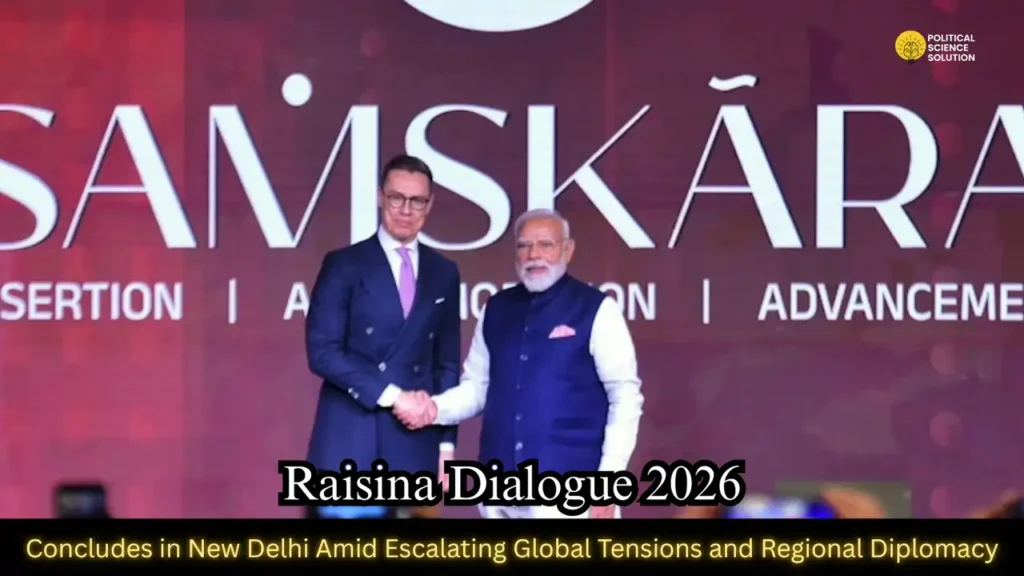
Prime Minister Narendra Modi formally inaugurated the conference on March 5, with Finland’s President H.E. Dr. Alexander Stubb attended as Chief Guest and delivered the keynote address. The theme “Saṁskāra” drew from civilizational roots, emphasizing the need for nations to assert their identities, accommodate differences, and advance through refinement in an era of profound change.
Six Thematic Pillars Guide In-Depth Deliberations
The conference structured its agenda around six core pillars that captured the multifaceted challenges of the current global landscape:
- Contested Frontiers: Power, Polarity, and Periphery — Examining shifting power balances and regional tensions.
- Repairing the Commons: New Groups, New Guardians, New Avenues — Addressing shared global resources and governance reforms.
- White Whale: The Pursuit of Agenda 2030 — Progress toward sustainable development goals amid setbacks.
- The Eleventh Hour: Climate, Conflict, and the Cost of Delay — Intersections of climate action, geopolitical rivalries, and urgent timelines.
- Tomorrowland: Towards a Tech-topia — Navigating AI risks, digital sovereignty, semiconductor dependencies, and emerging technologies.
- Trade in the Time of Tariffs: Recovery, Resilience, Reinvention — Adapting to economic coercion, supply chain vulnerabilities, and new trade paradigms.
Key sessions highlighted India’s Digital Public Infrastructure as a model for inclusive growth, the future of transatlantic security and NATO, deterrence dynamics in the Taiwan Strait, defense production gaps, UN Security Council reform needs, Africa’s demographic dividend, Latin America’s role in critical minerals for AI economies, and connectivity initiatives such as the India-Middle East-Europe Economic Corridor. Discussions also touched on maritime threats in the Indian Ocean and Red Sea, including risks to undersea cables and autonomous systems.
India used the forum to project its vision of Viksit Bharat 2047 — becoming a developed nation by the 100th anniversary of independence — while positioning itself as a bridge between the Global North and South.
Jaishankar’s Bilateral Engagements Reinforce Neighbourhood First and Beyond
External Affairs Minister Dr. S. Jaishankar held a series of productive bilateral meetings on the sidelines, underscoring India’s commitment to regional stability and strategic partnerships.
- With Sri Lanka’s Foreign Minister Vijitha Herath, talks focused on bilateral ties and regional dynamics, guided by Vision MAHASAGAR and Neighbourhood First.
- Bhutan’s Foreign Minister Lyonpo D.N. Dhungyel reaffirmed dedication to deepening the special India-Bhutan relationship.
- Mauritius Foreign Minister Dhananjay Ritish Ramful stressed further strengthening strategic cooperation.
- Kenya’s Musalia W. Mudavadi explored unlocking full bilateral potential.
- Malta’s Foreign Affairs Minister Ian Borg offered insights on the maritime sector, which Jaishankar welcomed.
- Seychelles Foreign Minister Barry Faure reviewed implementation of recent high-level commitments.
- Rwanda’s Foreign Minister Olivier J.P. Nduhungirehe emphasized advancing economic and digital collaboration.
These interactions highlighted India’s active engagement in the Indian Ocean region and Africa amid broader uncertainties.
West Asia Crisis Casts Long Shadow Over Proceedings
The Dialogue occurred against the backdrop of a sharply escalating Iran-US-Israel conflict, following the February 28 killing of Iran’s Supreme Leader Ayatollah Ali Khamenei in an Israel-U.S. strike. Iran retaliated with attacks on Israeli targets and U.S. bases in Gulf nations including the UAE, Bahrain, Kuwait, Jordan, and Saudi Arabia, fueling fears of a wider, prolonged war.
A dramatic escalation unfolded on March 4 when a U.S. Navy submarine torpedoed and sank the Iranian frigate IRIS Dena in the Indian Ocean, approximately 40 nautical miles off Sri Lanka’s southern coast near Galle. The vessel, a Moudge-class frigate, had participated in India’s Milan multilateral naval exercise and was returning home in a non-combat, unarmed configuration. The attack — using a Mark 48 torpedo — marked the first U.S. submarine torpedo sinking of an enemy warship since World War II and resulted in at least 87 Iranian sailors killed, with Sri Lankan forces rescuing survivors and recovering bodies.
Iran’s Deputy Foreign Minister Saeed Khatibzadeh, participating in the Raisina Dialogue, condemned the incident forcefully during sidelines statements and sessions. Describing the IRIS Dena as an “unarmed” ceremonial vessel invited by India, he called the sinking a grave violation of international law that “cannot go with impunity.” He also criticized the U.S. for Khamenei’s assassination, accusing Washington of “cherry-picking” international norms and setting dangerous precedents for targeting state leaders.
Khatibzadeh framed Iran’s response as “ultimate resistance” in an “existential” struggle, vowing to fight to the last resources while portraying it as a stand for regional stability, history, and international law. He highlighted deep Indo-Persian civilizational ties and expressed optimism that halting aggression could enable new regional dynamics. India issued condolences over Khamenei’s death, drawing domestic scrutiny for its restrained stance.
Final Day Emphasizes Resilience and Future Order
Day 3 sessions concentrated on economic recovery, supply chain security, maritime challenges, and envisioning a balanced global order. Participants debated financial mechanisms for climate adaptation, technological transformation’s human impact, and pathways to inclusive multilateralism.
As the Raisina Dialogue 2026 concluded, it solidified its reputation — often compared to the Munich Security Conference — as a vital arena for candid exchange amid assertion of sovereign priorities, accommodation of divergent views, and collective advancement in a turbulent era. With West Asia tensions spilling into the Indian Ocean and technological rivalries intensifying, the conference’s insights are poised to shape ongoing policy responses worldwide.
FAQs
1. What is the Raisina Dialogue, and what was its theme in 2026?
The Raisina Dialogue is India’s premier annual conference on geopolitics and geo-economics, organized by the Observer Research Foundation (ORF) in partnership with the Ministry of External Affairs. Held in New Delhi, it brings together global leaders, ministers, experts, academics, industry figures, and youth to discuss pressing international challenges. The 11th edition ran from March 5–7, 2026, under the theme “Saṁskāra – Assertion, Accommodation, Advancement”. This civilizational concept emphasizes nations asserting their identities, accommodating differences and contradictions, and advancing through refinement and collective progress in a turbulent world.
2. Who were the key participants and how was the event inaugurated?
The conference featured around 2,700 in-person attendees from 110 countries, including ministers, former heads of state/government, parliamentarians, military commanders, technology leaders, and scholars. Prime Minister Narendra Modi inaugurated the Dialogue on March 5. Finland’s President H.E. Dr. Alexander Stubb attended as Chief Guest and delivered the keynote address. Discussions spanned six thematic pillars: Contested Frontiers, Repairing the Commons, White Whale (Agenda 2030), The Eleventh Hour (climate and conflict), Tomorrowland (tech future), and Trade in the Time of Tariffs.
3. What bilateral meetings did External Affairs Minister Dr. S. Jaishankar hold during the event?
On the sidelines, Dr. Jaishankar engaged with foreign ministers from several nations to strengthen ties under India’s Neighbourhood First and extended partnerships:
• Sri Lanka’s Vijitha Herath (focused on bilateral ties, regional issues, guided by Vision MAHASAGAR and Neighbourhood First).
• Bhutan’s Lyonpo D.N. Dhungyel (reaffirmed unique partnership).
• Mauritius’ Dhananjay Ritish Ramful (enhanced strategic partnership).
• Kenya’s Musalia W. Mudavadi (realizing full potential of relations).
• Malta’s Ian Borg (insights on maritime industry).
• Seychelles’ Barry Faure (follow-up to recent Presidential visit).
• Rwanda’s Olivier J.P. Nduhungirehe (economic and digital cooperation). These meetings highlighted India’s active regional diplomacy amid global uncertainties.
4. What major global crisis overshadowed the Raisina Dialogue 2026?
The event took place against the backdrop of the escalating 2026 Iran–US–Israel conflict, which began with joint US-Israeli strikes on February 28 that killed Iran’s Supreme Leader Ayatollah Ali Khamenei and other senior officials. Iran launched widespread retaliatory attacks on Israel and US bases in Gulf countries (UAE, Bahrain, Kuwait, Jordan, Saudi Arabia). A dramatic escalation occurred on March 4 when a US Navy submarine torpedoed and sank the Iranian frigate IRIS Dena in the Indian Ocean off Sri Lanka’s coast. The vessel, returning from India’s MILAN multilateral naval exercise in a non-combat/unarmed configuration, suffered at least 87 sailor deaths. Iran’s Deputy Foreign Minister Saeed Khatibzadeh, present at Raisina, condemned it as a violation of international law that “cannot go with impunity,” framing Iran’s stance as “ultimate resistance.”
5. What were the key discussion topics on the final day, and what is the lasting significance of Raisina Dialogue 2026?
The concluding day (March 7) emphasized economic resilience, maritime security (including undersea cables and autonomous systems), supply chain vulnerabilities, trade amid tariffs, climate finance, technological transformation, and the future global order. Topics included transatlantic security shifts, NATO’s role, Taiwan Strait deterrence, UN Security Council reforms, Africa’s demographics, Latin America’s critical minerals, and India’s Viksit Bharat 2047 vision. Often compared to the Munich Security Conference, the 2026 edition reinforced its role as a vital platform for navigating assertion of national interests, accommodation of diverse views, and advancement toward stability—especially timely amid West Asia’s spillover into the Indian Ocean and intensifying great-power rivalries.