

The Strait of Hormuz is the world’s most critical maritime chokepoint, acting as the only sea outlet from the oil-rich Persian Gulf to the open ocean. As of April 2026, it stands at the centre of a major global energy crisis triggered by escalating regional conflict.
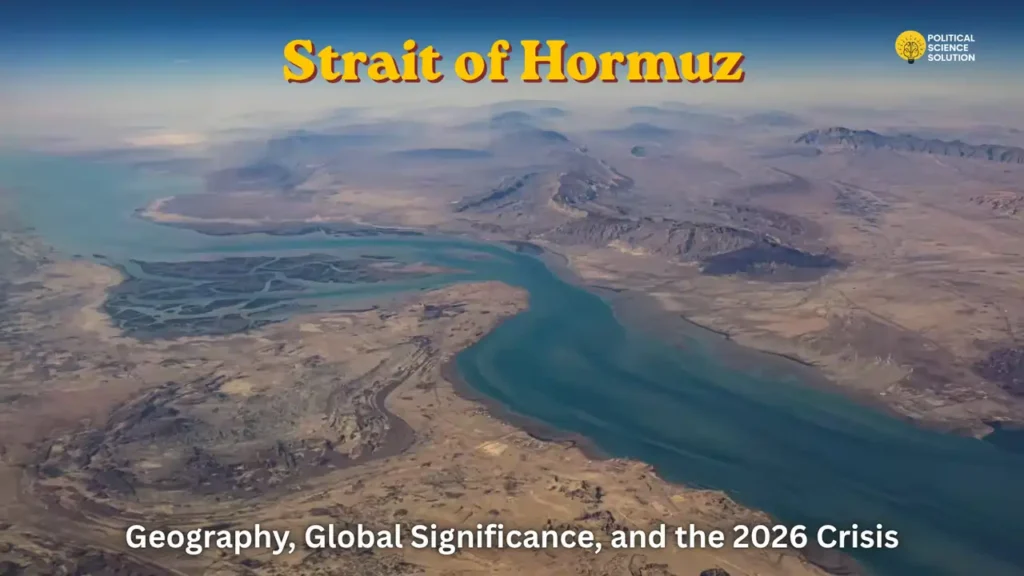
Geography and Physical Characteristics
The strait lies between Iran to the north and the Musandam Peninsula (an exclave of Oman) along with the United Arab Emirates to the south.
It stretches roughly 167 km (104 miles) in length. At its narrowest point, the width is about 33 km (21 miles), but the usable navigation space is far smaller due to shipping regulations.
To manage heavy maritime traffic, vessels follow a Traffic Separation Scheme (TSS) consisting of:
- Two shipping lanes, each about 3.2 km (2 miles) wide
- One inbound and one outbound lane
- A 2-mile-wide buffer zone between them
Depth ranges from 60 to 100 metres, sufficient for massive oil tankers such as Ultra Large Crude Carriers (ULCCs), while deeper sections (up to 200 metres) lie closer to the Omani side.
Global Economic Lifeline
The Strait of Hormuz is indispensable to the global energy system:
- Oil Flow: Around 20–21 million barrels per day pass through it
- ~25% of global seaborne oil trade
- ~20% of total global oil consumption
- Natural Gas: About 20% of global LNG exports, largely from Qatar
- Fertilizers: Nearly 30% of global trade in urea and ammonia transits here
A large majority—over 80%—of this energy supply is destined for Asian economies, particularly China, India, Japan, and South Korea.
Because global oil demand is relatively inelastic, even small disruptions or threats in the strait can trigger sharp price increases. For instance, in March 2026, Brent crude prices surged beyond $117 per barrel amid rising tensions.
Strategic and Military Importance
The strait’s shipping lanes lie largely within the territorial waters of Iran and Oman, yet it is governed internationally under the United Nations Convention on the Law of the Sea.
- It is classified as an international waterway where ships enjoy “transit passage” rights, allowing uninterrupted movement.
- Iran, which has signed but not ratified UNCLOS, sometimes challenges this by asserting stricter “innocent passage” rules, giving it greater control over naval movement.
The region is heavily militarized. The United States Fifth Fleet, based in Bahrain, along with multinational coalitions such as Combined Task Force 150, patrol the area to ensure freedom of navigation.
Historical and Geological Context
The Strait of Hormuz has been a vital trade corridor for over 4,000 years, linking civilizations such as the Indus Valley and Mesopotamia through the exchange of goods like lapis lazuli and spices.
In 1507, the Portuguese seized Hormuz Island to dominate maritime trade, but were expelled in 1622 by a joint force of Safavid Persia and the English East India Company. The famed traveler Marco Polo once described Hormuz as the “jewel in the ring of the world” due to its wealth and strategic importance.
Geologically, the strait was formed by the subduction of the Arabian Plate beneath the Eurasian Plate, a process that also created the Zagros Mountains and continues to gradually narrow the passage over time.
The 2026 Crisis: A De Facto Closure
As of March–April 2026, the strait is experiencing a near-total disruption of normal operations:
- Blockade Conditions: Following the outbreak of the 2026 Iran conflict, Iran has reportedly deployed naval mines and issued warnings restricting ship passage.
- Insurance Breakdown: War-risk premiums have surged by 400–600%, leading insurers to withdraw coverage and causing maritime traffic to fall by over 90%.
- Limited Alternatives: Existing bypass pipelines—such as Saudi Arabia’s East-West Pipeline and the UAE’s Habshan–Fujairah line—can redirect only 3.5–5.5 million barrels per day, far below the normal volume moving through the strait.
This mismatch has stranded a significant portion of global energy supply, intensifying volatility in international markets and underscoring the strait’s unmatched strategic importance.
Overall the Strait of Hormuz is not merely a narrow waterway but a critical artery of the global economy, where geography, geopolitics, and energy security intersect. Its vulnerability makes it one of the most consequential strategic points in the modern world.
FAQs
1. What exactly is the Strait of Hormuz and why is it so important?
The Strait of Hormuz is the only sea passage connecting the oil-rich Persian Gulf to the open ocean, located between Iran to the north and Oman/UAE to the south. It is the world’s most critical energy chokepoint, with 20–21 million barrels of oil, 20% of global LNG, and nearly 30% of fertilizer trade passing through it daily — making it indispensable for global energy security.
2. How has the 2026 Iran conflict affected shipping in the strait?
Iran has deployed naval mines and issued warnings restricting passage, turning the strait into a de facto blockade. This has caused maritime traffic to drop over 90%, war-risk insurance premiums to surge 400–600%, and most commercial tankers to avoid the route entirely.
3. Can any pipelines replace the Strait of Hormuz?
No. Existing bypass pipelines (Saudi East-West and UAE’s Habshan–Fujairah) can only handle 3.5–5.5 million barrels per day — less than 30% of the strait’s normal volume. This leaves the majority of Persian Gulf exports stranded.
4. What is the historical and geological significance of the strait?
For over 4,000 years it has been a major trade route between ancient civilizations. Marco Polo called it the “jewel in the ring of the world.” Geologically, it was formed by the subduction of the Arabian Plate under the Eurasian Plate — the same forces creating the Zagros Mountains — and is slowly narrowing over time.
5. Who controls the Strait of Hormuz and what are the legal issues?
Shipping lanes lie mostly in Iranian and Omani territorial waters. While UNCLOS grants “transit passage” rights, Iran (which signed but did not ratify the treaty) prefers stricter “innocent passage” rules. The U.S. Fifth Fleet and international coalitions patrol the area to protect freedom of navigation.
As the 2026 crisis continues to unfold, the Strait of Hormuz stands as a powerful reminder of how a relatively small geographic feature can hold disproportionate influence over the global economy. Diplomats, energy traders, and military strategists are closely monitoring developments, knowing that the reopening — or further closure — of this vital waterway could determine economic fortunes for years to come.