
New Delhi, February 21, 2026 – In a pointed and wide-ranging critique, the Supreme Court of India has sharply rebuked state governments for their growing reliance on indiscriminate “freebies” – especially announcements made close to elections – asserting that such practices are eroding fiscal responsibility, discouraging productive work, and diverting crucial funds away from sustainable nation-building efforts.
The observations came during a February 19, 2026 hearing in the case of Tamil Nadu Power Distribution Corporation Limited v. Union of India. A three-judge bench comprising Chief Justice of India Surya Kant, Justice Joymalya Bagchi, and Justice Vipul M. Pancholi was examining a writ petition filed by the Tamil Nadu Power Distribution Corporation Limited (TNPDCL), a state-run entity under the DMK-led government.
Challenge to Electricity Rules Sparks Broader Debate
At the heart of the petition lies TNPDCL’s challenge to Rule 23 of the Electricity (Amendment) Rules, 2024. This provision mandates that electricity tariffs must be cost-reflective, ensuring no significant gap persists between the approved Annual Revenue Requirement (ARR) and the revenue generated from approved tariffs, barring exceptional circumstances like natural calamities.
The petitioner argued that enforcing this rule would impose an “exponential tariff shock” on consumers and place an “unsustainable burden” on the state exchequer. TNPDCL highlighted that Tamil Nadu already absorbs a massive annual subsidy gap – reportedly exceeding ₹50,000 crore for certain categories – to keep power affordable. Senior advocates Gopal Subramanium and P. Wilson represented the petitioner.
The bench, however, redirected attention to the proposed policy of supplying free electricity to all consumers, regardless of income or ability to pay. The judges questioned the abrupt timing of such announcements, which often disrupt regulatory planning and force distribution companies into last-minute tariff revisions and budget adjustments.
Chief Justice Questions Indiscriminate Distribution
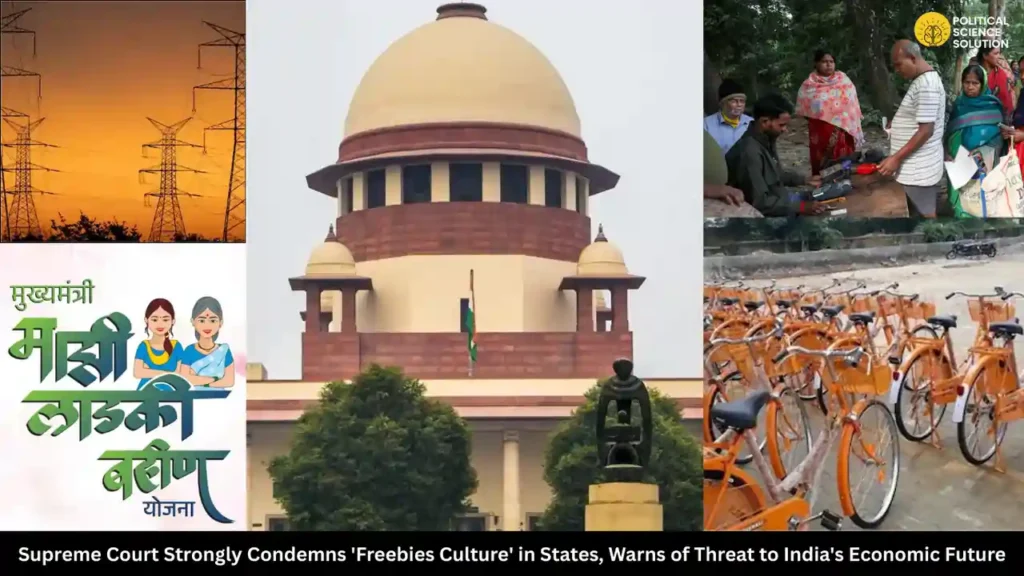
Chief Justice Surya Kant voiced deep concern over the nationwide pattern. He asked pointedly: “What kind of culture are we developing pan-India?” He illustrated the escalation: “If you start giving free food from the morning… then a free cycle… then free electricity… and now we are reaching a stage where we transfer cash into people’s accounts directly… imagine.”
While acknowledging the state’s duty to support the genuinely needy – such as providing free education to children who cannot afford it or aid to the marginalized – the CJI stressed that blanket schemes benefiting even affluent households amount to an “appeasement policy” rather than genuine welfare. “It is understandable to provide, as part of a welfare system, for those who cannot pay. But if you distribute without distinction between those who can afford and those who can’t…”
He further warned that such largesse risks fostering a mindset that rewards dependency over effort, potentially creating disincentives to work. “If you start giving free food from morning to evening then free cycle, then free electricity then who will work and then what will happen to the work culture,” he remarked.
Fiscal Discipline and Development Priorities
The bench emphasized prudent resource allocation. Chief Justice Kant suggested that states – even revenue-surplus ones – should earmark at least 25 per cent of annual revenue for infrastructure, hospitals, schools, and colleges. “Sometimes we are really disturbed. Even if you are a revenue surplus state… is it not your obligation to spend for development for the overall public… Instead, you keep on distributing things at the time of election.”
Justice Bagchi reinforced the call for transparency: “It’s not one State we are talking about, it’s about all States. It is a planned expenditure. Why don’t you make Budget proposals and give justification that this is my outlay on unemployment of people?”
The court lamented that many states, despite running deficits, prioritize short-term populist measures over long-term growth. “Not a single penny is left for development because of such policies by state governments. It is the problem of all states, not just yours,” the bench observed.
Broader Concerns: Fiscal Strain, Environmental Risks, Institutional Damage
The critique aligns with earlier warnings. The Economic Survey 2025-26 noted that states’ combined gross fiscal deficit rose from 2.6% of GDP in FY22 to 3.2% in FY25, partly fueled by such expenditures. Funds meant for infrastructure and job creation are instead channeled into open-ended transfers that deliver immediate political gains but limited lasting benefits.
Environmental and institutional fallout was also highlighted. A Comptroller and Auditor General (CAG) report previously linked free agricultural electricity to accelerated groundwater depletion in states like Punjab. Loan waivers and subsidized power have similarly weakened banks and power distribution companies (DISCOMs).
The Reserve Bank of India distinguishes between merit goods – education, healthcare – with broad, enduring advantages, and non-merit freebies that offer short-term relief at high fiscal cost.
Historical Context and Past Judicial Views
This is not the Supreme Court’s first intervention. In Subramaniam Balaji v. Tamil Nadu (2013), the court held that election manifesto promises of freebies do not constitute bribery under the Representation of the People Act, nor can courts dictate budgetary priorities. Yet it urged focusing on employment generation as authentic welfare.
More recently, in February 2025, Justice B.R. Gavai (retired November 2025) critiqued Maharashtra’s ‘Ladki Bahin‘ scheme (monthly ₹1,500 to eligible women) for potentially eroding work ethic and fostering a “class of parasites.” In January 2026, Chief Justice Kant flagged excessive freebie spending as a matter requiring serious examination to avoid burdens on future generations.
The Election Commission has required parties since 2014 and 2022 to explain the rationale, funding, and feasibility of poll promises.
Political Dimensions and Way Forward
The ‘freebies’ issue remains politically charged. Prime Minister Narendra Modi has accused opposition parties of “revdi” (sweets) politics to buy votes. Critics counter that such measures ease hardships amid inflation and job scarcity, representing legitimate public spending.
The bench directed Tamil Nadu to file a reply detailing funding for its free electricity promise and issued notice to the Centre and others. While clarifying the concern is pan-India, the directive signals greater judicial scrutiny of fiscal prudence in welfare delivery.
Models like Mexico’s Progresa and Brazil’s Bolsa Família – conditional cash transfers tied to school attendance and health check-ups – offer lessons in balancing equity with accountability and long-term gains in productivity and income.
As elections approach in several states, including poll-bound Tamil Nadu, the Supreme Court’s intervention underscores an urgent need for political parties to shift from competitive populism toward investments that strengthen India’s economic foundation and empower citizens through opportunity rather than perpetual handouts.
FAQs
1. What exactly did the Supreme Court say about freebies on February 19, 2026?
The Supreme Court, led by Chief Justice Surya Kant (with Justices Joymalya Bagchi and Vipul M. Pancholi on the bench), strongly condemned the practice of states announcing indiscriminate freebies — such as free electricity, food, cycles, or cash transfers — especially ahead of elections. The Court warned that providing such benefits without distinguishing between those who can afford to pay and those who cannot amounts to an “appeasement policy” rather than genuine welfare. It emphasized that this trend hampers long-term economic development, strains state finances, diverts funds from infrastructure, hospitals, schools, and job creation, and risks creating a culture that discourages work. The bench remarked, “What kind of culture are we developing pan-India?” and noted that even revenue-surplus states should allocate at least 25% of revenue to development instead of election-time largesse.
2. Why was the Supreme Court hearing this matter, and what triggered the comments?
The observations arose during a hearing on a writ petition filed by Tamil Nadu Power Distribution Corporation Limited (TNPDCL) challenging Rule 23 of the Electricity (Amendment) Rules, 2024. This rule requires electricity tariffs to be largely cost-reflective, limiting large gaps between approved revenue requirements and actual tariff collections (except in cases like natural disasters). TNPDCL argued the rule is arbitrary, unconstitutional, and violates the Electricity Act, 2003, as it would force sharp tariff hikes and burden the state exchequer, especially since Tamil Nadu already absorbs massive subsidies (reportedly over ₹50,000 crore annually for certain categories). The Court shifted focus to Tamil Nadu’s proposal for universal free electricity (regardless of income), questioning its sudden announcement, funding source, and why it was not planned in advance or justified in the budget.
3. What are the main concerns raised by the Supreme Court regarding freebies?
The Court highlighted several risks:
Broader issues — The problem affects all states, not just one, and sudden announcements disrupt regulatory processes for power utilities. The bench urged states to treat such schemes as planned budgetary expenditure with clear justification.
Fiscal burden — States run deficits yet prioritize short-term handouts over sustainable investments.
Impact on development — Funds are diverted from infrastructure, education, healthcare, and employment generation, leaving “not a single penny” for nation-building.
Work culture and dependency — Indiscriminate benefits could reduce incentives to work and foster dependency.
Lack of distinction — Benefits reach affluent people who can pay, turning welfare into appeasement.
4. Has the Supreme Court commented on freebies before, and what is the legal position?
Yes, this builds on earlier views. In the 2013 Subramaniam Balaji v. Tamil Nadu case, the Court ruled that poll promises of freebies do not amount to bribery or corruption, and courts cannot dictate how governments spend public money. However, it encouraged focusing on employment creation as real welfare. More recently, in 2025 observations (including by retired Justice B.R. Gavai), the Court criticized schemes like Maharashtra’s ‘Ladki Bahin’ for potentially creating a “class of parasites” and discouraging work. The Election Commission has also mandated since 2014 and 2022 that parties disclose funding and rationale for promises. The 2026 remarks stress revisiting policies to avoid unsustainable burdens on future generations.
5. What happens next in this case, and what could change for states?
The Supreme Court directed Tamil Nadu to file a detailed reply explaining how it plans to fund the free electricity promise. It issued notices to the Union government and other parties. While the Court clarified its concern is nationwide (not targeted at one state), the hearing signals increased judicial scrutiny of fiscal prudence in welfare schemes. Experts suggest this could push states toward more targeted, conditional models (e.g., cash transfers linked to education or health, as in Brazil’s Bolsa Família or Mexico’s Progresa). It may also influence political discourse ahead of elections in states like Tamil Nadu, encouraging greater transparency and a shift from competitive populism to investments in long-term growth and employment.