

New Delhi: More than twelve years after the Supreme Court mandated the introduction of the None of the Above (NOTA) option on Electronic Voting Machines, the country’s top court has openly questioned whether the provision has delivered any meaningful change to the quality of political candidates or the overall health of Indian democracy.
During a hearing held on February 24, 2026, a bench comprising Chief Justice of India Surya Kant and Justice Joymalya Bagchi made pointed observations while hearing a Public Interest Litigation (PIL) filed by the Vidhi Centre for Legal Policy. The petition challenges the long-standing practice of declaring candidates elected unopposed when only one valid nomination is filed, arguing that such uncontested wins deny voters the fundamental right to exercise NOTA even in single-candidate constituencies.
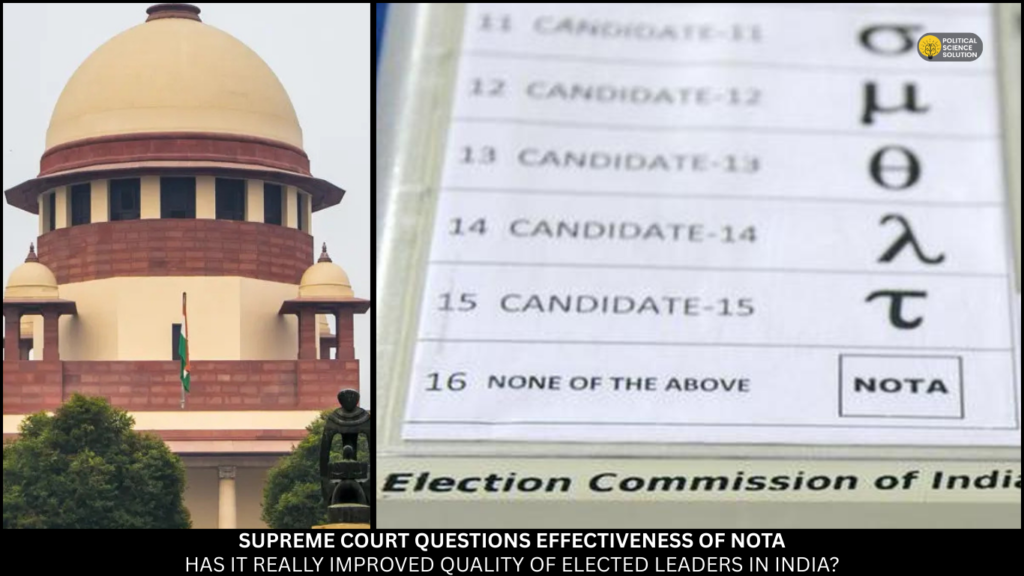
Landmark 2013 Judgment That Introduced NOTA
The NOTA option owes its existence to the Supreme Court’s historic verdict in People’s Union for Civil Liberties (PUCL) vs Union of India (2013). In that judgment, the Court recognised the right to reject all candidates as an essential aspect of free and fair elections and the freedom of expression under Articles 19(1)(a) and 21 of the Constitution.
Prior to 2013, voters who wished to register dissent had to use Form 49-O under the Conduct of Elections Rules, 1961 — a process that compromised secrecy. To address this, the Court directed the Election Commission of India (ECI) to add NOTA as an additional button on EVMs.
NOTA was rolled out for the first time during the 2013 legislative assembly elections in Chhattisgarh, Mizoram, Rajasthan, Madhya Pradesh, and Delhi.
Core Limitations That Weaken NOTA’s Power
Despite its symbolic importance, NOTA suffers from several structural weaknesses that limit its influence:
- No electoral consequence — Even if NOTA receives the highest number of votes in a constituency, the candidate securing the second-highest valid votes is declared the winner.
- Uncontested elections exclude NOTA — When only one candidate files valid nomination papers and no poll is held under Section 53(2) of the Representation of the People Act, 1951, voters cannot express rejection through NOTA.
- Persistent candidate selection practices — Political parties continue to prioritise “winnability” and electoral calculations over moral character or criminal antecedents.
The bench repeatedly asked whether these realities have changed in over a decade. Justice Bagchi directly queried:
“Has the quality of elected leaders improved with NOTA? Because what tells us is that educated, well-off people vote less and the economically weaker section vote more.”
Chief Justice Surya Kant echoed similar skepticism, observing:
“We have been using NOTA for over a decade. Has the quality of candidates improved? They continue to be selected based on electability and not on moral grounds.”
Voter Participation Patterns Highlighted by the Court
The hearing also shed light on contrasting voter behaviour across social and economic groups. The Court noted that voter apathy appears more pronounced among educated and affluent urban sections, even though NOTA provides a formal channel to express dissatisfaction.
In contrast, turnout remains consistently higher among economically weaker sections and in rural areas. The Chief Justice described polling day in villages as a festive occasion:
“In rural areas… women who are exempted from taking up labour or construction works, they have sigh of relief as they go in groups to cast votes, while singing songs etc.”
Justice Bagchi further underlined the growing participation of women voters, particularly in rural constituencies, stating:
“Women voters have perpetually increased.”
Practical Concerns Over Uncontested Elections
The core issue before the Court is whether candidates should be allowed to enter Parliament or state assemblies without facing any contest at all. The petitioner argued that mandatory polling — even with a single candidate — would allow voters to register NOTA and uphold the democratic principle of choice.
However, the bench expressed serious reservations about the consequences of such a rule. Chief Justice Surya Kant remarked:
“If the argument is to be accepted that a candidate should not get elected without facing an election, are we not looking at a situation that will create a legislative vacuum as NOTA is not a person but a situation which cannot fill up a seat.”
The Court emphasised that rejecting an unopposed candidate without an alternative would leave the constituency without representation, potentially violating constitutional requirements for a functional legislature.
Arguments Presented During the Hearing
- Senior Advocate Arvind Datar (for the petitioner) stressed the urgency of the matter, noting that assembly elections in six states are scheduled in 2026.
- Prashant Bhushan, appearing for intervenor Association for Democratic Reforms (ADR), pointed out that NOTA assumes special relevance in uncontested scenarios, where it could potentially outpoll the lone candidate — though without changing the outcome under existing law.
- Attorney General R Venkataramani, representing the Union Government, opposed the plea, describing the issue as largely academic. He argued that uncontested elections have been extremely rare since 1991 and that there is no fundamental right to insist on a poll in every case.
- The Election Commission of India has maintained that NOTA has never secured a majority in any election since 2013.
The petitioner cited historical data showing 26 instances of unopposed candidates entering Parliament since 1952, while the ECI referred to only nine such cases under the 1951 Act.
Global and State-Level Alternatives
The Court was informed of alternative models that give NOTA greater teeth:
- Colombia follows a 50%+1 rule: If NOTA secures more than 51% of valid votes, re-elections are held and previous candidates are barred from contesting again.
- Maharashtra and Haryana State Election Commissions have experimented by treating NOTA as a fictional candidate in local body polls, triggering re-elections when NOTA wins a majority.
These experiments were cited as possible middle paths that balance voter expression with administrative feasibility.
What Lies Ahead for Electoral Reforms?
The Supreme Court has kept the matter alive, posting it for further hearing in April 2026. The bench has signalled that it views the petition not merely as a technical challenge but as an opportunity to strengthen democratic values and explore ways to make voter rejection more meaningful.
While the Court appears reluctant to create legislative vacuums or mandate costly re-polls without clear alternatives, its observations have reignited national debate on whether NOTA — in its present form — has truly served the purpose for which it was introduced.
As India prepares for another round of major state elections, the outcome of this PIL could influence future conversations on electoral integrity, criminalisation of politics, and mechanisms to enhance voter voice without destabilising the representative system.
FAQs
1. What is NOTA, and when was it introduced in Indian elections?
NOTA is an option on Electronic Voting Machines (EVMs) that allows voters to formally reject all contesting candidates without supporting any of them. It was introduced following the Supreme Court’s landmark 2013 judgment in People’s Union for Civil Liberties (PUCL) vs Union of India. The Court directed the Election Commission of India (ECI) to add NOTA to EVMs to protect voter secrecy and enable dissent. It was first used in the 2013 assembly elections in states like Chhattisgarh, Mizoram, Rajasthan, Madhya Pradesh, and Delhi. Before NOTA, dissatisfied voters used Form 49-O, which did not ensure anonymity.
2. Why did the Supreme Court question NOTA’s effectiveness in February 2026?
During a hearing on February 24, 2026 (some reports note February 23 or 25), a bench led by Chief Justice of India Surya Kant and Justice Joymalya Bagchi examined a Public Interest Litigation (PIL) filed by the Vidhi Centre for Legal Policy. The PIL challenges the practice of declaring lone candidates elected unopposed under Section 53(2) of the Representation of the People Act, 1951, as it prevents voters from using NOTA in such cases. The Court observed that after more than a decade, NOTA has “hardly made an impact” on political parties’ candidate selection. Parties still prioritize “electability” over moral grounds, and NOTA remains largely symbolic with no real electoral consequences—even if it gets the most votes, the runner-up wins.
3. What key limitations of NOTA did the Supreme Court highlight?
The bench pointed out several issues:
Voter apathy persists among educated and affluent urban sections despite NOTA, while turnout is higher among economically weaker and rural voters (including women, who often vote in groups celebratorily).
NOTA has no binding effect—if it receives the highest votes, it does not trigger re-elections or disqualify candidates.
In uncontested elections (only one candidate), no poll occurs, so voters cannot exercise NOTA at all.
The Court noted NOTA “cannot fill up a seat” and rejecting an unopposed winner would create a “legislative vacuum” since NOTA is not a person who can represent the constituency.
4. What alternative ideas or mechanisms did the Supreme Court discuss?
Chief Justice Surya Kant suggested exploring “some compulsory but not harsh mechanism” to encourage voting and boost participation, potentially making NOTA less relevant by attracting better candidates. The Court referenced state-level experiments in Maharashtra and Haryana, where NOTA is treated as a fictional candidate in local polls, leading to re-elections if it wins a majority. Internationally, Colombia’s 50%+1 rule was mentioned—if NOTA exceeds 51% of valid votes, re-elections are held with previous candidates barred. The bench emphasized non-punitive ways to strengthen democracy rather than forcing outcomes that cause governance gaps.
5. What is the current status of the case and what could happen next?
The PIL, along with related pleas (including one by Shiv Khera), seeks mandatory polls even in single-candidate scenarios to enable NOTA usage. The Supreme Court has not issued final orders but adjourned the matter for further hearing—reports mention April 2026 or March 17, 2026. The bench views the issue as constitutionally significant, focusing on voter expression, democratic values, and remedies for dissatisfaction (e.g., if 35% reject a candidate). No major reforms are guaranteed, but the observations have renewed debate on electoral changes, including possible ECI pilots or legislative amendments to the Representation of the People Act. The Court remains cautious about practicality, balancing voter rights against administrative and representational stability.