

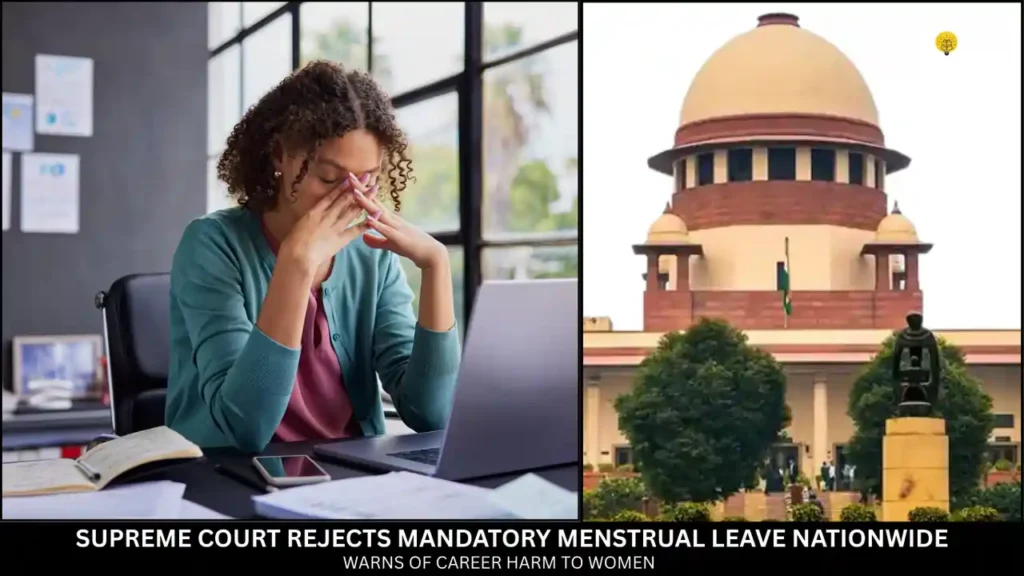
New Delhi: In a landmark decision delivered on March 13, 2026, the Supreme Court of India dismissed a public interest litigation seeking a uniform national law for paid menstrual leave. The bench, led by Chief Justice Surya Kant and comprising Justice Joymalya Bagchi, expressed serious concerns that enforcing such a mandatory policy could unintentionally damage women’s employment opportunities and reinforce outdated gender stereotypes.
The ruling came in response to a writ petition filed by advocate Shailendra Mani Tripathi. He urged the court to direct the central government to introduce paid leave provisions for working women and female students during menstruation, citing alignment with Article 21’s right to dignity and India’s commitments under the Convention on the Elimination of All Forms of Discrimination Against Women (CEDAW).
Court’s Key Observations and Concerns
Chief Justice Surya Kant emphasized the distinction between voluntary employer or state-level initiatives and compulsory statutory rights. He stated that while the intent behind recognizing menstrual health challenges is commendable, legislating mandatory paid leave could create long-term negative effects in the job market.
The Chief Justice remarked that employers might hesitate to hire women or entrust them with major responsibilities if additional leave obligations arise. He specifically noted, “The moment you introduce this as a law and make it a compulsory condition, you may not be able to assess the amount of damage you may do to their career. Nobody may give them big responsibilities. In judicial services, people may not assign trials to them.”
The bench further highlighted the risk of fostering a perception among women that they are “not at par” with male colleagues, potentially instilling a “psychological fear or impression” of inferiority. This could undermine gender equality efforts in professional settings dominated by men.
The court encouraged voluntary measures, praising actions by states like Odisha, Karnataka, and Kerala, as well as private companies. It suggested the government consult stakeholders to develop an appropriate policy rather than imposing one through judicial directive.
Understanding Menstrual Leave and Its Proposed Benefits
Menstrual leave provides paid or unpaid time off for women facing discomfort, severe pain (dysmenorrhea), or related conditions like endometriosis during their periods. Advocates argue it reduces low productivity from presenteeism, supports recovery for better performance, and aligns with constitutional provisions for humane working conditions under Article 42 and the Occupational Safety, Health and Environment Code, 2020.
Such policies could help challenge cultural taboos, promote menstrual health awareness, and advance gender equality by acknowledging biological realities without stigma.
Major Criticisms and Potential Drawbacks
The Supreme Court’s decision echoed broader critiques that mandatory menstrual leave might backfire. Key issues include:
- Impact on Hiring and Advancement — Additional obligations could make women appear less attractive to employers, especially alongside existing requirements like maternity benefits and creche facilities. This risks discrimination in recruitment and promotions.
- Reinforcement of Stereotypes — Framing menstruation as requiring special treatment may perpetuate views that women are biologically weaker or less suited for demanding roles, rooted in “benevolent sexism.”
- Informal Sector Challenges — With about 88% of India’s workforce in the unorganized sector lacking structured leave systems, a national mandate would prove difficult to implement, leaving many women without benefits while potentially affecting wage-dependent daily earners.
- Medicalization of Normal Physiology — Menstruation is a standard process, not a disease. Only around 5% of women face severely debilitating symptoms, often tied to conditions like endometriosis. Blanket leave might over-medicalize it, deepening taboos instead of normalizing it.
Critics argue flexible arrangements—such as rest rooms, sanitary product access, pain relief options, adjustable hours, or compensatory work—would better support affected women without broad entitlements that could spark resentment.
Current Landscape in India
India lacks a central law on menstrual leave. Provisions remain fragmented:
- Bihar — Pioneered in 1992, offering two days per month to government employees (including contract workers).
- Kerala — Introduced in 2023 for female staff and students in universities and industrial training institutes.
- Odisha — Implemented in 2024, providing additional casual leave for women government employees.
- Karnataka — Became the first to mandate one paid day per month (up to 12 annually) across public and private formal sectors in late 2025, targeting women aged 18-52 in registered establishments.
Several private organizations have adopted voluntary policies, including Zomato (up to 10 days yearly), Swiggy, BYJU’s, L&T (one day monthly), and RPG Group’s CEAT subsidiary (two days monthly since 2025).
Global Experiences and Mixed Results
Policies exist in countries like Japan, South Korea, Indonesia, Spain (five paid days since 2023), Vietnam, Taiwan, China, Zambia, Ireland, and Italy. However, uptake varies:
- Japan sees only 0.9% usage.
- South Korea’s unpaid version limits participation.
- Spain reports low adoption.
- Zambia faces debates over perceived abuse as extra holidays.
In India, Karnataka’s recent rollout shows inconsistent compliance, with many women hesitant due to fears of stigma or discrimination.
Broader Implications and the Path Forward
The Supreme Court’s ruling has polarized opinions. Supporters of stronger protections argue it overlooks workplace dignity and forces women into discomfort during painful periods. Others praise the caution against policies that could exclude women from opportunities amid declining female workforce participation.
The decision shifts focus to enabling environments: better sanitation, flexible scheduling, medical support, awareness programs, and lifestyle education for managing menstrual pain. It underscores the need for inclusive approaches that empower women without limiting their professional growth in a competitive market.
As menstrual health discussions evolve, the emphasis remains on voluntary, stakeholder-driven solutions to balance health needs with equitable employment.
FAQs
1. What did the Supreme Court decide regarding menstrual leave?
The Supreme Court dismissed a public interest litigation (PIL) seeking a nationwide mandatory paid menstrual leave policy for working women and female students. The bench, led by Chief Justice Surya Kant and Justice Joymalya Bagchi, refused to issue directions for a uniform law, stating it is a policy matter for the government.
2. Why did the Supreme Court reject the plea for mandatory menstrual leave?
The Court expressed concerns that making paid menstrual leave compulsory could harm women’s careers by making them less attractive to employers. It warned that companies might hesitate to hire women or assign them significant responsibilities (e.g., major projects or trials in judicial services), potentially reinforcing gender stereotypes that women are “less than” or “not at par” with men due to biology.
3. What were the key remarks made by Chief Justice Surya Kant?
The Chief Justice highlighted that imposing mandatory leave as a statutory right could create a “psychological fear” among women that they are inferior. He noted, “Nobody may give them big responsibilities,” and cautioned that such a law might lead to employers avoiding hiring women altogether, ultimately damaging their growth and opportunities.
4. Does the ruling ban menstrual leave entirely in India?
No, the Supreme Court did not ban menstrual leave. It welcomed voluntary policies by states (e.g., Bihar, Kerala, Odisha, Karnataka) and private companies (e.g., Zomato, Swiggy). The bench encouraged the government to consult stakeholders and consider framing a suitable policy, while rejecting judicial imposition of a compulsory national mandate.
5. What are the broader implications of this Supreme Court decision?
The ruling has sparked debate on balancing women’s health needs (e.g., severe dysmenorrhea or endometriosis) with workplace equality. Critics argue it overlooks dignity and humane conditions, while supporters say it prevents unintended discrimination in hiring amid existing obligations like maternity benefits. It shifts focus toward flexible workplace measures, awareness, and voluntary initiatives rather than blanket laws.