

Equality is the principle of ensuring fairness and equal treatment for all individuals, regardless of their differences or backgrounds. It promotes a level playing field where everyone has the same opportunities and rights.
Introduction
The idea of equality stands as a defining feature of modern political thought, challenging the classical and medieval belief in natural hierarchies. Equality is not just a concept; it is a prescriptive term that emphasizes that all individuals must be treated as equals. This concept is built upon the assumption that humans are rational beings, endowed with the faculty of reason, and all are created equal by a higher power.
According to Harold Laski, concept of equality entails abolishing special privileges, offering opportunities for individual growth, granting unrestricted access to social benefits, and diminishing economic and social disparities. This vision underscores a commitment to a fair and just society where all individuals enjoy equal rights and opportunities.
Meanwhile, John Locke provided a different perspective. According to him men have equal rights to their natural freedom. But men having equal worth does not mean that they have equal talent and equal capacity and therefore equal treatment would not fit in the meaning of equality.
Further, this article delves into the multifaceted concept of equality, exploring various dimensions and the evolution of this idea.
Table of Contents
Definitions of Equality
Various political theorists have offered their definitions of equality, shedding light on the different aspects of this complex concept. Here are a few notable definitions:
Mikhail Bakunin: “Political freedom without economic equality is a pretense, a fraud, a lie, and the workers want no lying.”
D.D Raphael: “The right to equality is a right of equal satisfaction of basic needs including capacities.
Barker: “Barker’s perspective holds that equality signifies identical rights for all individuals and the abolition of all special rights or privileges.”
Laski: “As per Laski, equality ensures that no individual within a society should be in a position to surpass their neighbor to an extent that it amounts to a rejection of the latter’s citizenship.”
Theodore Bikel: “I am a universalist, passionately devoted to the cause of equality within the human family.”
Feagler: “Equality of opportunity is freedom, but equality of outcome is repression.”
Fromm: “Men are born equal, but they are born different as well.”
Evolution of the Concept of Equality
Since ancient Greek civilization, the concept of equality has been a prevailing ideal that has evolved significantly over the centuries, influenced by and influencing the countless individuals who have championed various movements for equality and against exploitation.
During the 17th century and beyond, the prevailing notion revolved around natural equality, drawing from the traditions of natural law and social contract theory. This perspective was exemplified by Hobbes, who posited that in their natural state, individuals possess equal rights because their capacity to harm each other is fundamentally the same.
Locke, on the other hand, argued that all humans share the natural right to self-ownership and freedom. Rousseau emphasized that with the advent of civilization and emergence of private property human innocence got corrupted and resulted into inequality and prevalence of violence which could only be surmounted by establishing a collective civil existence based on shared subjectivity.
Early 18th century, it was commonly assumed that humans were inherently unequal, resulting in a natural hierarchy. However, this assumption began to erode with the advent of the concept of natural rights, which indicated an inherent equality among all human beings. This concept implied substantive, universal, moral equality, as individuals were considered children of God, making everyone equal before God. Alexis de Tocqueville in his book ‘Democracy in America’ states that “equality is inevitable and irresistible. The gradual process of equality is something that is fated”. For him, equality is an ideal which includes freedom from slavery, subordination and discrimination.
Types of Equality
Equality can be classified into various forms, each addressing different aspects of human society:
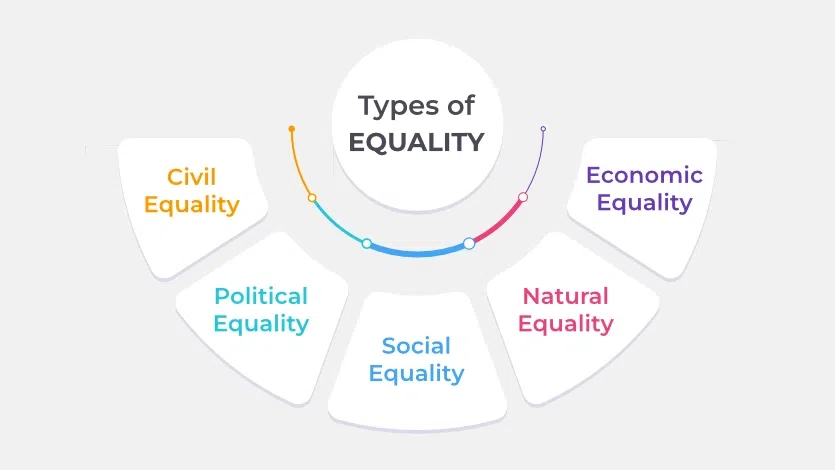
Legal Equality
Legal equality is the foundation upon which many modern societies are built. It demands that all individuals be granted equal legal status, regardless of their differences. This concept finds its roots in the works of thinkers like Jean-Jacques Rousseau, who believed that extending legal equality to all citizens was a primary characteristic of civil society. Legal equality ensures equal access to the law and the equal subjection of all citizens, creating formal equality before the law.
Political Equality
Political equality focuses on providing equal political rights to all citizens, emphasizing the idea that individuals are rational beings capable of making political judgments. This concept includes democratic rights, universal suffrage, freedom of expression, and the right to form associations to influence political decisions. Political scientist Robert Dahl identifies five criteria for a democratic government consistent with political equality, including voting equally, effective participation, enlightened understanding, controlling the agenda, and inclusion of all adult members in collective decisions.
Social Equality
SI Benn and RS Peters in their work “social principles and the democratic state” (1975) have significantly remarked that the term Social Equality has been adopted by socialists largely to distinguish their objective from earlier egalitarian ideals of the French Revolution.
Social equality aims to establish a society where all individuals or groups have the same status in certain respects. Socialists have adopted this term to distinguish their objectives from earlier egalitarian ideals. Social equality seeks to eliminate aristocratic legal privileges and feudal obligations while promoting a more equitable social order.
Economic Equality
Economic equality does not imply identical economic conditions for all but rather the absence of significant economic disparities. It emphasizes the importance of meeting urgent and basic needs before addressing specific ones. Economic inequality, according to Marxists, can lead to the dominance of one economic class over another, resulting in exploitation.
Egalitarianism
Egalitarianism is a fundamental philosophy rooted in the pursuit of equality, emphasizing that all individuals, regardless of their age, gender, or personal preferences, should be treated equitably. This concept extends its reach to economic and legal spheres, giving rise to two prominent branches: economic egalitarianism and legal egalitarianism.
Economic Egalitarianism: Economic egalitarianism posits that individuals should have equal access to wealth. It underlines the importance of ensuring that no one is denied the opportunity to prosper.
Legal Egalitarianism: Legal egalitarianism emphasizes the need for a level playing field in the legal arena. It asserts that everyone should adhere to the same laws, thereby preventing anyone from receiving special legal privileges.
Equality of Outcome
Equality of outcome is a radical and contentious form of egalitarianism. It posits that all individuals should finish the metaphorical race of life together, regardless of their starting point and speed.
Advocates of equality of outcome (whether in its moderate or radical sense) usually argue that it is the most vital form of equality, since without it order forms of equality are not genuine. For example, equal legal and civil rights are of little benefit to citizens who do not possess a secure job, decent wage, a roof over their head and so forth. Rousseau endorsed the concept of equal outcomes and famously expressed, “No individual should possess sufficient wealth to purchase another, and no one should be so destitute as to be compelled to trade their own self.”
The economic cost of equality is, however, less forbidding than the moral price that has to be paid. The new right thinkers such as Friedrich Hayek and Keith believed that equality is based on little more than social envy, the desire to have what the wealthy already possess. Policies that aim to promote equality by redistributing wealth do little more than rob the rich in order to pay the poor.
Equality of Opportunity
Equality of Opportunity is about giving everyone a fair start in life. It’s like making sure all runners start at the same starting line in the race. But, in this case, it’s not about making sure everyone finishes at the same time. It’s about giving everyone an equal chance to do their best, even if they end up at different places.
Some people believe that giving everyone an equal start in life is what makes the race fair, even if some people end up ahead of others. So, the idea of equal opportunity is more about giving everyone a chance to be their best, even if it means they’ll have different outcomes. In this way, it’s considered okay for some natural differences to exist because they’re seen as either unavoidable or right.
Indeed, in the eyes of many, it is precisely the ‘equal start to the race which legitimizes its unequal outcome. In effect, the principle of equal opportunities comes down to an equal opportunity to become unequal. This is because the concept distinguishes between two forms of equality , one is acceptable and the other is unacceptable. Natural inequalities considered to be either inevitable or morally ‘right’. In Margaret Thatcher’s words, there is a right to be unequal.
So, in simple terms, Equality of Outcome is about making everyone finish at the same time, while Equality of Opportunity is about giving everyone an equal start, even if they end up at different places in the race of life. As rightly said by John F Kennedy “All of us do not have equal talents but all of us should have an equal opportunity to develop our talents”.
Concept of Meritocracy by Michael Young
Michael Young’s concept of meritocracy, introduced in his 1958 essay, explores the idea of rewarding individuals based on their talents and efforts rather than inherited privilege. He cautioned against its blind acceptance, highlighting potential issues. A pure meritocracy, he argued, could create a new elite based on education and intellectual advantages, potentially perpetuating inequality. Meritocratic rhetoric might mask systemic disadvantages. The intense competition in a meritocratic system can lead to stress and anxiety. Young’s work serves as a critical examination of the limitations of meritocracy as a sole solution for achieving equality of opportunities, emphasizing the need to address systemic inequalities.
Equality of Resources
Equality of resources is a concept that has been discussed and majorly developed by John Rawls, Ronald Dworkin, and Michael Walzer three influential political philosophers. While they share some similarities in their approach to the concept, they also have some key differences. Let’s explore their views on the equality of resources in detail.
John Rawls’ Theory of Justice:
John Rawls is best known for his theory of justice outlined in his influential work “A Theory of Justice” (1971). Rawls proposes the idea of a just society based on two key principles:
The Principle of Equal Basic Liberties: Rawls argues that in a just society, individuals should have equal access to a basic set of political and personal liberties. This ensures that all citizens are free to exercise their fundamental rights and participate in political life without discrimination.
The Difference Principle: Rawls acknowledges that economic inequalities may exist in a just society, but they should be structured in a way that benefits the least advantaged. He argues that inequalities in income and wealth are permissible as long as they work to the advantage of the least well-off members of society. In other words, inequalities should be designed to improve the welfare of the most disadvantaged individuals.
Rawls does not explicitly use the term “equality of resources.” Still, his theory incorporates the idea that individuals should have an equal opportunity to access the basic goods and social primary goods, such as income, wealth, education, and health, which can be seen as resources for achieving a good life.
Dworkin’s Vision: Equality of Resources
Ronald Dworkin in his book “Sovereign virtue: Theory and practice of equality” explained his perspective of equality of resources which has been a cornerstone in the realm of distributive justice.
Dworkin’s theory of equality of resources centers on the idea that individuals should be treated as equals regarding the resources they have at their disposal. Resources encompass not only material wealth but also opportunities, natural talents, and personal abilities. The goal is to ensure a fair distribution of resources among all members of society. Dworkin explained his concept of equality combining Ambition-sensitive equality and Insurance schemes which provides a comprehensive framework for addressing resource distribution in a just society.
Ambition-Sensitive Equality
Dworkin’s ambition-sensitive principle of equality addresses the balance between equalizing initial resources and accounting for individual choices and ambitions. According to this principle, everyone should start with an equal share of resources, regardless of their initial endowments and talents. However, it also considers the notion that people who work harder, take risks, or make ambitious choices should have the opportunity to benefit from their efforts. In essence, ambition-sensitive equality allows for inequalities to arise due to variations in ambition and effort but ensures that these inequalities are not driven by factors beyond an individual’s control.
Insurance Scheme Equality
Dworkin’s insurance scheme equality complements the ambition-sensitive principle by emphasizing the importance of a safety net. Under this principle, individuals should be guaranteed a minimum level of resources, serving as a form of insurance against adverse events in their lives. If someone encounters unexpected hardships or lacks essential resources due to factors beyond their control, society should step in to provide a safety net to maintain a basic standard of living. This safety net helps protect against the arbitrary effects of luck.
Luck Egalitarianism
Luck egalitarianism is a broader concept that encompasses Dworkin’s philosophy of justice. It posits that inequalities resulting from factors beyond an individual’s control, such as genetic endowments or circumstances of birth, are unjust and should be rectified. In contrast, inequalities stemming from voluntary choices or efforts should be allowed, as long as they do not worsen the disadvantages of those who are less fortunate. Luck egalitarians believe that people should be held responsible for their choices but not for their luck.
The Envy Test
The envy test is a vital criterion for assessing the fairness of resource distribution in a society. Dworkin suggests that a distribution of resources passes the envy test if no one has justified reasons to envy the resources possessed by others. In other words, a just distribution is one where individuals do not envy those who are better off because they understand that their own circumstances are the result of their choices and ambition rather than factors beyond their control.
Ronald Dworkin’s theory of equality of resources offers a nuanced approach to distributive justice. By combining ambition-sensitive and insurance scheme equality with the principles of luck egalitarianism and the envy test, Dworkin provides a comprehensive framework for addressing resource distribution in a just society. This framework aims to balance the equalization of initial resources, individual responsibility for choices, and the provision of a safety net to ensure that no one is unduly burdened by factors beyond their control. It remains an important and thought-provoking contribution to the field of political philosophy.
Complex Equality – Michael Walzer
In his book “Spheres of Justice” (1983), the renowned political philosopher Michael Walzer introduced the concept of “complex equality.” This concept represents a nuanced perspective on distributive justice that goes beyond mere wealth redistribution. It aims to tackle social and economic inequalities in a more comprehensive manner.
Complex equality acknowledges that various aspects of an individual’s life, such as wealth, education, health, and social opportunities (referred to as social goods), hold different meanings in different societies. Walzer advocates for a more intricate approach to justice that recognizes the intricacy of these disparities. He argues that justice necessitates the fair distribution of social goods like education and healthcare, rather than relying solely on market forces. The responsibility for maintaining the boundaries of each sphere of justice falls upon the state.
According to Walzer, complex inequalities call for a contextual and relational understanding of justice. The distribution of goods and opportunities should consider the specific historical, cultural, and social context of each society. This perspective challenges one-size-fits-all solutions to inequality and underscores the importance of tailored, context-sensitive approaches to creating a fair and equitable society. Therefore, Walzer’s concept of complex equality doesn’t advocate for an entirely egalitarian society but instead seeks to prevent the monopolization of social goods.
Short Comparison: Equality of Resources
| Aspect | John Rawls | Ronald Dworkin | Michael Walzer |
|---|---|---|---|
| Key Idea | Justice as Fairness | Equality of Resources | Complex Equality |
| What should be equal? | Primary social goods | Resources | Social goods in different spheres |
| View on Inequality | Allowed if it benefits the least advantaged | Allowed if due to personal choice, not brute luck | Allowed if one social sphere does not dominate others |
| Main Principle | Difference Principle | Envy Test, Ambition-sensitive equality, Insurance scheme | Different goods should be distributed by different principles |
| Role of State | Ensures fair opportunities and redistribution | Compensates for brute luck and ensures equal starting resources | Maintains fairness within each sphere of justice |
| Major Work | A Theory of Justice (1971) | Sovereign Virtue (2000) | Spheres of Justice (1983) |
Mapping the Landscape of Luck Egalitarianism
Luck egalitarianism is a prominent theory of distributive justice that maintains that inequalities are just only when they arise from individuals’ voluntary choices rather than from circumstances beyond their control. Its central claim is that justice requires society to neutralize the effects of brute luck—such as genetic disadvantages, disabilities, or being born into poverty—while holding individuals responsible for option luck, namely the outcomes of informed and voluntary choices, such as gambling, investment decisions, or career risks.
Although this shared intuition unites luck egalitarians, they disagree on the appropriate “currency” of equality—that is, what exactly should be equalized to achieve justice. Ronald Dworkin, Richard Arneson, and G. A. Cohen each offer distinct answers, shaping the major strands of the luck egalitarian tradition.
1. Ronald Dworkin: Equality of Resources
Core Concept: Ambition-Sensitive, Endowment-Insensitive Distribution
Ronald Dworkin argues that justice requires an equal distribution of resources, rather than welfare or happiness. According to him, a just society must be endowment-insensitive, ensuring that people are not disadvantaged by natural inequalities such as disabilities or unequal talents. At the same time, it should remain ambition-sensitive, allowing differences in outcomes that result from individuals’ choices, ambitions, and efforts.
The Mechanism
To illustrate his theory, Dworkin develops a series of thought experiments.
The Desert Island Auction: Imagine a group of shipwreck survivors arriving on an uninhabited island rich in resources. Each individual is given an equal number of bidding tokens (clamshells) and participates in an auction for the island’s resources. Since everyone begins with the same purchasing power, the resulting allocation reflects individual preferences rather than arbitrary privilege.
The Envy Test: Dworkin proposes the envy test as the standard for a fair distribution. A distribution is considered equal when no individual prefers another person’s bundle of resources to their own. If no one envies another’s allocation, the distribution is regarded as just.
Hypothetical Insurance Markets: Dworkin recognizes that natural disadvantages, such as disabilities or limited talents, cannot be addressed through the auction alone. To compensate for these forms of brute luck, he introduces the idea of a hypothetical insurance market. Individuals, before knowing their natural endowments, would choose to purchase insurance against potential disadvantages. The premiums that rational individuals would be willing to pay provide the basis for compensating those who are actually born with disabilities or other natural disadvantages.
Foundational Works
- “What Is Equality? Part 1: Equality of Welfare” (1981)
- “What Is Equality? Part 2: Equality of Resources” (1981), both published in Philosophy & Public Affairs
- Sovereign Virtue: The Theory and Practice of Equality (2000)
2. Richard Arneson: Equality of Opportunity for Welfare
Core Concept: Equalizing Opportunities for Well-Being
Richard Arneson criticizes Dworkin’s emphasis on resources, arguing that resources possess value only because they contribute to welfare or well-being. Equal resources do not necessarily generate equal opportunities for happiness. For instance, a person with a severe disability may require significantly more resources than an able-bodied individual to attain the same level of well-being. Therefore, justice should aim to equalize opportunities for welfare rather than resources themselves.
The Mechanism
Arneson explains his approach through the idea of decision trees.
Equivalent Decision Trees: An individual’s life can be imagined as a branching decision tree, where each branch represents a possible choice leading to different levels of lifetime welfare.
Equal Starting Gate: Justice requires that, at the beginning of adulthood, all individuals face decision trees offering equivalent opportunities for achieving well-being. Differences arising from unequal natural talents, disabilities, or social backgrounds should therefore be compensated so that individuals begin from genuinely comparable positions.
Responsibility for Outcomes: Once equal opportunities for welfare have been established, individuals bear responsibility for the consequences of their own voluntary decisions. If two people begin with equivalent opportunities but one chooses imprudent or less rewarding paths, any resulting inequality in welfare is considered justifiable.
Foundational Works
- “Equality and Equal Opportunity for Welfare” (Philosophical Studies, 1989)
- “Liberalism, Distributive Shares, and Employment” (Philosophy & Public Affairs, 1990)
3. G. A. Cohen: Equality of Access to Advantage
Core Concept: Eliminating Involuntary Disadvantage
G. A. Cohen argues that neither resources nor welfare alone adequately capture what justice requires. Instead, he proposes equality of access to advantage, a broader concept that encompasses both material resources and opportunities for well-being. According to Cohen, justice demands the elimination of involuntary disadvantage—that is, disadvantages resulting from factors beyond an individual’s control.
His approach seeks to distinguish carefully between inequalities arising from choice and those resulting from luck, ensuring that only the latter are compensated.
The Mechanism
Cohen illustrates his position through several influential examples.
The Case of Expensive Tastes: Dworkin maintains that individuals who voluntarily cultivate costly preferences—such as a taste for luxury goods—are not entitled to additional resources. Cohen agrees when such tastes are freely chosen. However, he argues that if expensive tastes result from involuntary psychological or biological conditions beyond an individual’s control, they resemble a disability and therefore deserve compensation.
The Wheelchair versus the Armchair: Cohen further demonstrates the breadth of his theory by comparing two forms of disadvantage. A person unable to walk lacks a necessary resource, such as a wheelchair, while a person suffering from chronic pain lacks welfare despite possessing adequate resources. Since both disadvantages arise from brute luck, justice requires addressing each appropriately. Equality of access to advantage therefore accommodates both resource-based and welfare-based disadvantages within a unified framework.
Foundational Works
- “On the Currency of Egalitarian Justice” (Ethics, 1989)
- Rescuing Justice and Equality (2008)
Comparison of Major Luck Egalitarian Theories
| Aspect | Ronald Dworkin | Richard Arneson | G. A. Cohen |
|---|---|---|---|
| Core Theory | Equality of Resources | Equality of Opportunity for Welfare | Equality of Access to Advantage |
| Currency of Equality | Resources | Welfare (well-being) | Advantage (resources + welfare) |
| Main Concern | Equal resources while accounting for personal responsibility | Equal opportunities to achieve well-being | Eliminate all involuntary disadvantages |
| View of Luck | Compensate for brute luck, not option luck | Compensate unequal opportunities caused by brute luck | Compensate all disadvantages beyond individual control |
| Key Mechanism | Desert Island Auction, Envy Test, Hypothetical Insurance | Equivalent Decision Trees, Equal Starting Gate | Expensive Tastes & Wheelchair vs. Armchair examples |
| Responsibility | Individuals are responsible for choices and ambitions | Individuals are responsible after equal opportunities are ensured | Individuals are responsible only for voluntary choices, not involuntary disadvantages |
| Major Critique | Resources alone may not ensure equal well-being | Welfare is difficult to measure objectively | “Advantage” is broad and difficult to define precisely |
| Major Works | What Is Equality? (1981); Sovereign Virtue (2000) | Equality and Equal Opportunity for Welfare (1989) | On the Currency of Egalitarian Justice (1989); Rescuing Justice and Equality (2008) |
The Capabilities Approach: Amartya Sen
In contrast to the resource-based approach, the capabilities approach, championed by renowned Indian economist Amartya Sen in his book “Inequality Reexamined”, redirects the focus from material possessions to the capabilities of individuals. Amartya Sen contends that to lead a fulfilling life, people need various capabilities, including access to food, good health, mobility, communication, and the ability to choose their profession.
The capabilities approach underscores the importance of enabling individuals to achieve their full potential and lead lives characterized by well-being, freedom, and self-determination, irrespective of external circumstances. This approach provides an alternative perspective on achieving equality and justice in society.
The Capabilities Approach: Martha Nussbaum
Martha Nussbaum’s Capability Approach is a normative theory of justice and human development that judges a society by the real opportunities (capabilities) people have to live lives they value, rather than by income or GDP. It places human dignity at the centre and argues that governments should ensure the conditions necessary for human flourishing.
Drawing on Aristotle’s concept of eudaimonia (human flourishing), Nussbaum argues that the purpose of the state is to enable every individual to develop and exercise their potential. A key distinction in her theory is between capabilities (the genuine freedoms or opportunities people have) and functionings (the actual achievements they choose). Justice should guarantee capabilities, while individuals remain free to decide how to use them. For example, a fasting person has the capability to eat but chooses not to, whereas a starving person lacks that capability.
Unlike Amartya Sen, who believes that important capabilities should be determined through democratic deliberation, Nussbaum proposes a universal list of Ten Central Human Capabilities to protect vulnerable groups. These include
- Bodily Health – Health, nutrition, shelter, healthcare.
- Bodily Integrity – Freedom of movement; protection from violence; reproductive autonomy.
- Senses, Imagination & Thought – Education, creativity, freedom of speech and religion.
- Emotions – Ability to love, grieve, care, and form relationships.
- Practical Reason – Moral reasoning and planning one’s own life.
- Affiliation – Social relationships, equality, dignity, and non-discrimination.
- Other Species – Respect for animals and the environment.
- Play – Recreation and leisure.
- Control over One’s Environment – Political participation and economic/property rights.
She argues that these capabilities are non-commensurable, meaning that the absence of one cannot be compensated by the presence of another, and each must be secured above a minimum threshold for a life of dignity.
The Capability Approach has influenced constitutional justice, human rights, and development policy, including the UNDP’s Human Development Index (HDI), which measures development through health, education, and income rather than GDP alone. It has also been widely applied to the protection of women, persons with disabilities, minorities, and animal welfare.
Despite its influence, the approach has been criticised for being paternalistic because of its universal list of capabilities, for the difficulty of measuring qualitative capabilities such as dignity and emotions, and for the threshold problem, as Nussbaum does not clearly specify the minimum level at which each capability is considered adequately secured.
Difference between Martha Nussbaum and Amartya Sen
Although both scholars jointly developed the Capability Approach, their theories differ in several fundamental respects.
| Aspect | Amartya Sen | Martha Nussbaum |
|---|---|---|
| Capability List | Rejects a fixed list; capabilities should emerge through democratic deliberation. | Proposes a universal list of Ten Central Human Capabilities applicable to all societies. |
| Philosophical Foundation | Rooted in liberalism, social choice theory, freedom, and public reasoning. | Based on Aristotelian human flourishing and Kantian human dignity. |
| Primary Objective | Comparative evaluation of well-being and the reduction of identifiable injustices. | Development of a comprehensive theory of social justice establishing constitutional minimums. |
| Role of Democracy | Democratic discussion determines which capabilities deserve priority. | Democracy remains important, but governments must guarantee the universal capability threshold regardless of local preferences. |
| Animal Rights | Primarily concerned with human agency and development. | Extends the Capability Approach to include the flourishing and protection of non-human animals. |
Conclusion
The concept of equality is rich and multifaceted, encompassing legal, political, social, economic, and philosophical dimensions. Its evolution throughout history reflects the changing values and ideals of societies. Understanding these various dimensions of equality is essential for addressing the complex challenges of inequality in our modern world.
Read More:
- IMF Raises India’s GDP Growth Forecast to 7% for 2026-27 and 2027-28
- India Hosts Historic First BIMSTEC Home Ministers’ Meeting in New Delhi; Delhi Declaration Adopted
- President Droupadi Murmu Appoints New Governors Across Six States in Major 2026 Reshuffle
- Centre-State Relations in India | Video Lesson
- Indian Federalism & Constitutional Status | Video Lesson