

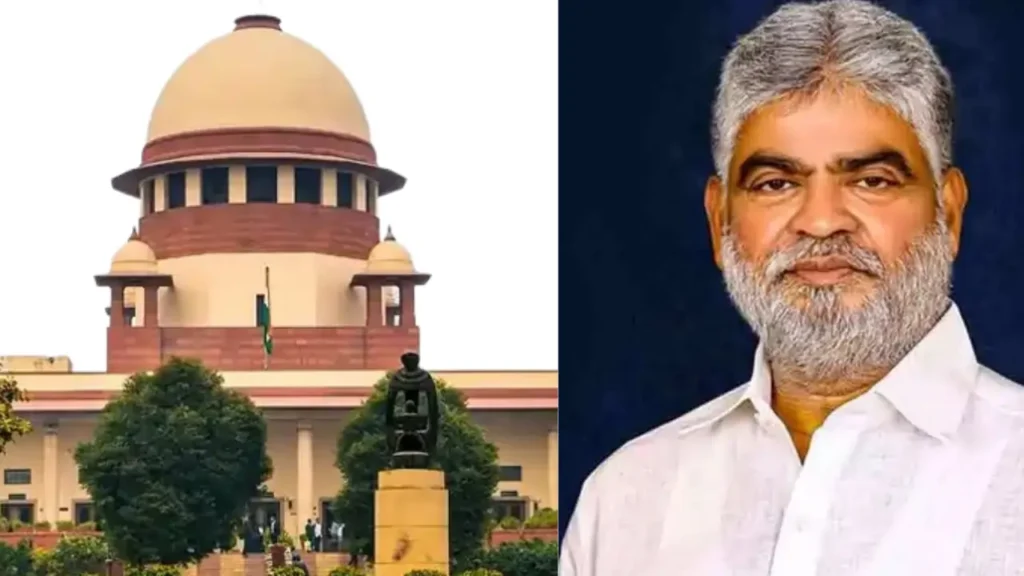
New Delhi: In a dramatic and sharply worded hearing on November 17, 2025, the Supreme Court of India issued a stern ultimatum to Telangana Legislative Assembly Speaker Gaddam Prasad Kumar, warning him of “gross contempt of court” for repeatedly failing to decide on disqualification petitions filed against ten Bharat Rashtra Samithi (BRS) MLAs who defected to the ruling Congress party in 2024.
A Bench headed by Chief Justice of India B.R. Gavai pulled no punches while hearing contempt proceedings initiated by senior BRS leaders, including Padi Kaushik Reddy, K.T. Rama Rao, and K.O. Vivekanand. The court reminded the Speaker that he enjoys no constitutional immunity when functioning as a tribunal under the Tenth Schedule of the Constitution (the Anti-Defection Law) and gave him a final two-week deadline to conclude the long-pending proceedings.
“Either finish the hearing by next week or face contempt,” Chief Justice Gavai remarked, adding with biting sarcasm, “It is for him (the Speaker) to decide where he wants to celebrate his New Year’s Eve.” The courtroom reverberated with the CJI’s observation that the Speaker’s prolonged inaction amounted to “the grossest kind of contempt” and that the court would not allow the anti-defection law to be reduced to a “mockery.”
Background: Mass Defection After 2023 Telangana Assembly Polls
The controversy stems from the 2023 Telangana Assembly elections in which the Congress delivered a crushing defeat to the Bharat Rashtra Samithi (formerly Telangana Rashtra Samithi), which had governed the state uninterrupted since its formation in 2014. In the months following the election — specifically between March and June 2024 — ten BRS MLAs switched sides and formally joined the ruling Congress, significantly bolstering the new government’s numbers in the 119-member House.
The BRS immediately cried foul, accusing the MLAs of “voluntarily giving up membership” of their original party — a clear ground for disqualification under Paragraph 2(1)(a) of the Tenth Schedule. Senior BRS MLA Padi Kaushik Reddy moved disqualification petitions before Speaker Gaddam Prasad Kumar, a Congress legislator, alleging that the defectors had violated the anti-defection law and undermined the people’s mandate.
Chronic Delay and Supreme Court’s Earlier Intervention
Despite repeated reminders, the Speaker sat on the petitions for over a year, prompting the BRS to approach the Supreme Court through a series of writ petitions. On July 31, 2025, a Bench comprising Chief Justice Gavai and Justice A.G. Masih granted the Speaker a strict three-month window to complete the entire adjudication process, holding that indefinite delay defeats the very purpose of the Tenth Schedule.
The court relied heavily on its own precedents:
- Kihoto Hollohan v. Zachillhu (1992) – Declared that the Speaker functions as a tribunal under the Tenth Schedule and his decisions are subject to judicial review.
- Rajendra Singh Rana v. Swami Prasad Maurya (2007) – Ruled that a Speaker cannot keep disqualification petitions pending indefinitely.
- Keisham Meghachandra Singh v. Speaker, Manipur (2020) – Laid down a normative timeline of three months for deciding disqualification pleas, except in extraordinary circumstances.
Yet, even after the July 31 deadline, only preliminary hearings were conducted. By September 29, 2025, the Speaker’s office had taken up only four of the ten petitions (those concerning Prakash Goud, Kale Yadaiah, Mahipal Reddy, and B.K. Reddy), leaving the remaining six untouched.
November 17 Hearing: Contempt Notice and Final Ultimatum
Frustrated by the continued inaction, BRS leaders filed contempt petitions. During Monday’s hearing, senior advocates Mukul Rohatgi and Abhishek Manu Singhvi appeared for the Speaker and sought yet another extension — this time of eight weeks. The Bench rejected the plea outright.
Senior advocate Abhishek Manu Singhvi assured the court that hearings in four cases had concluded and evidence recording was complete in three. Senior advocate Mukul Rohatgi promised to personally convey the court’s “grave view” to the Speaker’s office and expressed confidence that decisions would be delivered within four weeks.
The court, however, remained uncompromising. While granting temporary exemption from personal appearance to the Speaker and other respondents, it made its displeasure clear:
“We have already held he does not enjoy constitutional immunity when considering these matters… This should have been concluded long ago. Political defections, unless curbed, have the power to disrupt democracy,” the Bench observed.
The matter has now been posted for further hearing after four weeks, by which time the court expects final orders on all ten petitions.
Understanding the Tenth Schedule: India’s Anti-Defection Law
Enacted through the 52nd Constitutional Amendment in 1985, the Tenth Schedule was introduced to curb the infamous “Aaya Ram, Gaya Ram” culture of rampant floor-crossing that destabilized governments in the 1960s and 1970s.
Grounds for Disqualification
A legislator stands disqualified if he/she:
- Voluntarily gives up membership of the political party on whose symbol he/she was elected.
- Votes or abstains from voting in the House contrary to any direction issued by the political party (whip) without prior permission.
- An independent member joins any political party after an election.
- A nominated member joins any political party after six months of taking the seat.
The Merger Exception
The only major exception is when two-thirds of a party’s elected members agree to merge with another political party. In the present Telangana case, the BRS contends that no such two-thirds merger took place; instead, individual MLAs defected for personal gain.
Why This Case is a Litmus Test for Anti-Defection Law
Legal experts believe the Telangana episode will set crucial precedents on several fronts:
- Enforceability of Timelines: Whether the Supreme Court will impose hard deadlines and penal consequences on Speakers who drag disqualification cases.
- Speaker’s Impartiality: With Speakers almost always belonging to the ruling dispensation, the judiciary’s repeated assertion that they function as tribunals (and not as party functionaries) gains renewed significance.
- Constitutional Immunity Question: The court has categorically reiterated that Article 194(2) immunity does not extend to actions performed under the Tenth Schedule.
- Political Consequences: If the ten MLAs are disqualified, by-elections will be triggered in ten constituencies — a potential embarrassment for the Congress government barely two years into its term.
Political Reactions
The BRS has welcomed the Supreme Court’s tough stance, with party working president K.T. Rama Rao stating, “The Speaker was deliberately shielding defectors to protect the Congress government. The court’s intervention exposes the hollowness of their ‘moral victory’ claims.”
The Congress, on its part, has remained guarded. Party sources claim the defectors were welcomed because the BRS had “collapsed internally” and that the merger clause would eventually apply once formal processes were completed.
What Happens Next?
As of November 19, 2025, Speaker Gaddam Prasad Kumar has less than two weeks to pronounce his verdict on all ten petitions. Failure to comply could lead to:
- Formal contempt proceedings and possible punishment.
- Direct intervention by the Supreme Court, potentially removing the Speaker’s discretion altogether (a remedy the court has threatened in the past).
With the New Year just weeks away, the Telangana Speaker faces the most consequential decision of his tenure — one that will determine not only the fate of ten legislators but also the future robustness of India’s anti-defection framework.
The nation watches as the Supreme Court draws a firm red line: the Tenth Schedule cannot be allowed to become a dead letter through deliberate procrastination.
FAQs
1. Why did the Supreme Court threaten the Telangana Speaker with contempt of court?
The Supreme Court threatened Telangana Assembly Speaker Gaddam Prasad Kumar with contempt because he failed to decide 10 pending disqualification petitions against BRS MLAs who defected to Congress even after a clear three-month deadline given on 31 July 2025. The court called the delay “gross contempt” and “the grossest kind of contempt.”
2. What did the Chief Justice say about New Year celebrations?
During the hearing on 17 November 2025, Chief Justice B.R. Gavai sarcastically remarked: “It is for him (the Speaker) to decide where he wants to celebrate his New Year’s Eve,” implying that if the Speaker does not decide the cases immediately, he might have to spend New Year facing contempt proceedings or even in judicial custody.
3. Which 10 BRS MLAs are facing disqualification in Telangana?
The 10 BRS MLAs who defected to the Congress party between March and June 2024 are:
Prakash Goud, Kale Yadaiah, Mahipal Reddy, B.K. Reddy, and six others (exact names of all ten have been part of the petitions filed by BRS MLA Padi Kaushik Reddy). Hearings for the first four had started, but the remaining cases were pending for over 18 months.
4. Does the Speaker have immunity in anti-defection (Tenth Schedule) cases?
No. The Supreme Court has repeatedly held (starting from Kihoto Hollohan 1992 judgment and reaffirmed in the present case) that when the Speaker acts as a tribunal under the Tenth Schedule (Anti-Defection Law), he does NOT enjoy constitutional immunity under Article 194(2). His decisions are subject to judicial review, and deliberate delay amounts to contempt of court.
5. What is the time limit for Speaker to decide disqualification petitions?
Though the Tenth Schedule itself does not prescribe a time limit, the Supreme Court in Keisham Meghachandra Singh vs Speaker, Manipur (2020) laid down that disqualification petitions should normally be decided within 3 months. In the Telangana case, the court first gave 3 months (July–October 2025) and, after non-compliance, reduced it to just 2 weeks with a contempt warning.