

New Delhi: In a landmark observation that has reignited national debate on India’s long-pending constitutional directive, the Supreme Court declared that the time has arrived for implementing a Uniform Civil Code (UCC) nationwide. The apex court described UCC as the “most effective answer” to persistent inequalities in personal laws, particularly those affecting women’s rights in inheritance, succession, marriage, and divorce.
The remarks came during a hearing on March 10, 2026, before a three-judge bench led by Chief Justice of India Surya Kant, alongside Justices Joymalya Bagchi and R Mahadevan. The bench was addressing a public interest litigation filed by advocate Poulomi Pavini Shukla and the Nyaya Naari Foundation, challenging discriminatory aspects of the Muslim Personal Law (Shariat) Application Act, 1937.
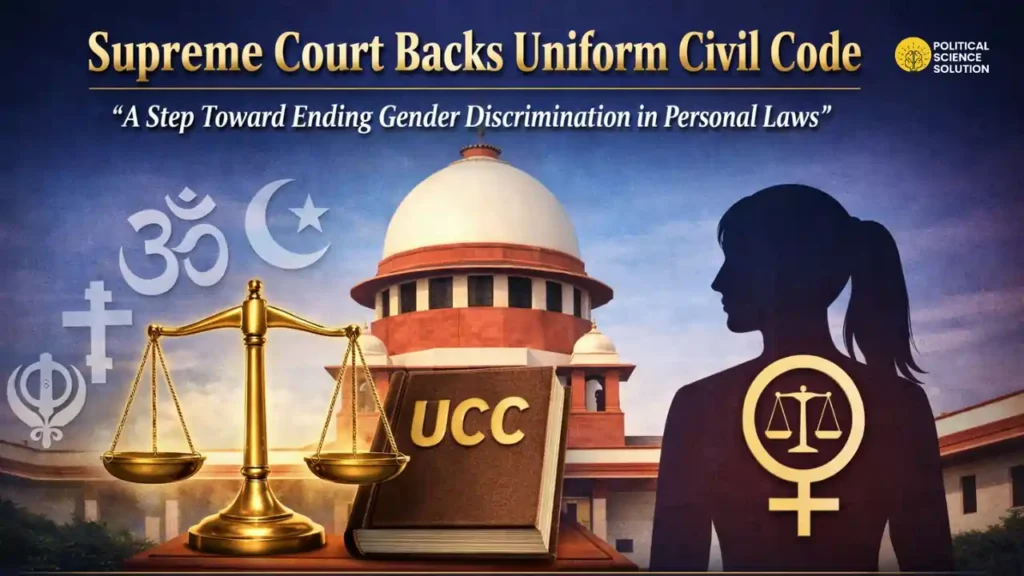
Petition Challenges Inheritance Disparities Under Shariat Act
The petitioners contended that provisions under the 1937 Act deny Muslim women equal shares in ancestral property compared to male heirs. They argued this creates artificial discrimination, violating fundamental rights to equality (Article 14), non-discrimination (Article 15), and dignity (Article 21) of the Constitution. Senior advocate Prashant Bhushan, representing the petitioners, emphasized that inheritance qualifies as a civil right rather than an essential religious practice, opening it to judicial review.
Bhushan drew parallels to the landmark Shayara Bano judgment of 2017, where the court invalidated instant triple talaq as unconstitutional. He asserted that nullifying the discriminatory elements of the 1937 Act would not leave a complete vacuum, as principles from the Indian Succession Act could apply, or the court could declare equal inheritance rights for Muslim women and men within the community.
Judicial Caution Against Creating Legal Vacuum
The bench expressed reservations about judicially striking down the provisions without a fallback mechanism. Chief Justice Surya Kant posed pointed questions: “What is the vacuum created then? What is the solution?” He cautioned that overzealous intervention might inadvertently strip affected individuals of existing entitlements, noting, “In our anxiety or over-anxiety, we may ultimately land in a situation where we deprive them of whatever they are getting.”
Justice Bagchi elaborated on the risks, highlighting that invalidating parts of personal laws could generate inconsistencies across communities. He referenced asymmetries in Hindu coparcenary rights under the Hindu Succession Act and questioned whether similar logic could extend to declaring bigamous relationships under personal laws violative of equality norms. The judge stressed that piecemeal judicial fixes fall short, and true resolution lies in legislative enactment of a UCC as per Article 44 of the Constitution.
UCC Emerges as Preferred Path to Gender Justice
The bench unanimously positioned the Uniform Civil Code as the comprehensive remedy. Chief Justice Kant stated, “The most effective answer…is the Uniform Civil Code.” Justice Bagchi reinforced this by saying the court has repeatedly recommended UCC, urging deference to the legislature’s wisdom in realizing this Directive Principle of State Policy.
The judges acknowledged the petition presented a “very good case” but deemed it more suitable for parliamentary action than court-mandated changes that might cause legal ambiguities. They noted inheritance under Muslim law lacks a parallel statutory code, unlike other communities, making abrupt invalidation problematic.
Petitioners Agree to Amend Plea with Alternatives
Responding to the bench’s concerns, Bhushan agreed to amend the petition to outline alternatives if provisions are struck down—such as invoking the Indian Succession Act or issuing a declaration of equal rights. The matter was adjourned to allow these modifications, keeping the door open for further arguments.
Understanding the Uniform Civil Code
A Uniform Civil Code envisions one secular legal framework governing personal matters for every citizen, transcending religious affiliations. It would cover marriage registration, divorce procedures, adoption rules, maintenance obligations, and inheritance succession uniformly.
Article 44 mandates the State to strive for such a code throughout India. These subjects appear in the Concurrent List (Entry 5, Seventh Schedule), permitting both central and state governments to legislate.
Advocates highlight multiple benefits:
- Gender justice by removing biases favoring men in inheritance and divorce rights.
- Secular governance separating civil entitlements from religious doctrines.
- Legal simplification reducing confusion from parallel systems.
- National integration building shared citizenship beyond communal lines.
Historical Judicial Advocacy and Current Landscape
The Supreme Court has long championed UCC through rulings like Shah Bano (1985) on maintenance for divorced Muslim women and Sarla Mudgal (1995) on bigamy via conversion. Yet, the 21st Law Commission (2018) advised against a rushed nationwide code, favoring targeted reforms within each community’s laws for gender equity.
Currently, India lacks a pan-India UCC. Uttarakhand pioneered implementation with its Uniform Civil Code Act, 2024, receiving presidential assent in March 2024 and taking effect on January 27, 2025. The state marked one year of enforcement on January 27, 2026, as “UCC Day,” and introduced amendments via ordinance in 2026 to refine procedures and penalties. Scheduled Tribes remain exempt.
Goa continues its longstanding common code rooted in the Portuguese Civil Code of 1867, applicable to most residents with limited exceptions.
Broader Implications and Ongoing Debate
The March 10 hearing underscores deepening judicial frustration with fragmented personal laws perpetuating gender disparities. While petitioners seek immediate relief for Muslim women, the bench’s preference for holistic legislative reform signals that piecemeal judicial remedies may prove inadequate.
Critics worry UCC could erode cultural and religious diversity protected under Article 25, while supporters view it as vital for constitutional equality and secularism. With Uttarakhand’s model in place and renewed Supreme Court endorsement, pressure mounts on Parliament to act on Article 44.
This case, rooted in demands for equal inheritance, may catalyze broader momentum toward a unified civil framework, balancing tradition with modern notions of justice and equality for all Indian women.
Frequently asked questions (FAQs)
1. What exactly is the Uniform Civil Code (UCC)?
The Uniform Civil Code refers to a proposed common set of secular laws that would govern personal matters—such as marriage, divorce, adoption, maintenance, inheritance, and succession—for all Indian citizens, irrespective of their religion, caste, gender, or community. Currently, personal laws in India are religion-specific (e.g., Hindu Marriage Act for Hindus, Muslim Personal Law based on Shariat for Muslims, Indian Divorce Act for Christians, and separate codes for Parsis). A UCC aims to replace these with one unified civil framework applicable nationwide, promoting equality and eliminating religion-based differences in civil rights.
2. Why has the Supreme Court repeatedly called for a Uniform Civil Code, including in the March 2026 hearing?
In the March 10, 2026, hearing of the plea by Poulomi Pavini Shukla and Nyaya Naari Foundation challenging discriminatory inheritance provisions under the Muslim Personal Law (Shariat) Application Act, 1937, a bench led by Chief Justice Surya Kant described UCC as the “most effective answer” to gender biases and asymmetries in personal laws. The court noted that piecemeal judicial striking down of discriminatory provisions (e.g., unequal inheritance shares for Muslim women) risks creating legal vacuums without alternative statutory rules. Justices emphasized that true gender justice, secularism, and equality under Article 14 cannot be fully achieved without a comprehensive UCC, deferring major reform to the legislature rather than the judiciary. This echoes earlier judgments like Shah Bano (1985) and Sarla Mudgal (1995), where the court urged implementation of Article 44.
3. What does the Indian Constitution say about the Uniform Civil Code?
Article 44, part of the Directive Principles of State Policy (Part IV), explicitly directs: “The State shall endeavour to secure for the citizens a uniform civil code throughout the territory of India.” While Directive Principles are not enforceable by courts like Fundamental Rights, they guide state policy. Personal matters like marriage, divorce, adoption, and succession fall under the Concurrent List (Entry 5, Seventh Schedule), allowing both Parliament and state legislatures to enact laws. The Supreme Court has interpreted Article 44 as a constitutional aspiration for national unity, gender equality, and secular governance.
4. What is the current status of UCC implementation in India as of March 2026?
No nationwide UCC exists yet. Uttarakhand became the first state in independent India to enact and implement a Uniform Civil Code through the Uniform Civil Code of Uttarakhand Act, 2024 (assented in March 2024 and effective from early 2025, with further refinements in 2026). It applies uniformly to most residents (excluding Scheduled Tribes) in areas like marriage registration, divorce grounds, inheritance equality, and live-in relationships. Goa has long followed a common civil code inherited from the Portuguese Civil Code of 1867, which is largely uniform across communities with minor exceptions. The central government has not introduced a pan-India UCC, though the Supreme Court’s recent remarks in the Pavini Shukla case have renewed calls for legislative action.
5. What are the main arguments in favor of and against implementing a Uniform Civil Code?
In favor:
- Ensures gender justice by removing discriminatory practices (e.g., unequal inheritance, polygamy allowances, or easier divorce for men in some personal laws).
- Upholds secularism by separating civil rights from religious doctrines.
- Simplifies legal procedures and reduces confusion from multiple parallel systems.
- Strengthens national unity and common citizenship beyond religious divisions.
Against:
- Concerns over infringing religious freedom (Article 25) and cultural diversity.
- Fears of majoritarian imposition or erosion of minority identity.
- Practical challenges in drafting a code acceptable to all communities.
- Past views (e.g., 21st Law Commission in 2018) suggested reforming individual religious family laws for gender equity instead of a single code.
The Supreme Court in 2026 stressed that UCC offers the holistic solution to avoid legal inconsistencies while achieving equality, but implementation remains a legislative prerogative.