

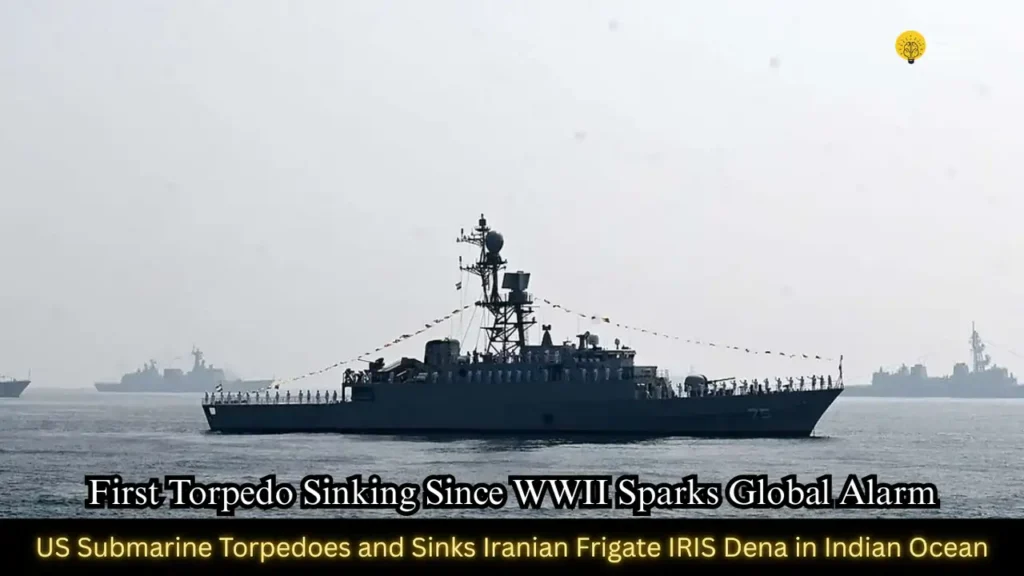
New Delhi: On March 4, 2026, a United States Navy nuclear-powered attack submarine torpedoed and sank the Iranian Navy frigate IRIS Dena in international waters of the Indian Ocean, approximately 40 nautical miles (about 74 km) off the southern coast of Sri Lanka near Galle. This marked the first time since World War II that a US submarine has sunk an enemy surface warship using a torpedo, a significant escalation in the ongoing US-Israeli military campaign against Iran that began in late February 2026.
US Defense Secretary Pete Hegseth confirmed the strike during a Pentagon briefing, describing it as a “quiet death” inflicted by a single Mark 48 heavyweight torpedo. The Pentagon released rare periscope footage showing the explosion at the frigate’s stern, lifting the vessel before it sank rapidly within minutes. Hegseth highlighted the attack as proof of America’s global naval reach and commitment to dismantling Iran’s navy, one of the war’s key objectives.
The IRIS Dena, a Moudge-class frigate commissioned in 2021 and armed with anti-ship missiles, torpedoes, guns, and capable of carrying a helicopter, was returning home to Iran after participating in peacetime multilateral exercises. Reports indicate the crew numbered between 130 and 180 sailors. Sri Lankan authorities received a distress call at around 5:08 a.m. local time, with survivors describing an explosion. Rescue operations recovered 87 bodies from the sea and saved 32 seriously injured personnel, who were treated at facilities like Karapitiya Hospital in Galle. Several sailors remained missing, with the rapid sinking leaving little chance for escape.
Background: From Diplomatic Guest to Target
The frigate had been a welcomed participant in India’s Milan 2026 multilateral naval exercise and the International Fleet Review 2026, held in Visakhapatnam, Andhra Pradesh, from February 15 to 25. These events involved navies from 74 countries and 18 warships, emphasizing interoperability, anti-submarine warfare, search-and-rescue, and maritime domain awareness. The Indian Navy publicly greeted the IRIS Dena on social media, sharing images of its arrival and crew under themes of friendship and unity across oceans.
Under typical exercise protocols, participating vessels often operate without full combat loads of live munitions for safety. Analysts suggest this left the IRIS Dena relatively defenseless when targeted. The ship departed Visakhapatnam shortly after the sea phase concluded, transiting international waters en route to Iran when struck. Some reports note it may have briefly called at Hambantota, Sri Lanka, before the attack.
The strike occurred amid intense US-Israeli operations that eliminated Iranian leadership, including Supreme Leader Ayatollah Ali Khamenei, and targeted missile sites, nuclear facilities, and naval assets. Over 17 Iranian vessels had reportedly been destroyed prior, with no Iranian warships remaining operational in the Persian Gulf, Strait of Hormuz, or Gulf of Oman.
Rescue Efforts and Sri Lanka’s Neutral Stance
Sri Lanka, adhering to UNCLOS obligations, launched immediate search-and-rescue with navy ships, air force support, and coordination from its Maritime Rescue Coordination Centre. No trace of the vessel remained upon arrival—only an oil slick and debris. Sri Lanka declared neutrality, calling for de-escalation while prioritizing humanitarian aid.
In a related development, Sri Lanka took custody of a second Iranian naval vessel (reported as the auxiliary IRIS Bushehr or similar) after it suffered engine failure near Colombo. Over 200 crew members were evacuated to Trincomalee port for safekeeping amid fears of further targeting.
Geopolitical Ramifications: War Reaches India’s Doorstep
The attack unfolded in the Indian Ocean Region (IOR), a vital artery for global shipping, energy security, and trade for Asian economies. Positioned in Sri Lanka’s search-and-rescue zone but outside territorial waters, the strike avoided direct Indian jurisdiction yet occurred in what many view as India’s strategic maritime neighborhood.
Indian naval assets, including INS Tarangini and INS Ikshak, supported search efforts with patrol aircraft and standby life rafts. Prime Minister Narendra Modi urged dialogue and diplomacy for global conflicts but refrained from direct criticism. External Affairs Minister S Jaishankar engaged Iranian counterparts diplomatically.
Domestic reactions in India were sharp. Retired admirals and analysts described the incident as embarrassing, with the war arriving “at our doorstep” and undermining India’s SAGAR/MAHASAGAR policies, IFC-IOR leadership, and aspirations as the IOR’s preferred security partner. Opposition leaders questioned New Delhi’s influence, moral responsibility as host of the exercise, and perceived ceding of regional space. Iran’s Foreign Minister Abbas Araghchi condemned the “atrocity at sea” 2,000 miles from Iran’s shores, noting the ship’s guest status in India and warning of regrettable precedents.
Legal and Military Dimensions
Experts debate the strike’s proportionality under international law, though belligerent warships are generally legitimate targets in armed conflict. Submarines rarely assist survivors due to exposure risks, and Geneva Convention duties apply conditionally. The rarity—only the fourth submarine sinking of a warship since WWII—underscores US undersea superiority, with assets from the Fifth Fleet or Indo-Pacific Command likely involved.
The event highlights IOR vulnerabilities, potential spillover risks (including Pakistan’s Saudi-linked signaling), and challenges to frameworks like the Quad’s free and open Indo-Pacific vision.
As investigations continue and tensions mount, the IRIS Dena’s sinking serves as a stark reminder of how swiftly diplomatic maritime cooperation can turn into lethal confrontation far from original conflict zones.
FAQs
1. What exactly happened to the Iranian warship IRIS Dena?
The Moudge-class frigate IRIS Dena was torpedoed and sunk by a US Navy nuclear-powered attack submarine in international waters of the Indian Ocean, about 40 nautical miles (74 km) off Sri Lanka’s southern coast near Galle. US Defense Secretary Pete Hegseth confirmed the strike, describing it as a “quiet death” caused by a Mark 48 heavyweight torpedo (with periscope footage released showing the explosion at the stern). The attack occurred in the early morning hours, with the ship sinking rapidly within minutes. This marked the first US submarine torpedo sinking of an enemy warship since World War II and part of the broader US-Israeli campaign to dismantle Iran’s navy amid the 2026 Iran conflict.
2. How many sailors were on board, and what were the casualties?
The IRIS Dena had approximately 180 crew members (some reports cite 130-180). Sri Lankan authorities, who led search-and-rescue operations after receiving a distress signal at around 5:08 a.m. local time, recovered 87 bodies from the sea and rescued 32 seriously injured survivors, who were treated at hospitals like Karapitiya in Galle. More than 10 sailors (up to around 61 in some updates) remained missing, with the rapid sinking and explosion limiting escape opportunities. The high casualty count has drawn international attention to the humanitarian impact.
3. Why was the IRIS Dena targeted, and was it a legitimate military action?
The frigate was returning to Iran after participating as a guest in India’s Milan 2026 multilateral naval exercise and International Fleet Review in Visakhapatnam (February 15-25, 2026), involving 74 countries. Under international law of naval warfare during an armed conflict (which escalated on February 28 with US-Israeli strikes on Iranian leadership and assets), belligerent warships are considered legitimate military targets. The US viewed the IRIS Dena as part of Iran’s naval forces amid efforts to eliminate its fleet. Experts note the strike was in international waters outside any territorial jurisdiction, though debates continue on proportionality, prior warnings, and Geneva Convention obligations for rescuing shipwrecked personnel (submarines typically do not surface to assist due to safety risks; Sri Lanka handled most rescues).
4. What was India’s involvement or response to the incident?
India hosted the IRIS Dena for the peaceful Milan 2026 exercises, where it arrived unarmed or with limited munitions per protocols. The sinking occurred well after the ship left Indian waters and outside India’s maritime jurisdiction. The Indian Navy deployed assets like INS Tarangini, INS Ikshak, and patrol aircraft to support Sri Lanka’s rescue efforts. Prime Minister Narendra Modi called for dialogue and diplomacy in global conflicts but issued no direct condemnation. Domestic critics, including retired admirals and opposition leaders, described it as embarrassing for India’s regional security role (under SAGAR/MAHASAGAR policies) and questioned moral responsibility as the exercise host. Iran highlighted the ship’s “guest” status in India, while analysts noted the strike avoided Indian jurisdiction to prevent diplomatic fallout.
5. What are the broader implications for the Indian Ocean Region and global maritime security?
The incident expands the US-Israel-Iran war beyond the Middle East into the Indian Ocean—a critical route for global shipping, energy supplies, and trade for Asian economies. It highlights US undersea dominance (with submarines from the Fifth Fleet or Indo-Pacific Command) and the rarity of such attacks (only the fourth warship sunk by submarine since WWII). Sri Lanka, maintaining neutrality, prioritized rescues and took custody of a second Iranian vessel for safety. The event raises concerns about spillover risks, challenges India’s “preferred security partner” image in the IOR, tests frameworks like the Quad’s free and open Indo-Pacific, and prompts discussions on UNCLOS maritime zones, neutrality in wartime, and escalation controls to prevent further spread to South Asian waters.