

New Delhi: Finance Minister Nirmala Sitharaman tabled the report of the Sixteenth Finance Commission in the Lok Sabha on February 1, 2026, just ahead of presenting the Union Budget for 2026–27. The recommendations, which have been fully accepted by the Union Government, will govern the sharing of central taxes with states and the provision of grants-in-aid for the five-year period spanning April 2026 to March 2031.
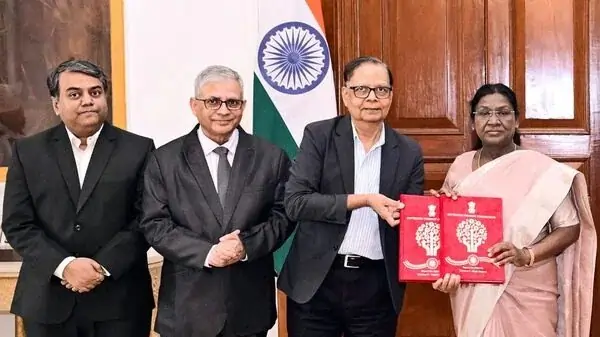
Chaired by noted economist Dr. Arvind Panagariya — former Vice-Chairman of NITI Aayog — the commission was constituted on December 31, 2023, and submitted its final report to President Droupadi Murmu on November 17, 2025. The document represents the latest chapter in India’s evolving framework of fiscal federalism under Article 280 of the Constitution.
Unchanged Vertical Sharing Continues at 41 Per Cent
The most closely watched number in every Finance Commission cycle is the vertical devolution ratio — the proportion of the Centre’s divisible tax pool that flows to the states. The Sixteenth Commission has recommended maintaining this share at 41 per cent, exactly the level fixed by the Fifteenth Finance Commission and in force since 2021–22.
The divisible pool continues to be defined as the gross tax receipts of the Union Government minus the cost of collection, but excluding all cesses and surcharges imposed by Parliament. The commission noted with concern that the increasing reliance on non-shareable levies has steadily shrunk the effective divisible pool. During the early years of the present decade, the share of shareable taxes in total gross tax revenue fluctuated between 74 and 80 per cent, compared with roughly 89 per cent in 2014–15.
The report explicitly states that there is little room to raise the states’ vertical share further without first enlarging the divisible pool itself. To achieve that objective in the longer run, the commission proposed a potential structural “grand bargain”:
- The Union Government would subsume a significant portion of existing cesses and surcharges into the regular tax structure.
- In return, states would accept a somewhat lower percentage share of the now-larger divisible pool.
The suggested arrangement is designed to deliver revenue neutrality for both tiers of government while restoring buoyancy to the shareable tax base. For the current award period, however, the commission judged it prudent to retain the existing 41 per cent vertical devolution ratio.
During the Budget presentation, the Finance Minister confirmed the government’s acceptance of this recommendation and announced an allocation of ₹1.4 lakh crore in Finance Commission grants to states for the financial year 2026–27. The package includes support for rural and urban local bodies as well as disaster response and mitigation.
Revised Horizontal Formula Tilts Modestly Toward High-Performing States
Although the overall share of states remains unchanged, the commission has reworked the criteria and weights used to distribute that 41 per cent among individual states. The new six-factor formula is as follows:
- Population (2011 Census) — 17.5%
- Demographic performance (rewarding lower fertility) — 10%
- Geographical area — 10%
- Forest and ecology — 10%
- Income distance (per-capita GSDP gap from the highest-performing state) — 42.5%
- Contribution to national GDP — 10% (new criterion)
Compared with the Fifteenth Finance Commission formula, the most noticeable changes are:
- Increase in population weight from 15% to 17.5%
- Reduction in demographic performance weight from 12.5% to 10%
- Reduction in area weight from 15% to 10%
- Replacement of the earlier 2.5% weight for “tax and fiscal efforts” with the new 10% weight for contribution to GDP
The introduction of a GDP contribution criterion, even at a relatively modest 10 per cent weight, represents a clear policy signal that economic dynamism and national output generation will receive greater recognition in resource allocation.
Southern States Record Collective Gain of ₹18,330 Crore in First Year
The recalibrated formula produces a noticeable — though not dramatic — redistribution of shares. The five southern states (Andhra Pradesh, Karnataka, Kerala, Tamil Nadu and Telangana) emerge as the largest net beneficiaries.
According to estimates based on a projected divisible pool of ₹15.26 lakh crore for 2026–27, these five states together will receive an additional ₹18,330 crore compared with the shares they would have obtained under the Fifteenth Commission award. Individual changes in percentage shares are:
- Andhra Pradesh: 4.047% → 4.217%
- Karnataka: 3.647% → 4.131%
- Kerala: 1.925% → 2.382%
- Tamil Nadu: 4.079% → 4.097%
- Telangana: 2.102% → 2.174%
Beyond the southern region, several other states also register gains in their relative shares, including Gujarat, Haryana, Maharashtra, Punjab, Assam, Himachal Pradesh, Uttarakhand, Jharkhand and Mizoram.
Hindi Heartland and Some Other States Record Declines
Conversely, the aggregate share of the five large Hindi-belt states — Uttar Pradesh, Bihar, Madhya Pradesh, Chhattisgarh and Rajasthan — is set to decline by approximately ₹17,338 crore in the first year of the award period. The most substantial percentage-point drop occurs in Madhya Pradesh (7.85% → 7.35%). Uttar Pradesh and Bihar, despite remaining the two largest recipients in absolute terms, also see modest reductions:
- Uttar Pradesh: 17.939% → 17.619%
- Bihar: 10.058% → 9.948%
Several northeastern and hill states, together with Odisha, West Bengal and Goa, likewise register lower shares under the new formula.
Emphasis on Fiscal Discipline and No Revenue Deficit Grants
The commission has reiterated the importance of macro-fiscal stability. It recommends that every state limit its fiscal deficit to 3 per cent of its Gross State Domestic Product (GSDP), with borrowings under the Special Assistance to States for Capital Investment scheme excluded from this ceiling.
No state has been recommended for revenue deficit grants during the award period, reflecting the commission’s assessment that most states possess adequate headroom to improve their own tax collection and contain non-essential expenditure.
Looking Ahead
The Sixteenth Finance Commission’s award maintains broad continuity in the vertical sharing arrangement while making targeted adjustments to the horizontal formula that reward economic contribution and demographic responsibility. Although the changes are incremental rather than transformative, they respond to long-standing arguments advanced by higher-income and lower-fertility states for a more performance-sensitive distribution mechanism.
With the recommendations now officially accepted, attention will turn to how states manage the new fiscal envelope, how the Centre addresses the underlying issue of cesses and surcharges, and whether the proposed “grand bargain” on tax structure gains traction in the coming years.
The full report, once publicly released in greater detail, is expected to provide deeper insights into the commission’s assessment of state finances, local-body funding, disaster resilience grants, and long-term fiscal sustainability challenges facing the Indian federation.
FAQs
1. What is the states’ share in central taxes recommended by the 16th Finance Commission, and has it changed from the previous commission?
The 16th Finance Commission (chaired by Dr. Arvind Panagariya) has recommended that states receive 41% of the divisible pool of central taxes (vertical devolution). This remains unchanged from the 15th Finance Commission recommendation implemented since 2021. The divisible pool includes gross tax revenues of the Centre minus collection costs, but excludes cesses and surcharges. The government accepted this recommendation, and Finance Minister Nirmala Sitharaman announced ₹1.4 lakh crore in Finance Commission grants to states for FY 2026-27, covering rural/urban local bodies and disaster management.
2. Why did southern states get a higher share under the new recommendations?
The commission retained the overall 41% vertical share but revised the horizontal devolution formula (how the 41% is divided among states). A major change is the introduction of a new criterion — contribution to national GDP — with a 10% weight, rewarding states that contribute more to India’s economic output. Other adjustments include:
- Population weight increased to 17.5% (from 15%)
- Demographic performance reduced to 10% (from 12.5%)
- Area reduced to 10% (from 15%)
- Income distance (per capita GSDP gap) at 42.5% (from 45%)
- Forest/ecology unchanged at 10%
These tweaks favor more developed, lower-population-growth, and higher-GDP-contributing states. As a result, the five southern states (Andhra Pradesh, Karnataka, Kerala, Tamil Nadu, Telangana) collectively gain an additional ₹18,330 crore in 2026-27 (based on a projected ₹15.26 lakh crore divisible pool), with notable percentage increases for Karnataka (3.647% to 4.131%) and Kerala (1.925% to 2.382%).
3. Which states lose share under the 16th Finance Commission formula, and why?
Several populous, less-developed states — particularly in the Hindi heartland — see a relative decline. The five large Hindi-belt states (Uttar Pradesh, Bihar, Madhya Pradesh, Chhattisgarh, Rajasthan) collectively lose around ₹17,338 crore in the first year compared to the previous formula. Madhya Pradesh experiences the largest drop (7.85% to 7.35%). Uttar Pradesh falls slightly (17.939% to 17.619%), and Bihar to 9.948% from 10.058%. Other states with declines include West Bengal, Odisha, and several northeastern/hill states. The shift occurs because the new formula places less emphasis on area and demographic performance while rewarding GDP contribution and maintaining strong weight on income distance for equity.
4. What did the commission recommend regarding fiscal discipline for states and the Centre?
The commission stressed macro-fiscal stability and recommended capping states’ fiscal deficit at 3% of their Gross State Domestic Product (GSDP), excluding borrowings under the Special Assistance to States for Capital Investment scheme. It did not recommend any revenue deficit grants, noting scope for states to raise their own revenues and rationalize expenditures (including subsidies and public sector enterprises). For the Centre, it suggested reducing the fiscal deficit to 3.5% of GDP by 2030-31. The report also called for outcome-linked spending, greater transparency in devolution data, power sector reforms (including privatization of DISCOMs), and periodic reviews of large cash transfer schemes with exit clauses to prevent fiscal strain.
5. What is the ‘grand bargain’ proposed by the 16th Finance Commission, and why was it suggested?
The commission highlighted that rising cesses and surcharges (not part of the divisible pool) have shrunk the shareable tax base from about 89% of gross tax revenue in 2014-15 to 74-80% in recent years, limiting further increases in states’ vertical share. It proposed a long-term “grand bargain”: the Centre would fold a large portion of cesses/surcharges into regular taxes (expanding the divisible pool), while states accept a lower percentage share — ensuring revenue neutrality for both sides and creating a more efficient, broad-based tax system. For the current 2026-31 period, however, the commission retained the 41% vertical share without this structural change.