

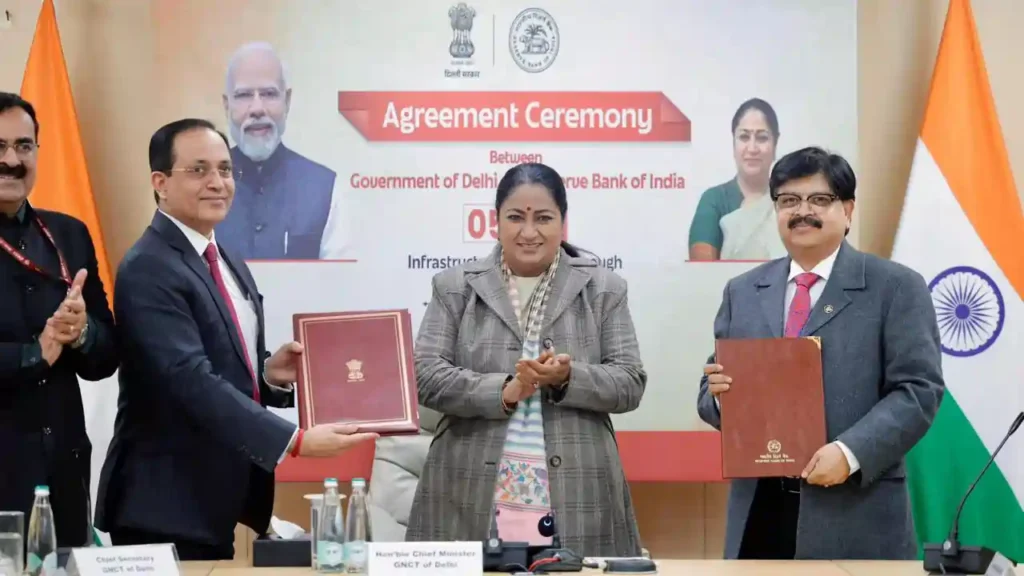
New Delhi: In a groundbreaking development for public finance in India’s capital, the Government of the National Capital Territory of Delhi has formalized a Memorandum of Understanding (MoU) with the Reserve Bank of India (RBI). This agreement positions the RBI as the official banker, debt manager, and financial agent for the Delhi government, integrating the city fully into the central bank’s comprehensive banking, cash flow, and public debt management system for the very first time.
The MoU, executed recently at the Delhi Secretariat, represents a pivotal shift toward enhanced fiscal responsibility and efficiency. It empowers the RBI to oversee critical aspects of Delhi’s financial operations, including the handling of public debt, market borrowings via State Development Loans (SDLs), automated surplus cash investments, and access to affordable short-term liquidity options. This alignment brings Delhi in line with standard practices adopted by most state governments across India.
Key Provisions of the Delhi-RBI MoU
The agreement outlines several transformative mechanisms designed to streamline Delhi’s financial governance:
- RBI’s Core Roles: The central bank will now serve as the primary banker responsible for managing receipts, payments, remittances, and overall banking operations. Additionally, it will act as debt manager for issuing and servicing public debt instruments and as financial agent for broader advisory and operational support.
- Market Borrowings Through SDLs: Delhi can now raise funds directly from the market using State Development Loans, a secure and cost-effective borrowing tool typically available to states. Unlike treasury bills limited to the central government, states including Delhi under this framework can issue only dated securities or bonds known as SDLs.
- Automated Surplus Cash Management: Any excess funds in Delhi government’s accounts will be invested daily through RBI channels, earning interest and preventing idle cash losses.
- Low-Cost Liquidity Support: Access to facilities like Ways and Means Advances and Special Drawing Facilities will help bridge temporary cash mismatches without relying on high-interest emergency options.
All these operations remain strictly governed by guidelines from the Government of India and provisions under the RBI Act, ensuring compliance and transparency.
Historical Context and Nationwide RBI Role
The RBI has long performed similar functions for governments. For the Union Government, Section 20 of the RBI Act, 1934, mandates the central bank to handle receipts, payments, remittances, banking operations, and public debt management. This includes issuing treasury bills (short-term) and bonds (long-term dated securities) to raise funds.
For state governments, such arrangements stem from agreements enabling RBI to manage public debt and related activities. Currently, these pacts cover all states except Sikkim, where only limited public debt management exists. Delhi’s entry into this framework closes a notable gap, as the national capital previously operated outside this structured RBI ecosystem despite its prominence.
The RBI also maintains principal accounts for both central and state governments at its Central Accounts Section in Nagpur, facilitating seamless tracking and reconciliation.
Broader Functions of the Reserve Bank of India
Beyond government banking, the RBI fulfills multiple critical mandates that underpin India’s economic stability:
- Monetary Authority: It formulates, implements, and monitors monetary policy while setting parameters for banking operations in the country’s financial system.
- Foreign Exchange Management: Under the Foreign Exchange Management Act (FEMA), 1999, RBI oversees external transactions.
- Currency Management: The central bank issues and exchanges currency notes, destroys unfit ones, and circulates coins minted by the Government of India.
- Payment and Settlement Systems: RBI regulates and supervises these systems for efficient transactions.
- Banker to Banks: It maintains accounts for all scheduled banks, acting as a lender of last resort.
These roles highlight RBI’s centrality in maintaining economic order, making its expanded involvement with Delhi a strategic enhancement.
Significance and Leadership Perspective
Delhi Chief Minister Rekha Gupta, who also oversees the finance portfolio, hailed the MoU as a “historic correction” and “transformational milestone” in the capital’s financial administration. She emphasized that, despite Delhi’s status as the nation’s capital, it had long been deprived of RBI’s structured support for banking and market borrowings. Gupta noted that prior administrations lacked the initiative to pursue this reform, which now prioritizes fiscal discipline, transparency, and sustainable growth.
The agreement enables professional cash flow oversight, reduces borrowing costs, and introduces efficiency measures that align with international best practices in public finance. It marks a departure from past inefficiencies, fostering long-term financial health for Delhi.
Why This Development Matters for Delhi’s Future
This MoU addresses longstanding anomalies in Delhi’s fiscal setup as a Union Territory with legislative powers. By adopting RBI’s full framework, the capital gains tools for prudent debt raising, optimized cash utilization, and resilient liquidity management. It enhances transparency in public accounts and supports informed policymaking.
Experts view this as a step toward greater fiscal autonomy within constitutional bounds, potentially lowering interest burdens on taxpayers and freeing resources for developmental priorities.
Quick Reference: Delhi-RBI MoU Highlights
- Primary Change: RBI becomes banker, debt manager, and financial agent.
- Borrowing Mechanism: Exclusive use of State Development Loans (SDLs) for market funds.
- Cash Efficiency: Daily automatic investments of surpluses.
- Liquidity Tools: Access to cost-effective advances for short-term needs.
- National Alignment: Matches arrangements with all states except Sikkim.
- Governance Impact: Boosts discipline, transparency, and sustainability.
Looking Ahead: Implications for Public Finance in India
As Delhi integrates into RBI’s established government banking network, this precedent reinforces the central bank’s role in promoting uniform fiscal standards nationwide. It underscores the importance of institutional reforms in unlocking efficiency, particularly for high-expenditure entities like the national capital.
The move also reflects ongoing efforts to modernize public financial management, ensuring that government resources are deployed effectively amid growing urban demands. For residents and stakeholders, it signals a commitment to responsible governance that could yield dividends in infrastructure, services, and economic stability.
This MoU not only resolves a historical oversight but sets a robust foundation for Delhi’s financial future under RBI’s expert stewardship.
FAQs
1. What is the significance of the MoU signed between the Delhi Government and the Reserve Bank of India?
The Memorandum of Understanding (MoU) marks the first time the Government of the National Capital Territory of Delhi has been brought fully under the Reserve Bank of India’s banking, cash management, and debt management framework. This agreement allows the RBI to act as the banker, debt manager, and financial agent for the Delhi government, enabling market borrowings through State Development Loans (SDLs), automatic investment of surplus cash, professional cash management, and access to low-cost liquidity facilities. It introduces greater fiscal discipline, transparency, and long-term financial sustainability in Delhi’s governance.
2. Which institution will now serve as the banker and debt manager for the Delhi Government?
The Reserve Bank of India (RBI) will now officially act as the banker, debt manager, and financial agent for the Delhi Government. Previously, Delhi operated outside this structured RBI framework despite being the national capital. With this MoU, the RBI will manage Delhi’s banking operations, cash flows, public debt, and market borrowings in line with practices followed by most state governments.
3. How does this arrangement benefit Delhi’s financial management?
The MoU provides several key benefits:
- Reduces overall borrowing costs and idle cash losses, thereby enhancing efficiency and promoting fiscal prudence.
- Enables market borrowings exclusively through State Development Loans (SDLs).
- Ensures automatic daily investment of surplus cash balances to earn interest.
- Offers access to low-cost short-term liquidity facilities such as Ways and Means Advances.
- Introduces professional cash flow forecasting and management practices.
4. Was Delhi previously excluded from the RBI’s government banking framework, and how common is this arrangement across India?
Yes, until this MoU, Delhi had not fully adopted the RBI’s comprehensive banking and debt management system, creating a long-standing gap in its financial governance. The RBI already performs similar functions for the Central Government (mandated under Section 20 of the RBI Act, 1934) and for all state governments except Sikkim. With this agreement, Delhi now aligns with the standard institutional framework followed by almost every state in the country.
5. Who led this initiative, and what has been the official response from the Delhi Government?
Delhi Chief Minister Rekha Gupta led the initiative. She described the MoU as a “historic correction” and a “transformational milestone” that previous governments failed to pursue. According to her, the agreement places fiscal discipline, transparency, and long-term sustainability at the core of governance, correcting years of denial of structured RBI support to the national capital and adopting globally accepted norms of fiscal prudence. The MoU was signed at a meeting held at the Delhi Secretariat.