

New Delhi: During German Chancellor Friedrich Merz’s maiden official visit to India on January 12–13, 2026, the two nations achieved an exceptionally comprehensive upgrade of their bilateral relationship. The summit between Prime Minister Narendra Modi and Chancellor Merz produced nineteen new memorandums of understanding and eight high-impact policy announcements, covering virtually every pillar of modern strategic cooperation—from defence industrial collaboration and advanced technology to clean energy transition, critical supply chains, higher education, and enhanced people mobility.
The visit carried deep symbolic weight, coming exactly one year after the two countries marked the 25th anniversary of their Strategic Partnership (in 2025) and precisely during the 75th anniversary of the establishment of full diplomatic relations (in 2026).
Warm Cultural Welcome in Ahmedabad Sets Positive Tone
The programme commenced in Ahmedabad, Gujarat. The two leaders first visited Sabarmati Ashram to pay floral tributes to Mahatma Gandhi, reaffirming the shared commitment to democratic values, non-violence, and mutual respect that underpins the partnership.
They then participated in the colourful International Kite Festival on the Sabarmati Riverfront. Flying kites side by side, the heads of government enjoyed a relaxed, people-centric moment that beautifully illustrated the increasingly warm and multi-dimensional nature of India-Germany ties.
Defence & Security: Foundation Laid for Long-Term Industrial Partnership
The most strategically significant outcome was the signing of a Joint Declaration of Intent to jointly prepare a detailed Defence Industrial Cooperation Roadmap. This forward-looking framework prioritises:
- technology transfer and joint R&D
- co-development of next-generation defence systems
- co-production of military platforms in India
- sustained industrial collaboration between Indian and German defence companies
Both sides welcomed intensified military-to-military engagement, including regular staff talks, service-level exchanges, joint exercises, training programmes, and senior-level visits.
India specifically appreciated Germany’s confirmed participation in several marquee Indian-led events:
- Multinational Naval Exercise MILAN
- Indian Ocean Naval Symposium Conclave of Chiefs (February 2026)
- Air Combat Exercise Tarang Shakti (later in 2026)
Germany will also deploy a dedicated Liaison Officer to India’s Information Fusion Centre–Indian Ocean Region, significantly enhancing real-time maritime security cooperation in the wider Indian Ocean.
In parallel, the two governments formally launched a new Track 1.5 Foreign Policy and Security Dialogue, creating a flexible channel for candid exchanges between senior officials and independent strategic experts.
Robust Economic Ties & Strong Momentum Toward India-EU FTA
Bilateral trade (goods + services) crossed the US$50 billion mark in 2024, with Germany accounting for over 25% of India’s total trade with the entire European Union. Germany continues to rank as the ninth-largest source of foreign direct investment into India.
Both leaders reiterated their strong support for the early conclusion of a comprehensive India–European Union Free Trade Agreement. Chancellor Merz conveyed measured optimism that a political-level breakthrough could be achieved before the end of January 2026—an outcome that would dramatically accelerate economic integration.
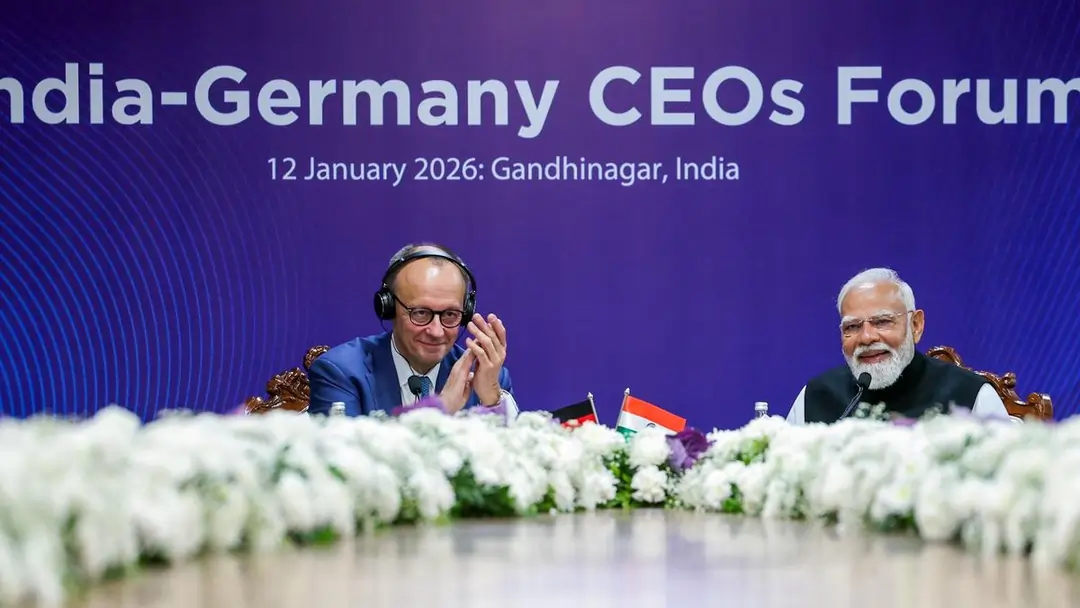
To maintain forward momentum in the commercial domain, the two sides formally welcomed the establishment of a high-level India-Germany CEO Forum, designed to facilitate direct, regular interaction between leading business figures from both countries.
Climate Action & Green Energy: Concrete New Commitments
Under the ongoing Green and Sustainable Development Partnership (GSDP), Germany has already committed or earmarked nearly €5 billion out of its total €10 billion pledge running through 2030.
New announcements during the visit included:
- Additional funding commitment of €1.24 billion to support major Indian initiatives, notably the PM e-Bus Sewa scheme and large-scale green hydrogen projects
- Decision to establish a dedicated India-Germany Centre of Excellence focused on green technology, climate innovation, and low-carbon solutions
- Creation of new joint working groups on battery energy storage, solar manufacturing, and wind energy development
A major commercial breakthrough was the signing of one of the largest green ammonia offtake agreements under India’s National Green Hydrogen Mission. Indian company AM Green will supply green ammonia to German energy major Uniper Global Commodities, creating a concrete bridge between India’s green hydrogen ambitions and Germany’s National Hydrogen Strategy.
Technology, Critical Minerals, Semiconductors & Enhanced People Mobility
Multiple agreements target strategic technologies and supply-chain security, including deeper institutional cooperation across the full semiconductor value chain, critical minerals security, next-generation telecommunications, digital public infrastructure, artificial intelligence, and broader innovation ecosystems.
On the human dimension, Germany introduced a visa-free airside transit facility for Indian passport holders, allowing seamless international transit through major German airports without requiring an Airport Transit Visa. This practical measure is expected to substantially ease international travel for students, professionals, tourists, and business travellers.
Education and skills received fresh momentum through the adoption of a comprehensive Indo-German Roadmap on Higher Education. Additional instruments cover vocational training in renewable energy sectors, expanded youth and sports exchanges (with special focus on youth hockey), and joint development of the National Maritime Heritage Complex at Lothal in collaboration with the German Maritime Museum.
Shared Global Outlook & Indo-Pacific Vision
The leaders reaffirmed their joint commitment to a free, open, inclusive, and rules-based Indo-Pacific, grounded in respect for international law, including the United Nations Convention on the Law of the Sea. They announced the creation of a new dedicated bilateral Indo-Pacific consultation mechanism.
Both governments reiterated strong support for the India–Middle East–Europe Economic Corridor (IMEC) and once again called for comprehensive reform of the United Nations Security Council.
The two countries issued a clear, unified condemnation of terrorism in all its forms—including cross-border terrorism—and pledged to strengthen cooperation through UN-led and multilateral channels.
On current international conflicts, the leaders expressed serious concern about the situations in Ukraine and Gaza, stressing the urgent need for sustained dialogue, full humanitarian access, and political solutions consistent with international law.
Looking Ahead
Chancellor Merz continued his programme in Bengaluru, focusing on India’s thriving technology and innovation ecosystem. Both leaders agreed that the next round of India-Germany Inter-Governmental Consultations will take place in Germany later in 2026.
With this exceptionally productive and wide-ranging visit, India and Germany have firmly positioned their Strategic Partnership as one of the most dynamic and future-oriented bilateral relationships in the contemporary world—capable of delivering concrete results across defence, clean energy, advanced technology, economic prosperity, and global stability for decades to come.
FAQs
1. What were the major highlights of Chancellor Friedrich Merz’s visit to India in January 2026?
The visit resulted in the signing of 19 MoUs and 8 major announcements. Key highlights included:
- A Joint Declaration of Intent to create a long-term Defence Industrial Cooperation Roadmap (focused on co-development, co-production, and technology partnerships)
- New funding of €1.24 billion under the Green and Sustainable Development Partnership
- One of the largest green ammonia offtake agreements under India’s National Green Hydrogen Mission (AM Green → Uniper)
- Introduction of visa-free airside transit for Indian passport holders through German airports
- Launch of a new Track 1.5 Foreign Policy and Security Dialogue
- Adoption of a comprehensive Indo-German Roadmap on Higher Education
- Strong joint push for early conclusion of the India-EU Free Trade Agreement
The visit also marked 75 years of diplomatic relations (2026) following the 25th anniversary of the Strategic Partnership (2025).
2. Will Indian passport holders really get visa-free transit in Germany now?
Yes. During the visit, Germany officially announced a visa-free airside transit facility for Indian passport holders.
This means Indian travellers can transit through major German international airports (Frankfurt, Munich, Berlin, etc.) without needing an Airport Transit Visa (ATV), provided they:
- remain in the international/transit area (airside)
- hold a confirmed onward ticket to a third country
- do not need to pass through immigration/enter Germany proper
The measure is expected to significantly ease international travel, especially for connecting flights to Europe, North America, and other destinations.
3. What exactly is the new Defence Industrial Cooperation Roadmap between India and Germany?
It is a strategic long-term framework agreed upon through a Joint Declaration of Intent signed during the visit.
Main objectives include:
- Joint research, development, and technology transfer in defence systems
- Co-development and co-production of advanced military platforms in India
- Building sustainable industrial partnerships between Indian and German defence companies
- Promoting greater integration of German technology into India’s defence manufacturing ecosystem under the ‘Make in India’ initiative
This roadmap is seen as a major step toward deeper and more institutionalised defence-industrial collaboration between the two countries.
4. How significant is the green ammonia deal signed during the visit?
Very significant — it is one of the largest offtake agreements concluded so far under India’s National Green Hydrogen Mission.
- Indian company AM Green will supply green ammonia (produced using renewable energy) to German energy major Uniper Global Commodities
- The deal creates a direct commercial linkage between India’s green hydrogen ecosystem and Germany’s National Hydrogen Strategy
- It supports large-scale decarbonisation of energy-intensive industries (fertilisers, chemicals, shipping, steel, etc.) in both countries and globally
This commercial agreement is considered a concrete milestone in bilateral clean energy cooperation.
5. When and where will the next major official meeting between India and Germany take place?
The two leaders agreed that the next round of India-Germany Inter-Governmental Consultations (the highest institutional mechanism between the two countries) will be held in Germany later in 2026.
These consultations usually involve the Prime Minister and Chancellor, along with several key ministers from both sides, and serve as the primary platform to review and advance the entire spectrum of bilateral cooperation.