

New Delhi: Chief Justice of India (CJI) Surya Kant has strongly advocated for sweeping institutional changes to boost female participation in the judiciary, describing it as vital for building trust among India’s roughly 650 million women and enhancing the overall legitimacy of the justice system.
Speaking at the inaugural session of the First National Conference of Indian Women in Law on International Women’s Day (March 8, 2026), CJI Surya Kant delivered a compelling keynote address under the theme “Half the Nation – Half the Bench”. He stressed that limited female presence on the bench is not merely a numerical shortfall but a deeper issue of institutional adequacy and fairness.
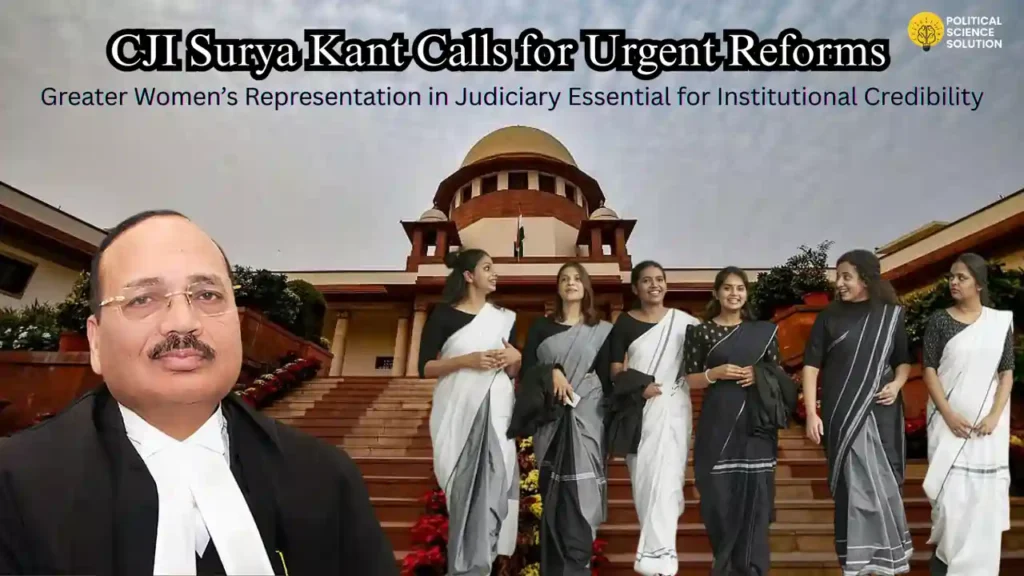
Stark Gender Disparity in Higher Judiciary
Current statistics paint a concerning picture of women’s representation in India’s higher courts. In the Supreme Court, only one woman judge serves among a total working strength of 33 judges, accounting for just about 3%. This lone representative is Justice B.V. Nagarathna, with no fresh elevations of women judges occurring since September 2021.
High Courts fare marginally better but remain far from balanced. Women constitute approximately 14.85% of judges, with 116 women out of a working strength of around 781 judges across 25 High Courts (as per official data from early February 2026). Over the years, only 291 women have been appointed to High Courts out of 5,161 total appointments, equating to a mere 5.6%.
Some High Courts show relatively stronger inclusion: Punjab and Haryana High Court leads with 18 women judges, while Bombay and Madras High Courts each have about a dozen. Recent progress includes the Centre’s approval of Justice Lisa Gill from Punjab and Haryana High Court as Chief Justice of Andhra Pradesh High Court, making her the third woman Chief Justice of a High Court.
In contrast, district and subordinate courts offer hope for future change, with women making up around 36.3% to 37-38% of judicial officers, reflecting a generational widening at the entry level.
Root Causes Behind Low Representation
CJI Surya Kant identified several structural and systemic barriers hindering women’s advancement. The seniority-cum-merit principle often advantages those with longer careers in a traditionally male-dominated domain. The collegium system for appointments, historically male-led, restricts women’s access to senior positions in the Bar.
Women lawyers and judges face persistent workplace hurdles, including gender bias, inadequate infrastructure, late-night professional demands, unreported harassment, and constant questioning of their competence. These create “invisible costs” that disproportionately burden women, contributing to a “leaky pipeline” phenomenon—where many qualified women enter the lower judiciary but few progress to higher benches.
Why Women’s Presence Strengthens Justice Delivery
The CJI emphasized that greater female representation goes beyond diversity quotas. Women judges infuse benches with distinct insights drawn from lived experiences in households, workplaces, and societal realities. Their contributions deepen judicial engagement with everyday issues without altering constitutional principles.
He argued that a judiciary reflecting half the nation’s population fosters gender-sensitive adjudication, promotes equal decision-making, builds public confidence—particularly among 650 million women—and serves as powerful role models encouraging more women to pursue legal careers.
CJI recalled Justice Fathima Beevi’s historic 1989 appointment as the first woman Supreme Court judge, who remarked, “I have opened the door.” Over three decades later, he urged that this door must stay open through deliberate institutional design, not sporadic individual successes.
Concrete Reforms Proposed by CJI
To bridge the gap, CJI Surya Kant urged High Court collegiums to treat the elevation of meritorious women Bar members as standard practice, not an outlier. Where local or age-bracket constraints limit options, collegiums should broaden their search to include eligible women advocates from the relevant state practicing in the Supreme Court.
“The moment for measured action is not in the future—it is now,” he declared, stressing that institutional intent requires pairing with “institutional imagination.” He cautioned against complacency, noting that nurturing the pipeline from its base is essential: “If the pipeline is narrow at its source, the bench cannot later be broad.”
He highlighted supportive Supreme Court directives reserving at least 30% seats for women in State Bar Councils and Bar Association elections to fortify the foundational layer of female lawyers.
Call for Collective Responsibility and Enduring Change
CJI Surya Kant made a direct appeal to male members of the Bar: women seek not concessions but overdue fair representation. He clarified that the demand centers on equal opportunity and a level starting line, enabling competence to shine.
Every woman ascending to the bench, he said, signals to aspiring female lawyers that perseverance is valued and belonging is assured. True progress, however, must transcend individual tenures or personalities.
“The story should not be that one individual secured greater representation,” he concluded. “It should be that the Supreme Court of India, and the High Courts across the country, consciously embedded fairness into their processes.” Only then will representation become structurally anchored and sustainable.
Event Highlights and Broader Context
Organized by Indian Women in Law (iWiL)—led by senior advocates Mahalakshmi Pavani and Shobha Gupta—the conference assembled women judges from High Courts, sitting Supreme Court justices including Justice B.V. Nagarathna and Justice Ujjal Bhuyan, and former CJI N.V. Ramana. Panels addressed gender gaps, inclusive benches, and reform pathways.
As discussions unfold, CJI Surya Kant’s address stands as a landmark push for systemic transformation, aligning with ongoing efforts to make India’s judiciary more representative and responsive in a rapidly evolving democratic landscape.
FAQs
1. What is the current representation of women judges in India’s Supreme Court?
As of March 2026, the Supreme Court has only one woman judge out of a total working strength of 33 judges (approximately 3%). This solitary position is held by Justice B.V. Nagarathna. No new woman judge has been elevated to the Supreme Court since September 2021, highlighting a persistent gap in the apex court despite historical appointments totaling just 11 women judges ever.
2. How many women judges serve in India’s High Courts, and what percentage do they represent?
Across the 25 High Courts in India, women constitute approximately 14.85% of sitting judges. According to Ministry of Law and Justice data from February 6, 2026, there are 116 women judges out of a working strength of 781 judges. Representation varies by court: Punjab and Haryana High Court leads with 18 women judges (29.51% of its bench), followed by Delhi and Madras High Courts with about 10 each (around 22.73% and 18.87%, respectively). Bombay High Court has roughly a dozen women judges (around 15%).
3. Why is women’s representation significantly higher in district and subordinate courts compared to higher judiciary?
Women make up around 36.3% to 37-38% of judicial officers at the district level, reflecting a generational shift and a widening “pipeline” at the entry point. This stronger base stems from increased entry of women into judicial services on merit, without reservations. CJI Surya Kant noted this as an encouraging foundation that could eventually translate to higher courts if the pipeline is nurtured properly. In contrast, the “leaky pipeline” in higher judiciary results from structural barriers, delaying women’s progression despite qualifications.
4. What are the main reasons for low representation of women in higher courts, according to CJI Surya Kant?
CJI Surya Kant identified several interconnected factors:
• The seniority-cum-merit criteria favor longer tenures in a historically male-dominated profession.
• The male-dominated collegium appointment system limits women’s access to senior Bar positions.
• Workplace challenges include gender bias, inadequate infrastructure, late-night briefings, unreported bias, and repeated questioning of authority, imposing “invisible costs” disproportionately on women.
• The “leaky pipeline” effect sees many qualified women enter but few reach senior benches. He emphasized these are not about seeking concessions but ensuring fair representation and equal opportunity.
5. What reforms did CJI Surya Kant propose to increase women’s participation in the judiciary?
CJI Surya Kant urged High Court collegiums to make elevating meritorious women Bar members the norm, not an exception. Where suitable local candidates in specific age brackets are unavailable, collegiums should widen their consideration to include eligible women advocates from the relevant state practicing in the Supreme Court. He stressed that institutional intent must pair with “institutional imagination” and that reform is a continuous process, not dependent on individual tenures. He also highlighted Supreme Court directives reserving at least 30% seats for women in State Bar Councils and Bar Association elections to strengthen the foundational pipeline. Ultimately, he called for embedding fairness structurally so representation becomes routine, boosting public trust and gender-sensitive justice.