
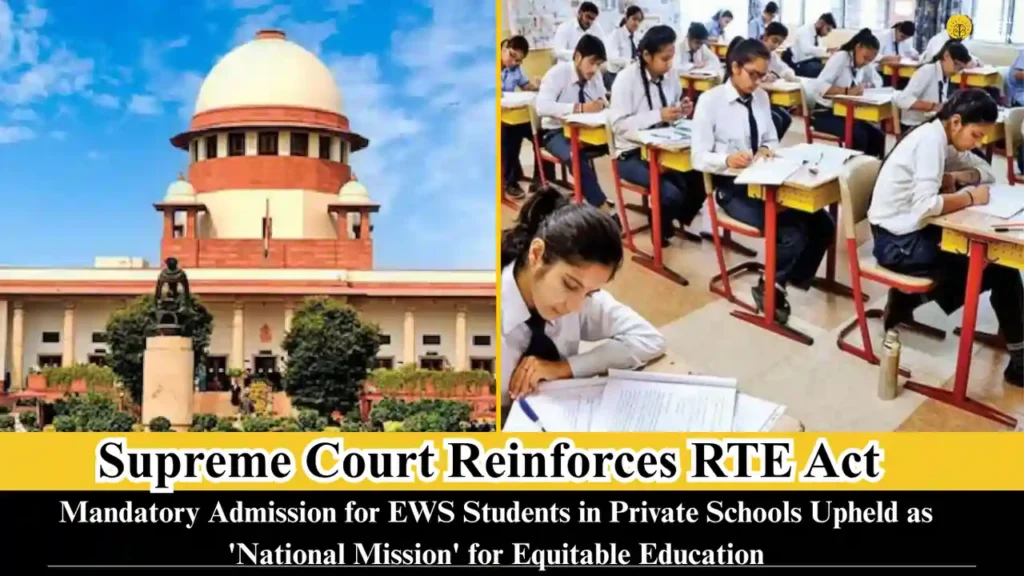
New Delhi, April 30, 2026 – In a landmark ruling that strengthens the foundations of inclusive education in India, the Supreme Court has emphatically upheld the mandatory admission of students from economically weaker sections (EWS) and disadvantaged groups under the Right of Children to Free and Compulsory Education (RTE) Act, 2009. The apex court described the 25% reservation provision in private unaided neighbourhood schools as a powerful tool with the “extraordinary capacity to transform the social structure of our society.”
The verdict came in the case of Lucknow Public School Vs. The State of Uttar Pradesh & Ors., where a bench comprising Justices P.S. Narasimha and Alok Aradhe dismissed an appeal by a Lucknow-based private school that had refused admission to a child selected under the RTE quota despite allocation by the state government.
Understanding the Right to Education Act, 2009: Constitutional Backbone of Inclusive Learning
The Right of Children to Free and Compulsory Education Act, 2009, commonly known as the RTE Act, was enacted to give concrete effect to Article 21A of the Indian Constitution. Introduced through the 86th Constitutional Amendment Act of 2002, Article 21A guarantees every child aged 6 to 14 years the fundamental right to free and compulsory education in a neighbourhood school until the completion of elementary education.
At its core, the RTE Act places a clear duty on the appropriate Government and local authorities to establish schools, provide necessary infrastructure, appoint qualified teachers, and ensure adequate learning facilities. Beyond government schools, the legislation introduces a bold mechanism for social inclusion by mandating 25% reservation in private unaided schools for children belonging to economically weaker sections and disadvantaged groups. In return, private schools are entitled to reimbursement from the State for the per-child expenditure incurred.
This provision aims to break down socio-economic barriers in education and foster an environment where children from diverse backgrounds learn together from an early age, promoting both academic excellence and social cohesion.
Key Highlights of the Supreme Court Judgement in Lucknow Public School Case
Delivering the judgement on April 28, the Supreme Court bench made several critical observations that have far-reaching implications for the implementation of the RTE Act across the country.
The court ruled that neighbourhood schools—including private unaided institutions—are constitutionally and statutorily obligated to provide immediate admission to eligible students allotted by the state government under the RTE framework. Any delay or denial of admission violates the fundamental right to education enshrined under Article 21A.
“Justices P.S. Narasimha and Alok Aradhe observed that denying admission to children from weaker and disadvantaged sections undermines the very purpose of the RTE Act,” the bench noted. The judges emphasized that once the state government forwards the list of selected students, private schools have no option but to grant admission without questioning or overriding the eligibility decisions made by government authorities.
The Supreme Court described the effective implementation of the 25% reservation as a “national mission” and stressed that admission into pre-primary classes must be treated with utmost seriousness. “The obligation of a ‘neighbourhood school’ to admit children belonging to weaker and disadvantaged sections of our society, to the extent of twenty-five percent of the class strength, under Section 12 of the RTE Act, 2009 has the extraordinary capacity to transform the social structure of our society,” the verdict stated.
Upholding the decision of the Allahabad High Court, the Supreme Court dismissed the appeal filed by Lucknow Public School. The private institution had challenged the mandatory admission directive, but the apex court made it clear that schools cannot obstruct the process, as doing so would render the fundamental right to education an “empty promise.”
Significance of the Ruling: Advancing Substantive Equality and Fraternity
This judgement holds profound significance for India’s education landscape. By reinforcing the mandatory nature of RTE admissions, the Supreme Court has promoted substantive equality and social integration starting from early childhood. The ruling gives enforceable and operational meaning to the constitutional principle of fraternity—one of the core values outlined in the Preamble of the Indian Constitution.
The verdict also aligns with the vision of a Common School System as recommended by the Kothari Commission (1964-66), which advocated for a unified education framework accessible to all children irrespective of their socio-economic background.
Experts believe the decision will act as a strong deterrent against resistance from private schools and send a clear message that the RTE Act is not a mere policy suggestion but a binding legal obligation backed by constitutional mandate.
Persistent Challenges in RTE Implementation Despite Legal Victories
While the Supreme Court’s ruling provides much-needed judicial clarity, the ground reality of RTE implementation continues to face multiple hurdles.
At the school level, many private unaided institutions continue to show resistance towards the full inclusion of EWS students. Reports suggest instances where schools cite infrastructure constraints, administrative difficulties, or concerns over academic standards as reasons for non-compliance, though such objections have now been firmly rejected by the apex court.
Another major issue is the hidden costs that often burden poor families. Although the RTE Act promises free education, expenses related to uniforms, textbooks, notebooks, school bags, and other learning materials frequently shift the financial load onto economically weaker parents, defeating the purpose of “free” education.
Weak monitoring mechanisms, limited accountability of implementing agencies, inter-state variations in execution and outcomes, and inadequate grievance redressal systems further complicate effective delivery. Last-mile challenges in reaching the most marginalized communities remain a persistent concern.
The Supreme Court’s emphasis on immediate admission without delay is expected to address some of these implementation gaps by reducing procedural delays and bureaucratic hurdles at the school level.
Other Constitutional Provisions Supporting Right to Education
The RTE Act does not operate in isolation. It draws strength from several other constitutional provisions that underscore the importance of education in nation-building.
- Fundamental Duty under Article 51A(k): This provision imposes a duty on every parent or guardian to provide opportunities for education to their child or ward between the ages of 6 and 14 years.
- Directive Principles of State Policy under Article 45: This article directs the State to endeavour to provide early childhood care and education for all children below the age of six years.
Together, these provisions create a comprehensive constitutional framework aimed at ensuring universal access to quality education and laying the foundation for an equitable society.
What This Means for Stakeholders: Private Schools, Parents, and Government
For private unaided schools, the message from the Supreme Court is unambiguous: compliance with Section 12 of the RTE Act is non-negotiable. Schools must admit allotted EWS students promptly and cannot challenge the selection process conducted by the government. Failure to do so may invite legal consequences, including contempt proceedings or other penalties as per law.
For parents of EWS and disadvantaged children, the ruling reinforces hope and accessibility. It strengthens their ability to claim the fundamental right to education without facing arbitrary denial or delays from neighbourhood private schools.
The State Governments now carry an even greater responsibility to ensure smooth implementation. This includes timely identification and allotment of students, prompt reimbursement to private schools, robust monitoring mechanisms, and effective grievance redressal systems. States must also address hidden costs by ensuring that uniforms, books, and other materials are provided free of cost as envisaged under the Act.
Looking Ahead: Towards a Truly Inclusive Education Ecosystem
The Supreme Court’s verdict in Lucknow Public School Vs. The State of Uttar Pradesh & Ors. marks a significant milestone in the journey towards realizing the constitutional promise of education for all. By describing the RTE admissions process as a “national mission,” the apex court has elevated the issue from a mere statutory requirement to a constitutional imperative that demands collective action from all stakeholders.
As India strives to build a knowledge-based society and achieve the goals of sustainable development, inclusive education remains central. The effective implementation of the 25% reservation can play a transformative role in reducing educational disparities, promoting social mobility, and fostering national integration.
While challenges persist, judicial pronouncements like this provide the necessary momentum and legal backing to overcome resistance and ensure that every child, regardless of their economic background, gets an equal opportunity to learn and grow in a diverse classroom environment.
The ruling is expected to have a cascading effect on pending cases and future disputes related to RTE admissions across various High Courts. Education activists and policy experts have welcomed the decision, viewing it as a step forward in making quality education truly accessible and equitable.
Conclusion
The Supreme Court has once again reaffirmed its commitment to protecting the fundamental rights of children by upholding mandatory RTE admissions. This judgement not only strengthens the RTE Act but also serves as a clarion call to all stakeholders to work towards building an education system that truly reflects the constitutional values of justice, liberty, equality, and fraternity.
Parents, schools, and governments must now align their efforts to translate this judicial wisdom into on-ground reality. Only then can the transformative potential of the Right to Education Act be fully realized, ensuring that no child is left behind in India’s pursuit of inclusive growth and social justice.
FAQs
Q1. What did the Supreme Court rule in the Lucknow Public School vs State of Uttar Pradesh case regarding RTE admissions?
Answer:
On April 28, 2026, the Supreme Court upheld the mandatory admission of students under the Right to Education (RTE) Act, 2009. A bench of Justices P.S. Narasimha and Alok Aradhe ruled that all neighbourhood schools, including private unaided institutions, are legally and constitutionally obligated to immediately admit students allotted by the state government under the 25% EWS quota. The court dismissed the appeal filed by Lucknow Public School and held that schools cannot deny or delay admission once the student is selected by the government.
Q2. Why is the Supreme Court judgement on RTE Act considered a ‘national mission’?
Answer:
The Supreme Court described the effective implementation of the 25% reservation for economically weaker and disadvantaged sections under Section 12 of the RTE Act as a “national mission”. The bench observed that this provision has the “extraordinary capacity to transform the social structure of our society” by promoting inclusion, substantive equality, and social integration from early childhood. The court emphasized that denying admission to EWS students would render the fundamental right to education under Article 21A meaningless.
Q3. Does the Supreme Court RTE verdict apply only to Uttar Pradesh or across India?
Answer:
The judgement has nationwide implications. It applies to all neighbourhood schools across India, including private unaided schools. The Supreme Court has clearly stated that once a child is selected under the RTE quota by the state government, the school is bound to grant immediate admission without questioning the eligibility or delaying the process. This ruling strengthens the implementation of the RTE Act, 2009 across the country.
Q4. What are the major challenges in implementing the RTE Act even after the Supreme Court order?
Answer:
Despite the Supreme Court’s clear directive, several challenges persist. These include resistance by some private schools to fully include EWS students, hidden costs (uniforms, books, and stationery) that burden poor families, weak monitoring mechanisms, inter-state variations in implementation, inadequate grievance redressal systems, and last-mile delivery issues. The court’s ruling aims to reduce school-level resistance by making admission mandatory and immediate.
Q5. What does the Supreme Court RTE judgement mean for private schools and EWS parents?
Answer:
For private unaided schools, the judgement means they have no choice but to admit students selected under the 25% RTE quota without delay. They are entitled to reimbursement from the government but cannot refuse admission.
For parents of EWS and disadvantaged children, it strengthens their fundamental right under Article 21A. They can now expect smoother and faster admission into neighbourhood private schools. The ruling also reinforces the duty of the state to ensure free and compulsory education till Class 8.