

New Delhi: In a dramatic setback for the Union government during a rare special sitting of Parliament, the Constitution (131st Amendment) Bill, 2026, which aimed to fast-track 33% reservation for women in the Lok Sabha and state legislatures from the 2029 elections while expanding the Lower House through a fresh delimitation exercise, was decisively defeated on April 17, 2026. The bill failed to secure the mandatory two-thirds majority in the Lok Sabha, with 298 members voting in favour and 230 against it, out of 528 present and voting. This outcome has stalled not only the core amendment but also two linked legislations—the Union Territories Laws (Amendment) Bill, 2026, and the Delimitation Bill, 2026—prompting the government to shelve them entirely, as they could not be viewed in isolation.
The defeat marks a significant victory for the united Opposition, particularly parties from southern and northeastern states, who argued that the package was less about empowering women and more about redrawing India’s electoral map to favour populous northern states. Parliamentary Affairs Minister Kiren Rijiju expressed deep disappointment, describing the legislation as a historic measure for women that represented a missed opportunity for consensus on a key reform. He reiterated the government’s commitment under Prime Minister Narendra Modi to continue efforts for greater representation and respect for women. Home Minister Amit Shah, who replied to the two-day debate, highlighted an existing imbalance in the voter-to-MP ratio across states and defended delimitation as the only way to correct it, while accusing the Congress of historically depriving citizens of this exercise both in power and now in opposition.
The voting followed intense deliberations in the Lok Sabha, where the House was adjourned shortly after the results and is scheduled to reconvene on April 18, 2026, at 11 a.m. With 528 members participating and zero abstentions, the bill fell short of the 352 votes required for passage under constitutional norms. This special session, convened amid ongoing state elections in five states, had been positioned by the government as a milestone for Nari Shakti (women’s power), building on the Nari Shakti Vandan Adhiniyam passed unanimously in 2023 and notified only late on April 16, 2026. However, the Opposition framed the amendments as a “panic reaction” that weaponised women’s rights to advance a deeper political agenda.
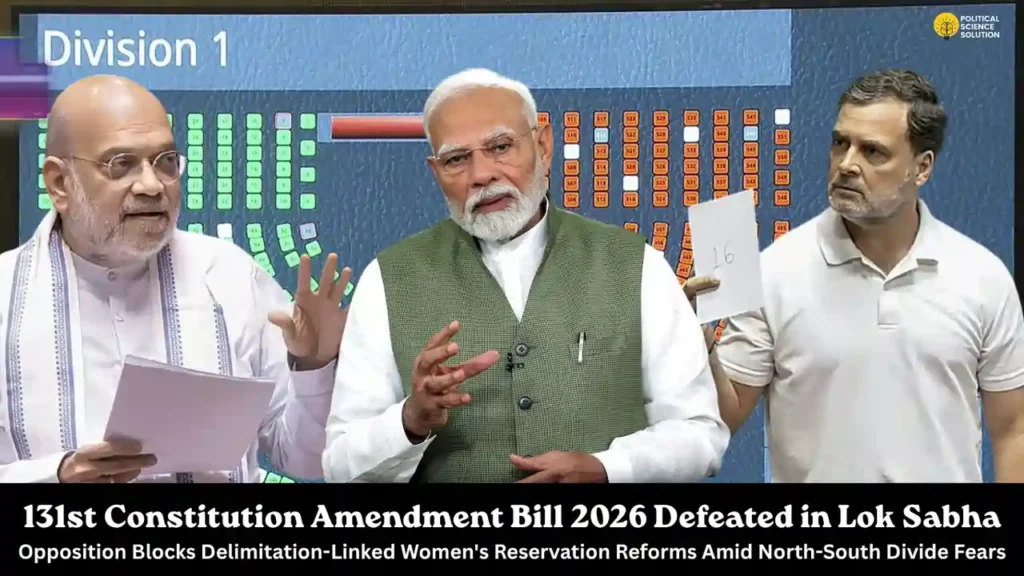
Rahul Gandhi’s Fiery Opposition: Bill Labelled ‘Anti-National’ and a Threat to Federalism
Leader of Opposition Rahul Gandhi delivered a hard-hitting speech that set the tone for the Opposition’s resistance, declaring the bill had “nothing to do with women’s reservation” but was instead an attempt to alter the country’s electoral map by stripping representation from southern, northeastern, and smaller states. He termed it “nothing short of an anti-national act” and assured the House that the entire Opposition would defeat this “attempt to attack the nation state” and deprive Dalits and OBCs of their rightful place. Gandhi walked out after his address without listening to replies, prompting BJP MP Anurag Thakur to criticise the move as against House rules, though Speaker Om Birla urged decorum and clarified members could leave if they wished.
Gandhi painted a broader picture, alleging the government was bypassing a caste census and denying space to minorities, including Dalits and OBCs, whom he said were called Hindus but given no real place in the country. He referenced past delimitation exercises in Jammu and Kashmir and Assam as examples of “rejigging” the political map and recalled lessons from his grandmother, former Prime Minister Indira Gandhi, about truth often lying in darkness and requiring courage to fight for it. In a lighter moment, he praised his sister Priyanka Gandhi Vadra’s speech the previous day for making Amit Shah laugh—something he claimed he hadn’t achieved in 20 years. Gandhi concluded by referencing “16” as the answer to the “riddle,” dismissing Prime Minister Modi’s address as “low energy” and asserting the bill was a calculated move to send messages of being pro-women while changing electoral dynamics. He urged the BJP to “stop hiding behind the people of India” and the armed forces.
Congress general secretary Jairam Ramesh echoed this in a post on X, calling the government’s attempt a “nefarious and mischievous” linkage of “dangerous delimitation proposals” to women’s reservation, now decisively defeated. He hailed it as a win for democracy, federalism, and the Constitution, while questioning the legitimacy of the “non-biological, non-grihasthi PM.” Ramesh demanded immediate implementation of the 33% women’s quota in the existing 543-seat Lok Sabha setup for the 2029 elections, a consistent Opposition demand since the 2023 Act.
Amit Shah’s Defence: Guarantees to Southern States and Critique of Congress Record
Home Minister Amit Shah, in his detailed reply, sought to allay fears by guaranteeing that southern representation would not diminish post-delimitation. He assured the House that MPs from southern India have the same rights as those from the north, extending fairness even to small Union Territories like Lakshadweep. Shah revealed the government plans a 50% pro-rata increase in Lok Sabha seats across all states, correcting the imbalance where some states have lakhs of voters per MP while others have far fewer. He pointed out that India’s population has surged since 1976, yet MP numbers remained static for nearly 50 years, and cited Indira Gandhi’s own 1972 increase from 522 to 543 seats as precedent.
Shah emphasised that delimitation would boost Scheduled Caste and Scheduled Tribe seats and accused opponents of being against such expansion. He highlighted the BJP’s consistent support for women’s participation, noting the rise from 22 women MPs in the first Lok Sabha to 75 in the 18th. Shah contrasted this with Congress’s alleged historical opposition to women’s reservation, citing the 1992 panchayat quota under P.V. Narasimha Rao (which Congress did not back fully) and Deve Gowda-era resistance. On caste issues, he accused Congress of never having an OBC Prime Minister, stalling the Mandal Commission in 1980, and opposing OBC reservation in 1990 under Rajiv Gandhi. Shah urged passage of the bills, offering an official amendment for the 50% seat increase if the Opposition agreed, and even suggested adjourning for an hour to build consensus—though Samajwadi Party chief Akhilesh Yadav expressed distrust in the BJP’s reform intentions.
Women and Child Development Minister Annpurna Devi reinforced these points, condemning Opposition “unparliamentary expressions” and accusing them of breaking the hopes of crores of women. She questioned Congress’s OBC record and credited Modi with granting constitutional status to the OBC Commission. BJP MP Hema Malini also spoke in favour, appealing for women’s independence and respect while thanking Modi.
Southern States Lead the Charge: Fears of Discrimination and Federalism Attack
Opposition from southern states was vocal and unified. DMK MP A. Raja called the bill a “nefarious attempt” by the Prime Minister and Home Minister to promote North-South discrimination under the guise of women’s rights, aiming for perpetual central rule, a theocratic state, and one language-one culture. He vowed Tamil Nadu’s opposition. DMK MP Kanimozhi accused the BJP of using women as a “shield for electoral gain,” criticising the lack of consultation with Chief Ministers, the postponement of the 2021 census, and the timing amid state polls. INC MP Hibi Eden from Kerala labelled the Delimitation Bill a “blatant attack on the cooperative federal structure,” questioning why no state would lose its share if progress in education and population control wasn’t being penalised.
Tamil Nadu Chief Minister M.K. Stalin reacted swiftly, declaring “Tamil Nadu defeats Delhi” and posting a portrait of himself setting a copy of the Delimitation Bill on fire. He promised to defeat “Delhi’s arrogance” alongside supporters on April 23. Congress MP Varsha Gaikwad opposed the Delimitation Bill disguised as women’s quota, demanding implementation on current seats and questioning BJP’s ability to elect a woman party chief or RSS chief. TMC’s Kalyan Banerjee supported women’s reservation on existing strength but rejected linking it to delimitation, citing low female representation in BJP ranks (12.91% in Lok Sabha, 16.98% in Rajya Sabha). SAD leader Harsimrat Kaur Badal supported reservation but not the goalpost shift, noting her party reached Parliament without quotas.
Smaller parties and allies added layers. JD(S) leader H.D. Kumaraswamy dismissed DMK arguments as “fear mongering” not reflective of southern views, while TDP MP Lavu Sri Krishna Devarayalu backed both bills after Shah’s 50% seat increase assurance for Andhra Pradesh. National Conference MP Mian Altaf Ahmad cited chaos from past delimitation in J&K and Assam, questioning the Commission’s credibility.
Proposed Seat Expansion and Broader Implications
The Delimitation Bill, 2026, had proposed expanding the Lok Sabha from 543 to 850 seats (815 for states, 35 for Union Territories) based on the 2011 Census, with a 50% pro-rata increase per state to maintain current proportions. According to details shared during the debate:
- Uttar Pradesh: 80 to 120 seats
- Maharashtra: 48 to 72
- West Bengal: 42 to 63
- Bihar: 40 to 60
- Tamil Nadu: 39 to 59
- Madhya Pradesh: 29 to 44
- Karnataka: 28 to 42
- Gujarat: 26 to 39
- Andhra Pradesh: 25 to 38
- Rajasthan: 25 to 38
- Odisha: 21 to 32
- Kerala: 20 to 30
- Telangana: 17 to 26
Shah and Modi had assured no southern state would lose share, with absolute numbers rising (e.g., southern states collectively from 129 to 195). Critics like Congress leader Shashi Tharoor called it a “profound shift in political power” and “political demonetisation,” warning of an unworkable 850-member House and imbalance with the Rajya Sabha. Akhilesh Yadav urged implementation only after a caste census to include OBC women. NC MP Aga Syed Ruhullah Mehdi feared minorities losing electoral power through gerrymandering.
Prime Minister Modi had appealed directly to MPs via X before voting, urging them not to deprive “Nari Shakti” of opportunities and to create history unanimously for women’s empowerment and democracy.
Government Shelves Package; Parliament Eyes Next Steps
Following the defeat, the government confirmed it would not proceed with the linked bills. The 2023 women’s reservation law remains in force but unoperationalised without delimitation. Opposition leaders, including K.C. Venugopal, called for an all-party meeting and immediate rollout on existing seats. The INDIA bloc had strategised earlier at a 10 a.m. meeting in Mallikarjun Kharge’s chamber.
This special sitting exposed deep fault lines over federalism, population-based representation, and women’s empowerment. As Parliament resumes on April 18, 2026, the defeat underscores the challenges of building consensus on reforms that touch the core of India’s electoral democracy. With southern states viewing it as punishment for population control and the government framing it as equitable growth, the episode is likely to shape political discourse leading into 2029 polls and beyond. The battle over delimitation, caste census, and reservation implementation is far from over, highlighting the tension between demographic realities and regional aspirations in the world’s largest democracy.
FAQs
1. Why was the 131st Constitution Amendment Bill defeated in Lok Sabha?
The Bill was defeated on April 17, 2026, as it secured only 298 votes against the required 352 (two-thirds majority) out of 528 MPs present and voting. The Opposition strongly objected to linking women’s reservation with delimitation.
2. What was the main controversy surrounding the Bill?
The Bill proposed implementing 33% women’s reservation from 2029 along with a major delimitation exercise to increase Lok Sabha seats from 543 to 850. Southern and smaller states feared loss of political representation, calling it an attack on federalism.
3. Will women’s reservation still be implemented?
The original 2023 Women’s Reservation Act remains law but is not yet operational. The government has shelved the linked Bills. The Opposition is demanding immediate implementation of 33% quota in the existing 543 seats without delimitation.
4. How would delimitation have affected different states?
The government proposed a 50% pro-rata increase in seats for all states. For example, Uttar Pradesh would go from 80 to 120 seats, Tamil Nadu from 39 to 59, and Kerala from 20 to 30, while maintaining current proportional shares.
5. What happens next after the Bill’s defeat?
Parliament will reconvene on April 18, 2026. The government has expressed disappointment and may seek consensus. The issue of delimitation, caste census, and women’s reservation is expected to dominate future political and electoral debates ahead of 2029 polls.