

New Delhi: The 11th Quadrilateral Security Dialogue (Quad) Foreign Ministers’ Meeting concluded in New Delhi on May 26, 2026, marking a significant step forward in multilateral cooperation across the Indo-Pacific region. Hosted by India’s External Affairs Minister S. Jaishankar, the gathering brought together top diplomats from the United States, Japan, and Australia to address pressing challenges including maritime security, energy resilience, critical minerals supply chains, and emerging geopolitical tensions.
This high-level meeting arrives amid heightened global uncertainties, from disruptions in West Asian maritime routes to ongoing concerns about rules-based international order in the Indo-Pacific. The outcomes announced signal a maturing platform focused on tangible deliverables rather than mere dialogue, reinforcing the Quad’s role as a key minilateral framework for stability, prosperity, and security.
What is the Quad? Understanding the Strategic Grouping
The Quad, formally known as the Quadrilateral Security Dialogue, comprises four major democracies: India, the United States, Japan, and Australia. It represents a powerful collective footprint—accounting for approximately 24% of the world’s population, 35% of global GDP, and 18% of global trade.
The grouping’s origins trace back to the devastating 2004 Indian Ocean Tsunami, when the four nations coordinated humanitarian assistance and disaster relief operations. In 2007, then-Japanese Prime Minister Shinzo Abe formally proposed the Quadrilateral Security Dialogue, though the initiative later went dormant due to differing strategic priorities and external pressures.
The Quad was revived in 2017 as concerns grew over challenges to the rules-based international order and increasing assertiveness in the Indo-Pacific. Since then, it has evolved from an informal arrangement into a multifaceted platform encompassing security cooperation, economic resilience, technological collaboration, and humanitarian efforts. Unlike traditional alliances such as NATO, the Quad operates without a formal secretariat, collective defense commitments, or rigid structures, instead emphasizing flexible coordination, joint exercises, and shared values.
Key Highlights from the 11th Quad Foreign Ministers’ Meeting
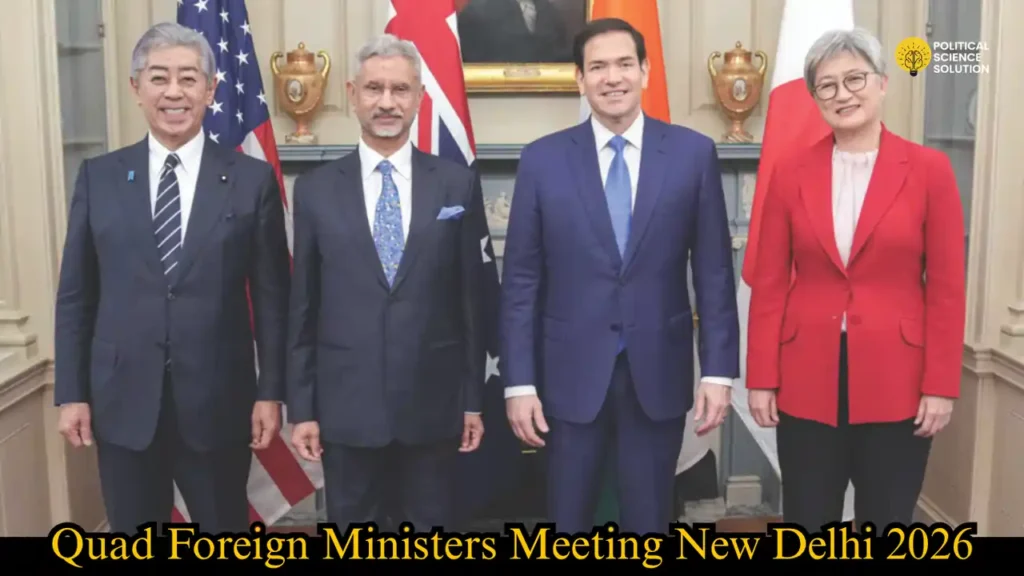
The May 26 meeting at Hyderabad House in New Delhi featured robust discussions on maritime and transnational security, economic prosperity, critical and emerging technologies, and humanitarian assistance. Foreign Minister S. Jaishankar hosted Australia’s Penny Wong, Japan’s Toshimitsu Motegi, and US Secretary of State Marco Rubio. The ministers issued a comprehensive joint statement outlining new initiatives and reaffirming their commitment to a free and open Indo-Pacific.
Quad Critical Minerals Initiative Framework
One of the most ambitious announcements was the launch of the Quad Critical Minerals Initiative Framework. This $20 billion initiative aims to coordinate investments across mining, processing, and recycling stages to build more resilient global supply chains. By leveraging the combined economic and technological strengths of the four nations, the framework seeks to reduce vulnerabilities in critical minerals essential for clean energy transitions, advanced electronics, and defense technologies.
Indo-Pacific Maritime Surveillance Collaboration (IPMSC)
Maritime security took center stage with the launch of the Indo-Pacific Maritime Surveillance Collaboration (IPMSC) Initiative. Initially focused on the Indian Ocean Region, this effort will enhance real-time information sharing and maritime domain awareness by integrating the surveillance capabilities of all Quad members. The initiative includes subject matter expert exchanges and tabletop exercises to strengthen collective responses to unlawful maritime activities.
Building on this, the ministers highlighted progress under the existing Indo-Pacific Partnership for Maritime Domain Awareness (IPMDA). Quad countries are developing a comprehensive Common Operating Picture (COP) to provide real-time insights across vast maritime zones, benefiting the entire region.
Energy Security and Connectivity Initiatives
The Quad Initiative on Indo-Pacific Energy Security was unveiled to promote cooperation in technology, management practices, policy frameworks, international market analysis, and emergency response exercises. The goal is to ensure open, stable energy markets and diversified supply chains, particularly important given recent disruptions from conflicts in West Asia.
On connectivity, Quad partners committed to connecting all Pacific Island Forum countries via undersea cables by the end of 2026. They also announced advancement of port infrastructure in Fiji under the Quad Ports of the Future Partnership, following a conference hosted by India in October 2025. These steps aim to boost trade, economic prosperity, and resilience against risks to critical infrastructure.
Other Major Outcomes
The ministers strongly reaffirmed their commitment to the United Nations Convention on the Law of the Sea (UNCLOS), emphasizing its importance for navigational rights, freedoms of overflight, and the lawful flow of global commerce—particularly in sensitive areas such as the Strait of Hormuz, Red Sea, and the East and South China Seas.
India will host the next Coast Guard-led Quad-at-Sea Ship Observer Mission, building on the success of the first mission from Palau to Guam. This initiative focuses on addressing unlawful maritime activities through enhanced interoperability and knowledge sharing.
In the technology domain, Quad partners announced collaboration on Next-Gen Communication Standards, with a primary focus on 6G development. Additional efforts include workshops on digital identity standards to improve cross-border interoperability and support for private sector operations.
Expanding Cooperation: From Counter-Terrorism to Agriculture and Health
The joint statement detailed extensive ongoing and new activities. India hosted two Quad Workshops on counter-terrorism in September 2025, addressing the use of unmanned aerial vehicles (UAVs) and drones for terrorist purposes, as well as preventing exploitation of emerging technologies. Australia will host a Quad Counterterrorism Tabletop Exercise in June 2026 focused on state-sponsored terrorism threats and uncrewed systems.
Under the Advancing Innovations for Empowering NextGen Agriculture (AI-ENGAGE) initiative, over $6 million in awards were announced for six international research projects. These projects leverage artificial intelligence, robotics, and sensing technologies to improve crop yields, pest management, and food security for farmers across the Indo-Pacific.
Humanitarian and emergency response efforts received significant attention. Quad partners are investing over $50 million in training health professionals for public health emergencies and have conducted tabletop exercises in Honolulu in 2025 to enhance disaster response capabilities. Funding and technological assistance exceeding $25 million has been directed toward energy technology supply chains in the region.
Progress was also noted in the Quad Open Radio Access Networks (Open RAN) cooperation with Palau, including the selection of trusted suppliers for secure 4G and 5G connectivity in early 2026.
Significance of the Quad for India and the Broader Region
For India, the Quad serves as a vital platform for counterbalancing challenges in the Indian Ocean Region while advancing economic and climate cooperation. Initiatives such as the Quad Investors Network and the Quad Climate Change Adaptation and Mitigation Package complement the security-focused efforts, including the annual Malabar naval exercises.
Analysts note that the Quad’s flexible, non-treaty-based structure allows member nations to balance economic relationships with strategic imperatives. Despite occasional questions about its long-term coherence—particularly amid varying domestic political priorities—the grouping continues to demonstrate resilience through consistent foreign ministers’ level engagement.
The meeting comes at a time when supply chain vulnerabilities exposed during the COVID-19 pandemic, combined with ongoing conflicts in Ukraine and West Asia, have underscored the need for diversified partnerships. The emphasis on critical minerals, energy security, and resilient connectivity directly addresses these concerns.
Expert Perspectives and Future Outlook
Commentators have pushed back against narratives suggesting the Quad is losing momentum. As highlighted in recent analyses, the absence of recent leaders’ summits does not diminish the platform’s value, especially as foreign ministers continue driving practical cooperation. The grouping is increasingly viewed as an essential component of a broader minilateral architecture—including linkages with frameworks like AUKUS and Five Eyes—that helps address complex challenges in the Indo-Pacific.
Looking ahead, the initiatives announced in New Delhi set the stage for deeper collaboration in defense, technology, and regional infrastructure. The commitment to undersea cable connectivity by 2026 and port development in key locations like Fiji demonstrates a long-term vision for connectivity that prioritizes security and economic inclusion.
The Quad’s focus on humanitarian assistance, climate resilience, and health security further broadens its appeal, positioning it as a constructive force that delivers benefits beyond traditional security concerns. As geopolitical dynamics continue to evolve, the 11th Foreign Ministers’ Meeting reinforces the Quad’s adaptability and enduring relevance.
This gathering in New Delhi not only strengthens ties among the four democracies but also sends a clear message about their shared vision for a stable, prosperous, and rules-based Indo-Pacific. With concrete frameworks now in place across multiple domains, the Quad is poised to play an even more influential role in shaping regional outcomes in the years ahead.
FAQs
1. When and where was the 11th Quad Foreign Ministers’ Meeting held?
The 11th Quadrilateral Security Dialogue (Quad) Foreign Ministers’ Meeting was held on May 26, 2026, in New Delhi, India, at Hyderabad House. It was hosted by External Affairs Minister S. Jaishankar and attended by Australia’s Foreign Minister Penny Wong, Japan’s Foreign Minister Toshimitsu Motegi, and US Secretary of State Marco Rubio.
2. What are the major initiatives announced at the 2026 Quad meeting?
Key initiatives include:
- The Quad Critical Minerals Initiative Framework ($20 billion) to secure mining, processing, and recycling supply chains.
- The Indo-Pacific Maritime Surveillance Collaboration (IPMSC) focused initially on the Indian Ocean Region.
- The Quad Initiative on Indo-Pacific Energy Security for technology, policy, and emergency cooperation.
- Commitment to connect all Pacific Island Forum countries with undersea cables by 2026 and develop port infrastructure in Fiji. Other outcomes include collaboration on 6G standards, counter-terrorism exercises, and agriculture innovation under AI-ENGAGE.
3. What is the Quad and why does it matter?
The Quad is an informal strategic forum of India, the US, Japan, and Australia. It originated after the 2004 Indian Ocean Tsunami and was revived in 2017 to uphold a free and open Indo-Pacific. It represents 24% of world population, 35% of global GDP, and 18% of global trade. It is not a formal military alliance like NATO but focuses on practical cooperation in maritime security, supply chains, technology, and humanitarian assistance.
4. How does the Quad address China-related concerns?
While not explicitly naming any country, the Quad emphasizes adherence to UNCLOS, freedom of navigation in the South China Sea, East China Sea, Strait of Hormuz, and Red Sea. It strengthens maritime domain awareness, critical minerals diversification, and resilient supply chains — areas widely seen as responses to regional assertiveness and supply chain vulnerabilities.
5. What is the significance of this meeting for India?
For India, the Quad strengthens its role in the Indo-Pacific, supports counterbalancing challenges in the Indian Ocean, and advances economic initiatives like the Quad Investors Network and climate cooperation. Hosting the meeting and the upcoming Quad-at-Sea Ship Observer Mission further elevates India’s leadership in maritime security and regional connectivity.
6. Is the Quad losing momentum?
No. Despite the absence of a leaders’ summit in recent years, the consistent foreign ministers’ meetings and the delivery of concrete initiatives (IPMSC, Critical Minerals Framework, energy security, connectivity projects) demonstrate the platform’s continued vitality. Experts view it as a flexible and effective minilateral mechanism for addressing shared challenges.