
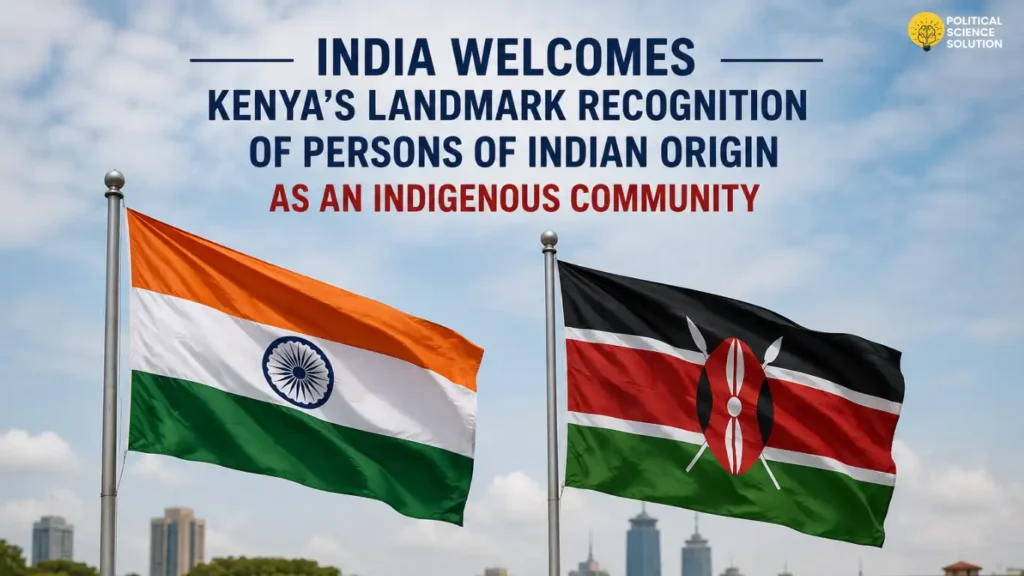
New Delhi: Lok Sabha Speaker Om Birla on Thursday extended a warm welcome to Kenya’s decision to recognise Persons of Indian Origin as an indigenous community, describing the step as a powerful affirmation of the deep-rooted ties linking the two nations. The remarks came during a bilateral meeting with Dr Moses M. Wetang’ula, Speaker of the National Assembly of Kenya, held at the Parliament House Complex. The Kenyan parliamentary delegation is currently visiting India, marking another chapter in the steady expansion of parliamentary contacts between New Delhi and Nairobi.
Speaker Birla opened the discussion by underlining that India and Kenya share historical and multifaceted relations that stretch back millennia. He observed that consistent high-level engagements over the years have steadily reinforced the bilateral partnership, giving it both continuity and fresh momentum.
Recalling Earlier Engagements and Shared Democratic Values
Birla recalled his earlier interaction with Dr Wetang’ula during the 28th Conference of Speakers and Heads of African Parliaments (CSPOC) held in New Delhi earlier this year. He spoke appreciatively of the Kenyan Speaker’s long experience in law, legislation and public administration, noting that this background has enabled meaningful contributions to stronger governance for the people of Kenya.
Both countries, Birla emphasised, place high value on democracy, inclusive development and human-centric progress. This common outlook, he said, gives the relationship a distinctive depth that goes well beyond formal diplomacy.
Centuries-Old People-to-People Bonds and Kenya’s Recognition Decision
At the centre of the conversation stood the centuries-old people-to-people connections that have long linked Indian and Kenyan societies. Birla specifically welcomed the Kenyan government’s decision to recognise Persons of Indian Origin as an indigenous community. He described the move as one that further deepens bilateral relations and formally acknowledges the lasting presence and contributions of the community within Kenya.
The recognition carries both symbolic and practical weight. It affirms the integral role that people of Indian origin have played in Kenya’s social and economic fabric while simultaneously strengthening the emotional and political bridges between the two countries.
Mahatma Gandhi’s Enduring Legacy and a Statue in Kenya’s Parliament
Speaker Birla also recalled the profound influence of Mahatma Gandhi on Kenya’s struggle for freedom against colonial rule. He observed that Gandhi continues to be regarded worldwide as an enduring symbol of the peaceful pursuit of truth and non-violence. In this context, Birla expressed sincere appreciation to Dr Wetang’ula for supporting the installation of a statue of Mahatma Gandhi in the Parliament of Kenya. The planned statue, he indicated, stands as a visible testament to shared values of peace, ethical leadership and non-violent resistance.
India’s Democratic Journey and the Role of Parliament
Turning to India’s own experience, Birla described the country as the world’s largest democracy, guided by its Constitution since Independence and marked by wide-ranging development and social transformation. He pointed to the scale of India’s electoral process: approximately 970 million citizens are eligible to vote, and around 650 million exercise their franchise. This level of participation, he said, reflects the people’s sustained faith and confidence in democratic institutions.
Parliament, Birla stressed, remains the highest forum of democracy—the place where the hopes and aspirations of citizens find clear expression. He noted that parliamentary dialogue between India and Kenya continues to grow stronger. Referring to the establishment of Parliamentary Friendship Groups in both countries, he emphasised that regular exchanges of parliamentary delegations can open new dimensions in the relationship and deepen mutual understanding of legislative practices.
Capacity Building Through PRIDE and the Promise of Technology
Capacity building forms a practical pillar of this cooperation. Programmes for members and officials of the Kenyan Parliament, carefully tailored to Kenya’s specific requirements, have been regularly organised by the Parliamentary Research and Training Institute for Democracies (PRIDE). These initiatives transfer institutional knowledge in a focused, demand-driven manner.
In today’s rapidly changing global environment, technology has become indispensable to parliamentary functioning. Birla highlighted that the Parliament of India has already leveraged artificial intelligence to promote transparency, efficiency, inclusivity and greater public participation. He conveyed India’s readiness to share its experience in the use of AI and related technologies with the Kenyan Parliament, offering a concrete pathway for future collaboration that could modernise legislative processes and strengthen democratic engagement.
Kenyan Speaker’s Response: Appreciation, Community Contributions and Multilateral Alignment
Responding to the warm reception, Dr Moses M. Wetang’ula thanked Speaker Birla for the hospitality. He recalled that the 28th CSPOC held in New Delhi earlier this year ranked among the best-organised parliamentary events he had attended. Wetang’ula highlighted the significant contribution of people of Indian origin to Kenya’s growth and development, noting that the community remains active across every sector of national life, including Parliament and government.
He underscored the strong relationship the two countries maintain in global multilateral forums, particularly the United Nations. Wetang’ula called for democratic reforms of the United Nations Security Council and expressed clear support for India’s inclusion as a permanent member. Such a step, he argued, would better reflect the political and demographic realities of the 21st century.
A Comprehensive Partnership Spanning History, Values and Future Ambitions
The meeting thus touched every major strand of India-Kenya engagement: the millennia-old historical foundation, the centuries of people-to-people interaction, the formal recognition of Persons of Indian Origin as an indigenous community, the shared commitment to democratic and inclusive development, the living legacy of Mahatma Gandhi, the structured work of Parliamentary Friendship Groups, the practical training delivered through PRIDE, the emerging opportunities in artificial intelligence and parliamentary technology, and the strategic alignment on United Nations Security Council reform.
Kenya’s decision on Persons of Indian Origin stands out as a particularly meaningful gesture. It publicly acknowledges the deep roots and multifaceted contributions of the community while reinforcing the bonds of affinity between Nairobi and New Delhi. Paired with the planned installation of a Mahatma Gandhi statue in Kenya’s Parliament, these steps illustrate how symbolic acts can reinforce substantive cooperation.
On the institutional side, Parliamentary Friendship Groups and regular delegation exchanges provide steady channels for dialogue. The capacity-building programmes under PRIDE ensure that cooperation moves beyond statements into tangible skill transfer. The offer to share India’s experience with artificial intelligence opens a new technological chapter that could help both legislatures operate with greater efficiency, transparency and citizen involvement.
Kenya’s explicit support for India’s permanent membership of the United Nations Security Council adds a strategic dimension. By linking Security Council reform to the need to reflect contemporary global realities, Speaker Wetang’ula aligned Kenya’s position with a long-standing Indian priority. This convergence in multilateral forums complements the warmth visible in the bilateral parliamentary meeting and signals broader agreement on questions of global governance.
Taken as a whole, the discussions at the Parliament House Complex presented a complete picture of a relationship that is at once ancient and thoroughly modern. Historical depth, community recognition, democratic values, institutional cooperation, technological partnership and strategic alignment on the world stage all came together in a single, substantive engagement. Speaker Om Birla’s welcome of Kenya’s recognition decision, his appreciation for the Gandhi statue initiative, and his offer of technological collaboration were matched by Dr Wetang’ula’s gratitude, recognition of the Indian-origin community’s role in Kenya, and clear backing for India’s aspirations at the United Nations.
As parliamentary diplomacy continues to mature through Friendship Groups, regular exchanges and focused capacity-building, the India-Kenya partnership is positioned to acquire still greater depth and practical content. The Thursday meeting served as a timely reminder that durable international relationships are built not only on high-level visits but also on the formal recognition of communities, the celebration of shared historical icons, the steady exchange of institutional knowledge, and the alignment of positions on the global stage. In welcoming Kenya’s decision and outlining a wide agenda of cooperation, Lok Sabha Speaker Om Birla and National Assembly Speaker Moses M. Wetang’ula have further strengthened a partnership that already spans millennia and now looks confidently toward shared opportunities in the decades ahead.
FAQs
1. What was the key focus of the bilateral meeting between Lok Sabha Speaker Om Birla and Kenyan National Assembly Speaker Moses M. Wetang’ula?
The meeting, held at the Parliament House Complex in New Delhi, centred on the historical and multifaceted relations between India and Kenya that date back millennia. Speaker Birla welcomed Kenya’s decision to recognise Persons of Indian Origin as an indigenous community, highlighting centuries-old people-to-people connections, shared democratic values, parliamentary cooperation, and India’s readiness to share expertise in artificial intelligence for legislative work. Dr Wetang’ula responded by thanking India for its hospitality, praising the organisation of the 28th CSPOC, acknowledging the contributions of the Indian-origin community in Kenya, and expressing support for India’s permanent membership of the United Nations Security Council.
2. Why did India specifically welcome Kenya’s recognition of Persons of Indian Origin as an indigenous community?
Lok Sabha Speaker Om Birla described the decision as a significant step that further deepens bilateral relations. It formally acknowledges the long-standing presence and contributions of the Indian-origin community across various sectors in Kenya, including Parliament and government. The move strengthens the centuries-old people-to-people bonds and reflects the shared commitment of both nations to inclusive development and human-centric progress.
3. How are India and Kenya strengthening parliamentary cooperation?
Parliamentary dialogue is growing through the establishment of Parliamentary Friendship Groups in both countries and regular exchanges of parliamentary delegations. The Parliamentary Research and Training Institute for Democracies (PRIDE) organises tailored capacity-building programmes for Kenyan parliamentarians and officials. India has also offered to share its experience in using artificial intelligence to enhance transparency, efficiency, inclusivity, and public participation in parliamentary functioning.
4. What role did Mahatma Gandhi’s legacy play in the discussions?
Speaker Birla recalled Mahatma Gandhi’s influence on Kenya’s freedom struggle against colonial rule and noted that Gandhi remains a global symbol of the peaceful pursuit of truth and non-violence. He expressed appreciation to Dr Wetang’ula for supporting the installation of a statue of Mahatma Gandhi in the Kenyan Parliament, viewing it as a meaningful gesture of shared values.
5. Did Kenya express support for India’s permanent membership of the United Nations Security Council?
Yes. In his response, Dr Moses M. Wetang’ula underscored the strong relationship between India and Kenya in multilateral forums, particularly the United Nations. He called for democratic reforms of the UN Security Council and explicitly supported India’s inclusion as a permanent member, stating that such representation would better reflect the realities of the 21st century.