

New Delhi: In a landmark development strengthening ties across the Indo-Pacific, India and New Zealand have formally elevated their bilateral relationship to a Strategic Partnership. This milestone came during Indian Prime Minister Narendra Modi’s official visit to Auckland on July 10-11, 2026 — the first by an Indian Prime Minister to New Zealand in 40 years. The visit, hosted by New Zealand Prime Minister Rt Hon Christopher Luxon, has set a comprehensive framework for deeper cooperation through the newly endorsed India-New Zealand Strategic Partnership: Roadmap to 2030.
The joint statement issued on July 11, 2026, highlights a shared vision rooted in democratic values, people-to-people connections, and mutual interests in a free, open, and prosperous Indo-Pacific region. Both leaders committed to structured implementation across political, defence, trade, education, culture, and multilateral domains, aiming to unlock significant economic and strategic potential in the coming years.
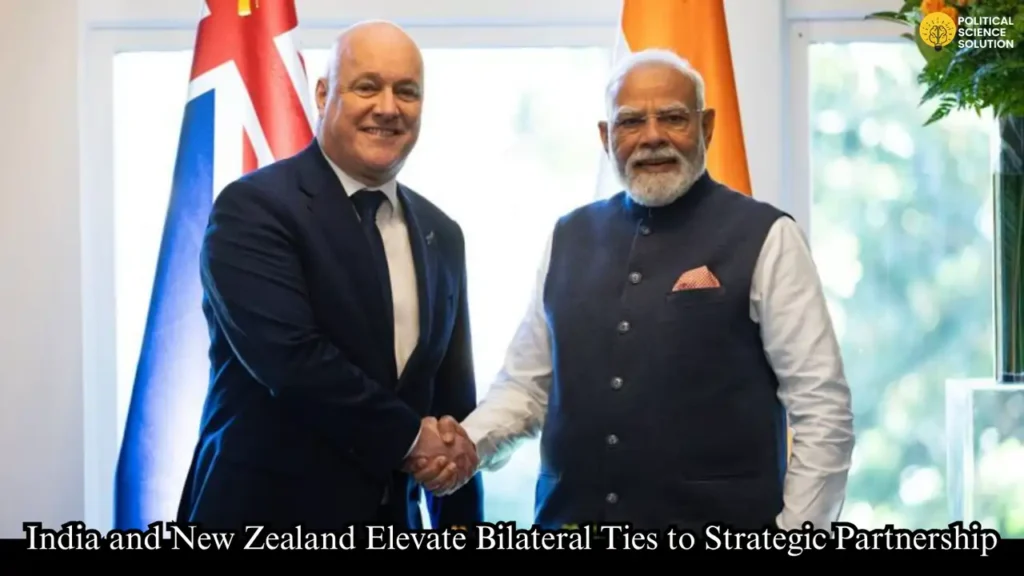
Historic Visit and Elevation to Strategic Partnership
Prime Minister Modi’s arrival in Auckland marked a new chapter in India-New Zealand relations, which were established diplomatically in 1952. The visit followed Prime Minister Luxon’s trip to India in March 2025, during which the two nations launched Free Trade Agreement negotiations and signed several memorandums of understanding in defence, education, customs, horticulture, forestry, and sport.
During the Auckland engagements, Prime Minister Modi received a formal ceremonial welcome at Government House, held extensive bilateral discussions with Prime Minister Luxon, addressed business leaders and the Indian community, and witnessed a showcase of New Zealand’s sporting innovation. The leaders recalled their previous meeting and decided to upgrade the relationship to a Strategic Partnership, endorsing the Roadmap to 2030 as a guiding framework for the next four years.
The ambitious long-term vision focuses on elevating bilateral relations, strengthening existing mechanisms, and exploring new avenues for cooperation both bilaterally and in multilateral forums. This elevation reflects growing momentum in high-level political engagement and recognizes the deep historical friendship between the two nations.
Political and Diplomatic Engagement: Institutionalizing Dialogue
The Prime Ministers emphasized the need for sustained high-level interactions. They agreed to regular reciprocal visits and meetings between Prime Ministers and Ministers, including on the sidelines of regional and multilateral events. A new regular Foreign Ministers’ Dialogue will provide strategic guidance, complemented by annual senior officials’ meetings between India’s Ministry of External Affairs and New Zealand’s Ministry of Foreign Affairs and Trade.
Parliamentary exchanges received a boost, with encouragement for ongoing engagement through the recently constituted Parliamentary Friendship Group for New Zealand in the Indian Parliament and reciprocal visits by Members of Parliament. These steps aim to deepen mutual understanding and reinforce the democratic foundations of the partnership.
Defence and Security Cooperation: Strengthening Maritime and Counter-Terrorism Efforts
Defence and security form a cornerstone of the enhanced partnership. The leaders welcomed progress under the 2025 India-New Zealand Memorandum of Understanding on Defence Cooperation and agreed to maintain regular structured engagements at ministry and service levels.
Notable achievements include cooperation under Combined Task Force 150 (CTF-150) in 2025, where New Zealand commanded and India served as Deputy Commander, focusing on deterring narcotics smuggling, terrorism, and illicit maritime activities in the Middle East and Western Indian Ocean.
As maritime nations, both countries agreed to bolster maritime cooperation through the newly concluded Maritime Cooperation Arrangement (MCA), an Implementing Arrangement on Hydrography and Nautical Cartography, and a Mutual Logistics Support Arrangement. Bilateral naval exercises and activities under the MCA were welcomed.
New Zealand nominated Maritime Security as its priority pillar under India’s Indo-Pacific Oceans Initiative (IPOI) — a non-treaty-based voluntary framework promoting a free and open Indo-Pacific. Both sides will explore specific activities under this pillar and establish an annual Maritime Security Dialogue for better coordination and information exchange.
On counter-terrorism, cyber security, and transnational crime, the leaders committed to closer collaboration. Plans include formalizing arrangements on counter-narcotics and law enforcement cooperation. They condemned terrorism in all forms, specifically referencing the April 22, 2025, attack in Pahalgam, Jammu & Kashmir, and the November 10, 2025, incident near Red Fort, New Delhi. A new Memorandum of Agreement established a Joint Working Group on Counter-Terrorism for information and knowledge sharing.
Trade and Economic Cooperation: Targeting NZ$7 Billion Trade by 2030
Economic ties received significant impetus with the conclusion and signature of a balanced, comprehensive India-New Zealand Free Trade Agreement (FTA). The agreement eliminates duties on 100% of Indian exports, while India has offered market access in 70.03% of tariff lines, keeping sensitive sectors protected. New Zealand’s exports to India will see 57% tariff-free access.
The leaders set an aspirational goal of doubling bilateral two-way trade in goods and services to NZ$7 billion (approximately ₹35,000 crore) by 2030. They emphasized removing trade barriers, enhancing investment flows, and leveraging complementarities. New Zealand’s expertise in primary industries — horticulture, forestry, animal husbandry, and dairying — will support India’s sustainable agricultural growth and Viksit Bharat vision for a developed nation by 2047.
Key initiatives include the Agricultural Productivity Partnership under the FTA, with action plans for kiwifruit, apples, and honey, plus the establishment of Centres of Excellence in kiwifruit in Nagaland and Uttarakhand. A Memorandum of Cooperation on Animal Husbandry and Dairying was concluded.
Tourism cooperation advanced through a signed Memorandum of Arrangement, with encouragement for direct non-stop flights. Dialogue between shipping authorities aims to enhance recognition of seafarer competency certificates, boosting maritime industry resilience.
People, Culture, and Sport: Deepening Human Connections
The Indian diaspora of approximately 3 lakh people (about 5% of New Zealand’s population) was highlighted as a vital bridge. Prime Minister Modi addressed over 10,000 community members at Auckland’s Spark Arena, underscoring intertwined futures and the FTA’s role in India’s development journey. Prime Minister Luxon praised the community’s contributions to New Zealand’s economy, society, and sports.
Celebrations marking 100 Years of Unity Through Sport in 2026 were welcomed, alongside the launch of the India-New Zealand Joint Action Plan on Sport. This framework covers high-performance sport, coaching, sport science, participation, sport business, and exchanges between national organizations.
Cultural ties deepened with an Arrangement on Cultural Cooperation, engagement on traditional medicine, and a Memorandum between India’s National Maritime Heritage Complex in Lothal and the New Zealand Maritime Museum. These initiatives celebrate shared maritime heritage and contemporary creativity.
Education, Research, Science, Technology, and Disaster Management
Education stands as a central pillar, with India as the second-largest source of international students in New Zealand. Both sides committed to advancing institutional partnerships, student mobility, and innovation under the 2025 Education Cooperation Arrangement.
Cooperation on climate change, clean energy, and sustainability will expand via the International Solar Alliance, Coalition for Disaster Resilient Infrastructure, and New Zealand’s joining of the Global Biofuels Alliance (launched by India in 2023). A Memorandum of Cooperation between India’s National Disaster Management Authority and New Zealand’s National Emergency Management Agency will enhance disaster risk reduction, preparedness, response, recovery, and resilience.
Research and innovation will target sustainable agriculture, food systems, digital transformation, and emerging technologies.
Regional and Multilateral Cooperation: Shared Indo-Pacific Vision
The leaders reaffirmed commitment to a rules-based Indo-Pacific, emphasizing freedom of navigation and overflight under the 1982 UN Convention on the Law of the Sea (UNCLOS). They support ASEAN centrality, cooperation in East Asia Summit, ASEAN Regional Forum, and ADMM-Plus.
Both advocated for UN Security Council reform, including expansion in permanent and non-permanent categories, with New Zealand backing India’s permanent membership. India’s potential accession to the Nuclear Suppliers Group was welcomed in the context of clean energy goals.
On global issues, the leaders expressed concern over Middle East tensions, calling for de-escalation, civilian protection, and restored navigation through the Strait of Hormuz. They addressed the Ukraine conflict, urging a just peace based on the UN Charter. Supply chain resilience, particularly for Pacific Island countries, was highlighted amid energy disruptions.
Strong condemnation of terrorism included calls for action against UN-proscribed groups via the UN and FATF.
Key Outcomes and Future Implementation
The visit yielded 18 concrete outcomes, including 10 agreements and MoUs spanning defence, tourism, sports, disaster management, dairy, and animal husbandry. Prime Minister Modi concluded his three-nation tour (Indonesia, Australia, New Zealand) with these gains, departing after warm hospitality from Prime Minister Luxon, who personally saw him off at the airport.
Ministers and officials have been directed to ensure timely implementation of the Roadmap to 2030, with regular progress reviews. The partnership is poised to inject fresh energy into shared goals of peace, prosperity, and resilience.
This strategic elevation not only doubles down on economic ambitions but also positions India and New Zealand as key partners in addressing regional security, climate challenges, and global governance reforms. As both nations move forward, the Roadmap to 2030 promises to transform longstanding friendship into a dynamic, future-oriented alliance benefiting their peoples and the broader Indo-Pacific.
FAQs
1. What is the India-New Zealand Strategic Partnership and when was it announced?
The Strategic Partnership was formally elevated during Prime Minister Narendra Modi’s visit to Auckland on July 10-11, 2026. It includes the endorsement of the India-New Zealand Strategic Partnership: Roadmap to 2030, a four-year framework to deepen cooperation in defence, trade, security, education, culture, and more.
2. What is the trade target set between India and New Zealand by 2030?
Both countries aim to double bilateral two-way trade in goods and services to NZ$7 billion (approximately ₹35,000 crore) by 2030. This builds on the newly signed Free Trade Agreement (FTA), which eliminates duties on 100% of Indian exports and provides significant market access.
3. How will the partnership strengthen defence and maritime cooperation?
Key steps include the Maritime Cooperation Arrangement (MCA), Mutual Logistics Support Arrangement, annual Maritime Security Dialogue, and cooperation under the Indo-Pacific Oceans Initiative (IPOI) with New Zealand nominating Maritime Security as its priority pillar. Both nations also committed to counter-terrorism efforts through a new Joint Working Group.
4. What are the main areas of cooperation in the Roadmap to 2030?
The Roadmap covers political-diplomatic engagement, defence & security, trade & economy (including agriculture and tourism), people-to-people ties, education & research, disaster management, sports, culture, and multilateral coordination in the Indo-Pacific and UN reforms.
5. How does the Indian diaspora in New Zealand benefit from this partnership?
The approximately 3 lakh strong Indian community is recognized as a vital bridge. The visit included a major community event, and the partnership enhances people-to-people links, education, sports, and economic opportunities, with the FTA expected to accelerate growth and mobility.