

New Delhi: Anahat Singh, the 18-year-old squash talent from Delhi, etched her name into the record books by capturing the girls’ singles crown at the World Junior Squash Championships. In the final held in Ontario, Canada, she overpowered Egypt’s Ruqaiyya Salem with scores of 11-3, 11-7 and 11-9. The result delivered India its first women’s world title at any level and marked the first occasion since 2011 that a player from outside Egypt claimed the junior world championship.
This success arrived in Anahat’s fifth and final appearance at the event. Previous campaigns had produced four quarterfinal exits and one bronze medal. She had described the competition as a personal “curse” because of those repeated near-misses. On this occasion the pattern ended decisively.
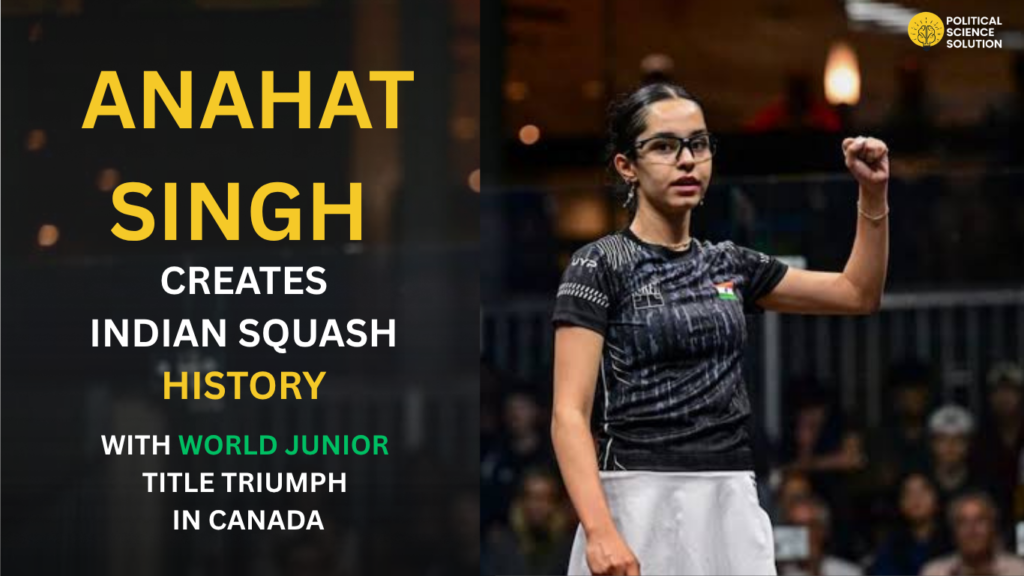
Historic Victory in Ontario Ends Long Egyptian Run
The final pitted the top seed against the second seed. Anahat took command immediately, racing through the opening game 11-3. She maintained pressure to secure the second 11-7 and closed out the third 11-9 after briefly trailing. Her focus on accurate line-hitting proved decisive when the score tightened.
Egypt had dominated the title for an extended period—reports place the streak at 13 consecutive victories or a 16-year hold. Anahat defeated three Egyptian opponents in succession: Habiba Rizk in the quarterfinals by 3-1 (11-7, 11-5, 6-11, 11-9), Barb Samah in the semifinals by 3-1 (11-3, 8-11, 11-4, 11-6), and Salem in the final. Across the entire tournament she surrendered only two sets. Earlier rounds featured wins against Lily Wilson of Australia, Pui Yin Chloe of Hong Kong and Douce Ye San Lee of Malaysia.
The last Indian to reach the final had been Joshana Chinappa in 2005. Anahat not only matched that achievement but converted it into gold, becoming the country’s first junior world champion.
Breaking Through Squash’s Toughest System
Egypt’s sustained excellence stems from an established pathway of high-level coaching, relentless domestic competition and a mindset that encourages young athletes to expect success at the highest level. Former Indian star Dipika Pallikal, who encountered Egyptian opponents throughout her career, explained the challenge: competing against a player from that system means facing the product of one of the sport’s most demanding environments. Technical skill, tactical intelligence and mental toughness are standard.
Pallikal noted that every victory against Egyptian players is hard-earned. When an athlete from outside that structure captures a major title, the moment carries wider significance for the global game. Anahat’s ability to dismantle three such opponents in a single championship underlined both her quality and the growing depth of Indian squash.
A Journey Defined by Persistence and Versatile Foundations
Anahat’s path began outside the squash court. She first played badminton and carried the wristy deception characteristic of that sport into her new discipline. She has spoken of admiration for Olympic medallist P.V. Sindhu, whom she watched at the Commonwealth Games. Her family background is professional rather than sporting—her father works as a lawyer and her mother as an interior designer.
By the time of the junior world championships she already held a senior world ranking of No. 20 and had claimed her first Professional Squash Association title in Washington earlier in the year. In May she was still managing examination preparation alongside training. By July she had completed a far more public examination inside the glass court.
She first represented India at the age of 14 during the 2022 Commonwealth Games and collected Asian Games medals by 16. With squash now on the Olympic programme, her results have drawn increasing attention. Consecutive India Open titles in Mumbai further illustrated her capacity to perform when expectations rise.
Coaching Network Shapes Tactical Maturity
Anahat’s support team blends Indian expertise with international experience. Saurav Ghosal, widely regarded as India’s leading squash mind, provides strategic guidance. Stephane Galifi oversees daily sessions and has emphasised the need to remain attacking while preparing alternative plans for different opponents.
French former world champion Gregory Gaultier joined the group specifically for the junior world championships. Gaultier himself endured four senior World Championship final defeats before winning the title on his fifth attempt. His presence offered a living example of persistence. He described Anahat as a strong mover who prefers to dominate the volley and noted the importance of identifying precise moments to attack Egyptian players who compete without fear.
Gaultier stressed teaching practical solutions rather than allowing frustration to accumulate. He reminded her that she was engaged in an activity she loves and therefore had no reason for complaint. He also observed that her natural talent, deception and high squash intelligence cannot be accelerated artificially—experience remains essential.
Reflections from Champions on the Significance of the Title
Anahat herself reacted with a mixture of disbelief and relief. “I still feel like I’m dreaming,” she said. “This tournament has been the worst tournament for me. I have been losing in the semis and quarters over the last four years. I have always said, if anyone asked, ‘This tournament’s a curse’, and I have never been able to play well in the event. This is my last year as a junior and my only chance to win it. It means the world.”
Dipika Pallikal placed the achievement in a broader context. Titles, she observed, represent accumulated discipline, sacrifice and the capacity to produce peak performance when pressure peaks. Success of this magnitude demonstrates that an athlete has learned to manage expectation, adapt across a tournament and complete the task. Such qualities distinguish champions from contenders. Pallikal expressed confidence that the junior world title marks only the beginning of Anahat’s trajectory toward the highest levels of the senior game, citing her talent, temperament and readiness to continue learning.
Balancing Academic Demands with Elite Ambition
Even while competing at the highest junior level and transitioning onto the senior circuit, Anahat maintained academic commitments. In the weeks leading into the championships she was still progressing through school examinations scheduled for May. The ability to manage both spheres without visible compromise speaks to organisational discipline that will serve her as the demands of professional travel increase.
Her final junior campaign therefore represented the closing of one chapter and the clear opening of another. She entered the event aware that it would be her last opportunity at that age group and left it as the player who rewrote the Indian record books.
Wider Implications for Indian Squash Development
The victory arrives at a moment when Indian squash is seeking greater consistency on the world stage. Previous generations produced talented individuals who reached deep into major events yet repeatedly encountered the Egyptian barrier. Anahat’s breakthrough supplies concrete evidence that the barrier can be crossed.
It also highlights the value of sustained coaching investment and exposure to varied competitive environments. The combination of domestic mentoring, specialised French technical input and the psychological insight of a coach who understood prolonged disappointment proved effective. Future Indian juniors now possess a recent reference point of what is possible.
With the Olympic pathway now open, attention turns to how Anahat converts junior success into sustained senior results. Her existing world ranking of 20 and first PSA title provide a platform. Continued progress will depend on the same attributes that served her in Canada: aggressive intent, tactical flexibility, mental resilience and the capacity to absorb guidance.
For the present, the 18-year-old from Delhi stands as the player who transformed a personal narrative of repeated near-misses into India’s first women’s world squash title. The glass court in Ontario witnessed not merely a change of champion but a shift in the historical balance of the junior game.
FAQs
1. Who is Anahat Singh and what historic achievement did she complete in 2026?
Anahat Singh is an 18-year-old squash player from Delhi whose father is a lawyer and mother an interior designer. In July 2026 she became the first Indian woman to win a world title in the sport by capturing the girls’ singles crown at the World Junior Squash Championships in Ontario, Canada. The victory marked her fifth and final appearance at the event after four previous quarterfinal exits and one bronze medal; she had previously called the tournament a “curse.”
2. What was the final score and which Egyptian players did she defeat on the way to the title?
In the final Anahat, the top seed, defeated second seed Ruqaiyya Salem of Egypt 11-3, 11-7, 11-9. She also beat two other Egyptians earlier in the draw: Habiba Rizk 3-1 (11-7, 11-5, 6-11, 11-9) in the quarterfinals and Barb Samah 3-1 (11-3, 8-11, 11-4, 11-6) in the semifinals. Across the entire championship she dropped only two sets and earlier eliminated Lily Wilson (Australia), Pui Yin Chloe (Hong Kong) and Douce Ye San Lee (Malaysia).
3. Why is Anahat’s victory considered a major breakthrough for Indian and world squash?
Egypt had held the girls’ World Junior title for 13 consecutive editions (or a 16-year span according to some accounts), creating one of the strongest monopolies in junior sport through elite coaching, fierce domestic competition and a culture of high expectation. Anahat became the first non-Egyptian champion since 2011 and India’s first finalist since Joshana Chinappa in 2005. Former Indian star Dipika Pallikal described every win against an Egyptian player as hard-earned because of their technical skill, tactical intelligence and mental resilience, calling the result a significant moment for the global game.
4. Who formed Anahat’s coaching team and what early influences shaped her game?
Her support network includes mentor Saurav Ghosal, day-to-day coach Stephane Galifi (who stresses remaining attacking while preparing alternative plans), and French legend Gregory Gaultier, who joined specifically for the junior worlds after himself losing four senior World Championship finals before winning the fifth. Anahat began in badminton, where she developed the wristy deception that remains a feature of her squash, and has cited Olympic medallist P.V. Sindhu as a sporting hero. By the time of the championships she was already World No. 20 on the senior PSA Tour and had won her first professional title in Washington.
5. How did Anahat balance academics with elite competition, and what lies ahead?
In May 2026 she was still preparing for school examinations while competing professionally. The junior world title was her last opportunity at that age level; she has already debuted for India at 14 (2022 Commonwealth Games), won Asian Games medals by 16, and claimed consecutive India Open titles. Dipika Pallikal believes she possesses the talent, temperament and willingness to learn required to establish herself among the world’s elite, positioning the junior crown as the start of a longer senior and Olympic pathway.