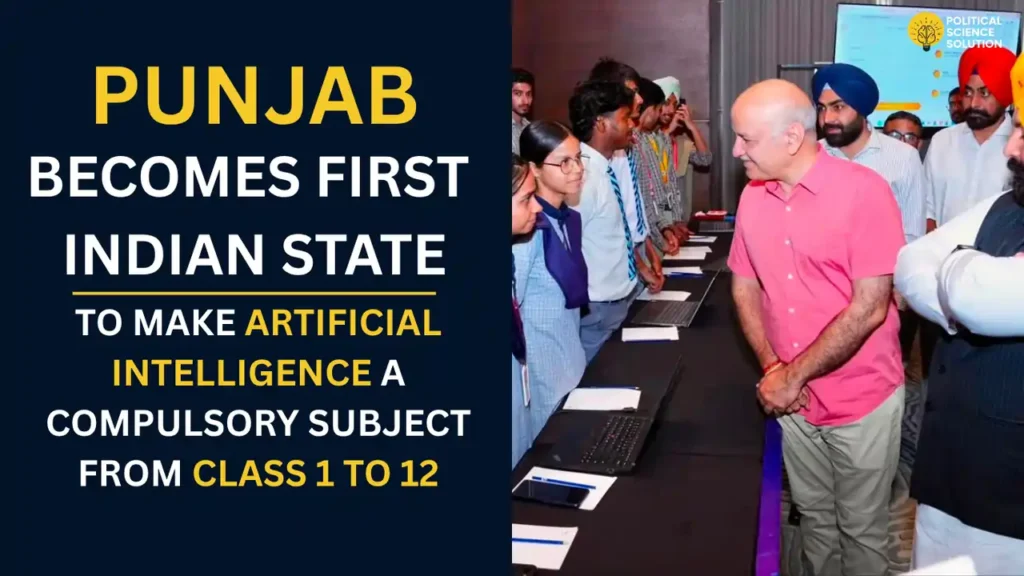
New Delhi: Punjab has taken a pioneering step in Indian school education by introducing Artificial Intelligence as a compulsory mainstream subject for every student from Class 1 to Class 12. Under the Sarbat.AI initiative of the Punjab School Education Board, the subject will now stand alongside Mathematics and Science in all government schools and those affiliated with the board. School Education Minister Harjot Singh Bains announced the policy, making clear that AI education will reach children in every village, border area, hill settlement and city classroom without exception.
Historic Scale of the Sarbat.AI Mission
The programme is designed to cover 25,172 schools and nearly 31.5 lakh students across the state. Unlike limited pilot schemes or optional electives offered elsewhere, AI has been positioned as a core academic requirement. Minister Bains described the move as essential for preparing Punjab’s children for an economy in which artificial intelligence will reshape employment on a global scale. He noted that the International Monetary Fund has projected nearly 40 percent of jobs worldwide will be affected by AI in the coming years, and that countries such as China and South Korea have already begun embedding advanced technology education from the primary stage.
Phased Rollout Across All Grades
Implementation will occur in carefully planned phases to maintain quality and readiness. In the first phase, AI content will be integrated into the existing Computer Science curriculum for students in Classes 8 to 12 in both government and affiliated private schools. Learning will take place through live online classes, recorded lectures, project-based work, continuous assessments and a dedicated Learning Management System. The second phase will extend age-appropriate AI education to Classes 1 through 7. AI textbooks are scheduled to reach every school within fifteen days of the announcement, and more than 90 percent of the curriculum has been designed as practical, hands-on activity rather than theoretical instruction.
Curriculum Inspired by Global Best Practices
The syllabus draws on educational models from Singapore, Finland, the United Arab Emirates and the United States while remaining fully aligned with UNESCO’s Ethical AI Framework. The progressive structure ensures skills develop with maturity. From Classes 1 to 5, children will learn responsible use of AI and develop into confident digital citizens. Beginning in Class 6, students will start building with AI tools. By Classes 8 and 9 they will create their own AI modules and apply them to real community problems, such as applications for village panchayats or tools supporting family businesses. In Classes 11 and 12, learners will produce industry-standard projects developed in partnership with leading technology companies.
Strong Industry and Technology Partnerships
Technical implementation is being led by Neeev AI, with support from Google, Amazon, Canva, Intel and FA-AI. These collaborations will strengthen AI literacy, teacher training, innovation platforms and workforce readiness. The current programme builds directly on an earlier pilot project conducted by the Punjab School Education Board with FA-AI. That pilot concluded with a statewide AI hackathon, and student projects from the event were showcased at the official launch.
Large-Scale Teacher Training Under Way
More than 12,000 computer faculty members are being trained as specialised AI teachers. In subsequent phases, nearly two lakh teachers from other subjects will receive training so that AI concepts can be integrated into teaching, learning and assessment across the entire curriculum. AI performance will also form part of every student’s academic record and appear on board certificates, giving the subject formal academic weight.
Foundation Laid by Four Years of Education Reform
Minister Bains emphasised that the AI initiative rests on the comprehensive reforms known as Sikhiya Kranti. When the present government took office, Punjab ranked 27th among Indian states in a 2020 national school education assessment. According to NITI Aayog’s latest School Education Quality Report, the state now ranks first in the country. A detailed review of government schools had revealed serious infrastructure gaps, including nearly 8,000 schools without boundary walls and many buildings in poor condition. The government responded with an allocation of ₹2,500 crore to modernise facilities and equip schools with advanced IT hardware and digital resources. Punjab has since become the first state to achieve 100 percent Wi-Fi connectivity across all government schools.
Rising Student Outcomes and Schools of Eminence
The same period saw the creation of Schools of Eminence that now compete with some of the country’s finest institutions. Results have followed. This year 882 students from Punjab’s government schools qualified for the National Eligibility cum Entrance Test, almost double the number recorded two years earlier. Aryan Gupta of Ludhiana, a product of the government school system, secured All-India Rank 1 in NEET UG 2026. Minister Bains observed that the older stereotype of “Udta Punjab” has been replaced by a generation of government-school students succeeding in the nation’s most competitive examinations.
Voices at the Launch Event
Former Delhi Education Minister Manish Sisodia, who attended the launch, described the Punjab programme as a national benchmark. He stressed that the goal is not merely to teach students how to use AI but to enable them to innovate and create with the technology. Sisodia also highlighted the need for technology-driven reforms to strengthen examination integrity in the light of recent paper-leak incidents. Punjab School Education Board Chairman Amarpal Singh confirmed that AI has been formally incorporated into the compulsory Computer Science curriculum and that related learning outcomes will be reflected on students’ board certificates.
From Annadata to Bhavishyadata
Minister Bains placed the announcement in a broader historical frame. Punjab once earned the title of Annadata by feeding the nation through the Green Revolution. Today the state aspires to become India’s Bhavishyadata by helping shape the nation’s future through the AI revolution. He recalled earlier school visits in which computer education still centred on basic software packages that had remained largely unchanged for a decade. An experience at an AI summit in Delhi earlier this year, where connectivity struggled and one institution presented a commercially purchased robot as original innovation, reinforced the conviction that genuine progress must begin in classrooms.
Equal Access Across Every Corner of Punjab
Whether a child studies in a border village in Fazilka, a hill village in Pathankot or a classroom in Mohali, the same foundational AI education will now be available. The government has already equipped schools with computers, smart panels and the necessary digital infrastructure. Minister Bains expressed confidence that other states will soon follow Punjab’s example, recognising that the question of preparing children for an AI-shaped world is one every Indian state will eventually have to answer.
A Clear Vision for Future-Ready Classrooms
By combining ethical grounding, practical project work, extensive teacher preparation and industry collaboration, Punjab aims to produce students who can both use AI responsibly and create original solutions. The Sarbat.AI mission marks the transition from infrastructure renewal to content transformation. With textbooks arriving shortly, large-scale teacher training under way and a transparent phased schedule in place, the state has moved from policy announcement to concrete implementation. The coming academic years will determine how effectively this pioneering framework translates into lasting student capability, innovation and opportunity.
Frequently Asked Questions
1. Is Punjab the first state in India to make Artificial Intelligence a compulsory subject from Class 1 to Class 12?
Yes. Punjab is the first Indian state to introduce Artificial Intelligence as a mainstream core subject for every student from Class 1 to Class 12 in government schools and those affiliated with the Punjab School Education Board. The decision was announced under the Sarbat.AI initiative by School Education Minister Harjot Singh Bains.
2. How many schools and students will the Sarbat.AI programme cover?
The initiative will eventually reach 25,172 schools and benefit nearly 31.5 lakh students across Punjab. It aims to provide equal access to AI education whether a child studies in a border village, a hill settlement or an urban classroom.
3. Will AI be taught from Class 1 immediately, and how is the curriculum structured?
The rollout is phased. In the first phase, AI will be integrated into the Computer Science curriculum for Classes 8 to 12. The second phase will extend age-appropriate content to Classes 1 to 7. Students in Classes 1–5 will focus on responsible use and digital citizenship. From Class 6 they will begin building with AI. By Classes 8–9 they will create their own modules to solve real community problems, and in Classes 11–12 they will produce industry-standard projects. More than 90 percent of the curriculum is practical and hands-on. Textbooks are scheduled to reach schools within fifteen days.
4. How are teachers being prepared and which organisations are supporting the programme?
More than 12,000 computer faculty members are being trained as AI teachers. Nearly two lakh teachers from other subjects will also receive phased training. Technical implementation is led by Neeev AI, with support from Google, Amazon, Canva, Intel and FA-AI. The curriculum draws on practices from Singapore, Finland, the UAE and the United States and is aligned with UNESCO’s Ethical AI Framework.
5. What earlier reforms made this AI push possible?
The Sarbat.AI mission builds on four years of Sikhiya Kranti reforms. Punjab rose from 27th position in a 2020 national school education assessment to first place according to NITI Aayog’s latest School Education Quality Report. The state invested ₹2,500 crore in infrastructure, achieved 100 percent Wi-Fi connectivity across all government schools, and established Schools of Eminence. These foundations, along with improved student outcomes such as 882 government-school students qualifying for NEET and Aryan Gupta securing All-India Rank 1 in NEET UG 2026, enabled the next step of making AI a core subject.