

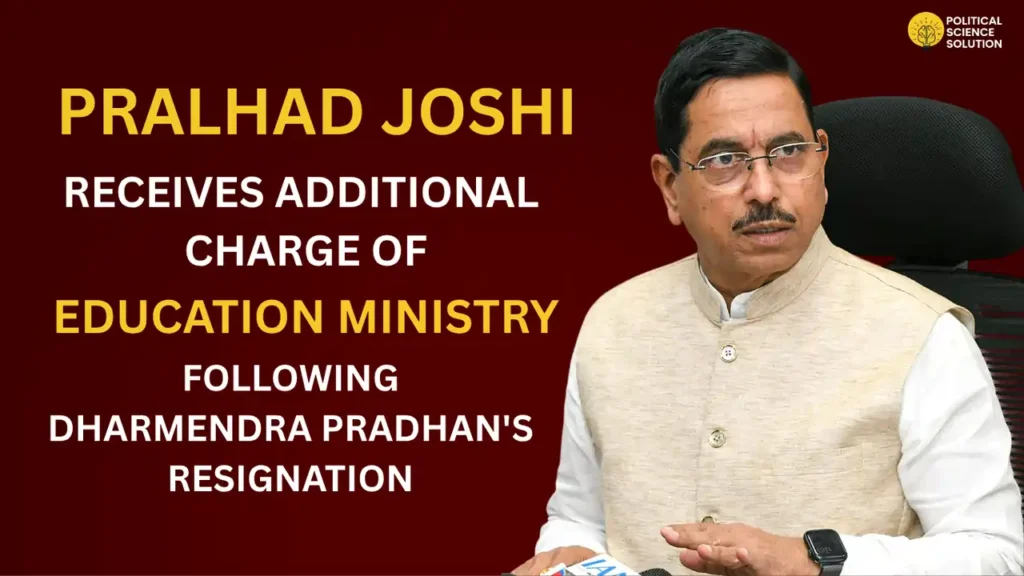
New Delhi: On 25 July 2026 the President of India directed that Cabinet Minister Pralhad Joshi be assigned the additional charge of the Ministry of Education. The decision was taken on the advice of Prime Minister Narendra Modi and took effect immediately after President Droupadi Murmu accepted the resignation of Dharmendra Pradhan from the Union Council of Ministers. Joshi continues to hold his existing portfolios of Consumer Affairs, Food and Public Distribution, and New and Renewable Energy.
The change followed 35 consecutive days of protests at Delhi’s Jantar Mantar organised by the Campaign for Justice for Students. The agitation, focused on alleged paper leaks in competitive examinations including the NEET-UG controversy, was led by Abhijeet Dipke, a Boston University graduate who returned to India to mobilise the campaign. Pradhan, aged 57, stated in his resignation letter that he was stepping aside to prevent anti-national forces from exploiting the situation. He recalled more than four decades dedicated to students, teachers and educational reform, describing a robust, inclusive and visionary education system as the cornerstone of a strong nation. Shortly after the resignation was accepted, CJP spokespersons Saurav Das and Ashutosh Ranka joined Union Ministers JP Nadda and Jitendra Singh to announce that the protest was being called off in good faith after the Centre assured it would address the group’s demands.
In his first remarks after the appointment, Joshi said he accepted the responsibility with a sense of duty and humility and expressed gratitude to the Prime Minister. He noted that the past twelve years under the Modi government had produced many historic achievements and specifically acknowledged the National Education Policy and other important initiatives advanced during Pradhan’s tenure. He pledged to work under the Prime Minister’s guidance with full dedication. A day earlier Joshi had told reporters that the government remained committed to protecting students’ interests, stood with the youth, and would take strict action against irregularities affecting their future. While affirming students’ right to peaceful protest, he cautioned that anti-social elements appeared to be attempting to hijack the movement and urged participants to remain vigilant.
Early Life, Education and Political Beginnings
Pralhad Venkatesh Joshi was born on 27 November 1962 in Vijayapura, formerly known as Bijapur, in Karnataka. He completed primary schooling at a Railway school in Hubballi and secondary education at New English School in the same city. In 1983 he earned a Bachelor of Arts degree from K.S. Arts College (also known as Kadasiddeshwar Arts College), affiliated with Karnataka University, Dharwad. His academic roots lie in the humanities, in contrast to several recent education ministers who held professional degrees in engineering, law or management. During his student years he developed an interest in public issues, social service and community development. Before entering electoral politics he was involved in entrepreneurship and grassroots initiatives focused on employment generation.
Joshi was associated with the Rashtriya Swayamsevak Sangh before joining the Bharatiya Janata Party and rising through its organisational ranks. He first gained wider public attention during the Hubballi Idgah Maidan movement in the early 1990s. BJP and RSS workers campaigned for permission to hoist the national flag at a disputed site in Hubballi. Supporters described the effort as an assertion of national pride; critics argued that it contributed to communal polarisation in Karnataka. The episode played a significant role in establishing Joshi as a prominent BJP figure in the state.
Electoral Success and Party Positions
Joshi was first elected to the Lok Sabha from the Dharwad constituency in 2004 and has retained the seat in every subsequent general election—2009, 2014, 2019 and 2024—making him a five-time Member of Parliament and one of Karnataka’s longest-serving BJP parliamentarians. Within the party organisation he served as president of the BJP Dharwad district unit, general secretary of the BJP Karnataka unit, and president of the BJP Karnataka from 2013 to 2016. His tenure as state president coincided with an important phase of organisational consolidation before he moved into national politics.
Ministerial Record Across Multiple Portfolios
After the BJP formed the government in 2019, Joshi was inducted into the Union Cabinet. Between 2019 and 2024 he served as Minister of Parliamentary Affairs, Minister of Coal and Minister of Mines. In the coal and mines portfolios he oversaw commercial coal mining reforms, coal block auctions and initiatives aimed at increasing domestic coal production. As Parliamentary Affairs Minister he coordinated the government’s legislative business in Parliament.
Following the 2024 Lok Sabha elections he was assigned the ministries of Consumer Affairs, Food and Public Distribution, and New and Renewable Energy. These responsibilities include consumer welfare, food distribution programmes and renewable energy initiatives such as work related to the National Green Hydrogen Mission and the expansion of solar energy. On 25 July 2026 the Education Ministry was added to his charge.
Within the BJP, Joshi is regarded as an experienced organisational leader and parliamentary strategist. Over the past two decades he has managed several important ministries and has frequently been responsible for coordinating the government’s legislative agenda, establishing him as one of the senior-most ministers in the Modi government.
Political Controversies and Public Criticism
Several episodes in Joshi’s career have attracted criticism from opposition parties and civil society groups, though as of July 2026 there are no major convictions or court findings establishing corruption or criminal misconduct against him. The Hubballi Idgah Maidan movement remains one of the defining early moments of his political career. As Union Minister for Parliamentary Affairs from 2019 to 2024 he frequently faced opposition accusations that the government limited debate on key bills, reduced discussion time and passed legislation during disrupted sessions; the government maintained that repeated opposition disruptions affected parliamentary proceedings. During his tenure as Coal Minister the expansion of commercial coal mining and greater private-sector participation drew criticism from opposition parties, labour unions and environmental organisations over environmental clearances, impacts on coal workers and increased private participation; these critiques were directed at government policy rather than personal allegations. Joshi has also made strong political remarks against the Congress, particularly on issues of governance in Karnataka, reservation, caste census and corruption allegations. Such statements have often led to political exchanges and media attention but have not resulted in adverse judicial findings.
Why the Appointment Matters
Joshi assumes charge of the Education Ministry at a politically significant moment. The ministry has been under intense scrutiny following the NEET-UG controversy, with students and opposition parties demanding greater accountability in the examination system. As one of the Modi government’s most experienced Cabinet ministers, he will oversee the Education Ministry while continuing to manage Consumer Affairs, Food and Public Distribution, and New and Renewable Energy.
The challenges ahead include restoring public confidence in competitive examinations, strengthening the National Testing Agency, advancing the National Education Policy, expanding higher-education opportunities and improving learning outcomes in schools. This is Joshi’s first assignment overseeing India’s education ecosystem. Success will be measured by whether institutional trust is rebuilt and whether reforms resonate with students, teachers and universities.
With concurrent responsibility for multiple portfolios, Joshi now holds one of the broader sets of charges in the current Cabinet. The appointment places a long-serving organisational leader and multi-domain administrator at the centre of a ministry facing sustained public and political pressure. The period ahead will test whether that accumulated experience can address immediate demands for accountability while delivering longer-term improvements in India’s education system.
FAQs
1. Who is Pralhad Joshi and what new responsibility has he been given?
Pralhad Venkatesh Joshi is a senior BJP leader and five-time Lok Sabha MP from Dharwad, Karnataka. On 25 July 2026 the President of India assigned him additional charge of the Union Ministry of Education while he continues to hold Consumer Affairs, Food and Public Distribution, and New and Renewable Energy.
2. What is Pralhad Joshi’s educational background and early life?
Born on 27 November 1962 in Vijayapura (formerly Bijapur), Karnataka, he completed schooling in Hubballi and earned a Bachelor of Arts degree in 1983 from K.S. Arts College (Kadasiddeshwar Arts College), affiliated with Karnataka University, Dharwad. Before politics he was associated with the RSS and engaged in entrepreneurship and community work.
3. How did Pralhad Joshi enter politics and what key positions has he held?
He first gained prominence during the Hubballi Idgah Maidan movement in the early 1990s. Elected from Dharwad in 2004, 2009, 2014, 2019 and 2024, he has served as BJP Karnataka president (2013–2016) and, in the Union Cabinet, as Minister of Parliamentary Affairs, Coal and Mines (2019–2024) before his current portfolios.
4. Has Pralhad Joshi faced any major controversies or corruption charges?
He has faced political criticism over the Hubballi Idgah Maidan campaign, parliamentary functioning, commercial coal mining reforms, and sharp statements against the Congress. As of July 2026 there are no major court convictions or judicial findings of corruption or criminal misconduct against him.
5. Why was Pralhad Joshi given charge of the Education Ministry at this time?
The appointment followed Dharmendra Pradhan’s resignation amid 35 days of Jantar Mantar protests over exam paper leaks, including the NEET-UG controversy. Joshi’s long administrative experience and multi-portfolio background were seen as assets for restoring confidence in examinations and advancing education reforms.