

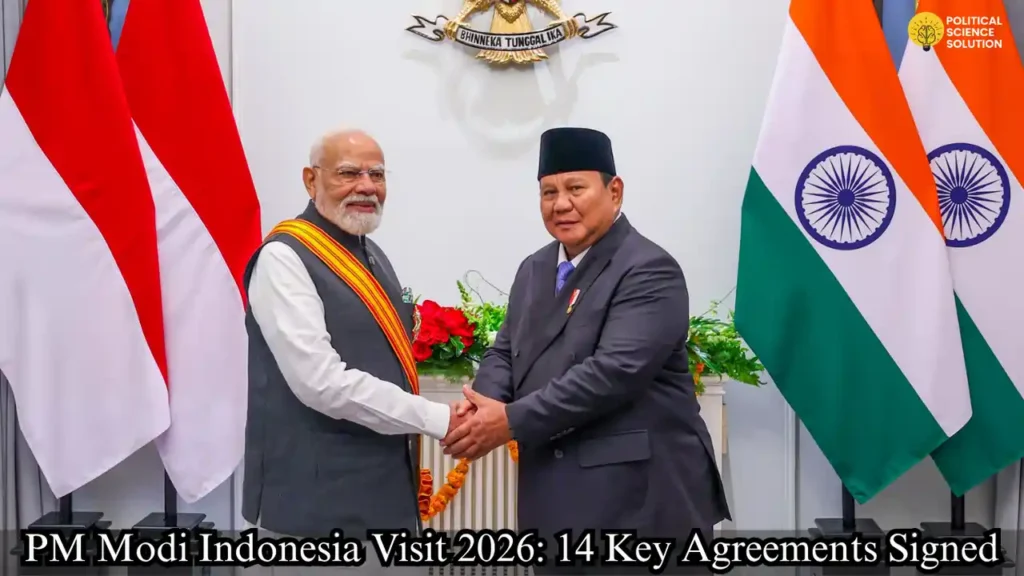
New Delhi: Prime Minister Narendra Modi concluded a significant three-day state visit to Indonesia from July 6-8, 2026, marking a new chapter in the India-Indonesia Comprehensive Strategic Partnership. The visit, which featured high-level bilateral engagements, the signing of 14 agreements across diverse sectors, and symbolic cultural gestures, underscores the deepening ties between the two maritime neighbors. From critical minerals and maritime security to temple conservation and people-to-people exchanges, the outcomes reflect shared ambitions for economic resilience, regional stability, and cultural heritage preservation amid evolving global challenges.
PM Modi’s itinerary began with a ceremonial reception at Jakarta’s Istana Merdeka, followed by bilateral talks with Indonesian President Prabowo Subianto in both restricted and delegation formats. President Prabowo hosted a state banquet, and PM Modi addressed the Indonesian Parliament at the invitation of Speaker Dr. Puan Maharani. The visit culminated in a joint trip to the Prambanan Temple complex in Yogyakarta, where the leaders inaugurated a conservation project, before PM Modi departed for Melbourne, Australia, personally seen off by President Prabowo at the airport.
Historical and Strategic Significance of India-Indonesia Relations
India and Indonesia share deep-rooted historical connections spanning centuries, including maritime trade routes, Buddhist and Hindu civilizational influences, and joint roles as founding members of the 1955 Bandung Conference and the Non-Aligned Movement. Today, these ties are reinforced by a vibrant Indian-origin diaspora of approximately 150,000 people contributing to business, education, and cultural links in Indonesia. Bilateral trade has surpassed US$30 billion, positioning Indonesia as India’s second-largest trading partner in ASEAN. Defence cooperation thrives through exercises like Garuda Shakti (Army), Samudra Shakti (Navy), and coordinated patrols under IND-INDO CORPAT, alongside growing defence-industrial collaboration.
Strategically, Indonesia’s location astride the Strait of Malacca makes it pivotal to India’s Act East Policy, MAHASAGAR Vision, and broader Indo-Pacific strategy. The 2018 Comprehensive Strategic Partnership provides the framework for enhanced cooperation in defence, economics, and regional security.
Key Outcomes: 14 Agreements and Major Initiatives
During the visit, India and Indonesia signed 14 agreements spanning critical minerals, steel supply chains, maritime security, medicines, education, outer space, research and innovation, telecommunications, and food security. A standout development was the agreement to jointly develop the strategically located Sabang Port in Indonesia, which overlooks the Strait of Malacca and lies approximately 160 kilometers from India’s Great Nicobar Island project. This partnership envisions cruise and marine-tourism facilities, ship-repair and shipbuilding industries, and shore-based services for offshore energy activities, promising investment, employment, technology transfer, and enhanced connectivity between India’s Andaman and Nicobar Islands and Sumatra Province.
The leaders emphasized building diversified and resilient supply chains in critical minerals and rare earths. They welcomed an MoU between India’s Non-Ferrous Materials Technology Development Centre (NFTDC), Midwest Ltds., and Indonesia’s PT. Perusahaan Mineral Nasional (PERMINAS), alongside an MoU on Minerals and Technology of Steel Supply Chain and a strategic joint venture between Steel Authority of India Ltd. (SAIL) and PT. Krakatau Steel for a stainless-steel slab manufacturing facility in Indonesia.
In defence and maritime domains, progress includes cooperation on the BrahMos Missile System and Air-to-Air Missile Cooperation Agreement. The leaders renewed the MoU on Maritime Safety and Security Cooperation and concluded an Implementing Arrangement between Indonesia’s BAKAMLA and the Indian Coast Guard. They welcomed the positioning of an Indonesian International Liaison Officer at India’s Information Fusion Centre-Indian Ocean Region (IFC-IOR) in Gurugram and agreed to expand defence industry collaboration, including joint production, technology transfer, ship-building, MRO facilities, and R&D.
Counter-terrorism cooperation received strong emphasis. Both leaders adopted a “zero-tolerance” approach, condemning terrorism in all forms and calling for action against globally proscribed terrorists under the UNSC 1267 Sanctions Committee. They agreed to enhance collaboration on terrorist financing, AML/CFT standards, online radicalization prevention, and transnational organized crime. Plans include concluding an MoU on Counter Terrorism and convening the 3rd India-Indonesia Security Dialogue (IISD) covering cyber security, emerging technologies, and maritime issues.
Economic, Trade, and Connectivity Milestones
Leaders highlighted synergies between India’s Viksit Bharat 2047 and Indonesia’s Indonesia Emas 2045 visions. They pushed for timely review of the ASEAN-India Trade in Goods Agreement (AITIGA) and deeper bilateral trade engagement. Mechanisms like the Working Group on Trade and Investment (WGTI), Biennial Trade Ministers’ Forum (BTMF), and Joint Economic and Financial Dialogue (EFD) will address tariff/non-tariff barriers and promote finance, digital economy, and supply chain cooperation.
Local Currency Transaction (LCT) guidelines between the Reserve Bank of India and Bank Indonesia are progressing, promising greater financial integration. The launch of Indonesia Open Network (ION) based on India’s ONDC architecture aims to boost MSME participation in the digital economy. Cross-Border QR Payment Linkage advancements will enhance transaction efficiency for MSMEs, tourism, and students. A new MoU on Telecommunications Technologies and Services further supports digital connectivity and transformation.
In health, pharma, food, and energy, agreements include an Implementation Arrangement on Professional Health Workforce Development, MoUs on medical products regulation (CDSCO-BPOM), processed food (BPOM-FSSAI), agriculture, marine and fisheries, and disaster management. Cooperation in fertilizers, LNG, green hydrogen, bioenergy, solar energy, and energy efficiency was prioritized for food and energy security. The Red and White Cooperative Network was noted as a potential distribution platform for pharmaceuticals.
Infrastructure and connectivity efforts include the 3rd Joint Task Force Meeting on Andaman-Aceh Connectivity planned for late 2026, aiming for expeditious implementation of maritime and air links.
Cultural Diplomacy and People-to-People Ties
A highlight was the inauguration of the India-supported restoration and conservation project at the UNESCO World Heritage Site Prambanan Temple Compounds in Yogyakarta by the Archaeological Survey of India (ASI). PM Modi thanked Indonesia for preserving this “grand heritage.” Indonesia gifted appreciation for a replica of the ancient Nalanda Copper Plate (circa 860 CE) exhibited at Muara Jambi. The leaders recalled the Kashi Cultural Pathway from the 2023 G20 and agreed to consultations on cultural heritage.
They declared 2026–2027 as the “Tagore–Dewantara Year of India-Indonesia Cultural and Educational Diplomacy,” commemorating the centenary of Rabindranath Tagore’s 1927 visit through joint programs. Tourism cooperation will see streamlined visas and increased visitor flows. Education initiatives include MoUs on primary/secondary and higher education, science and technology, with interest in Indian institutions like IIM Bangalore establishing campuses in Indonesia. Collaborations extend to elections management (ECI-KPU) and official statistics (MOSPI-BPS).
President Prabowo, who was Chief Guest at India’s 76th Republic Day in January 2025, highlighted his “Indian DNA” and urged learning from India’s development model at a diaspora event.
Regional and Global Convergence
Both nations reaffirmed commitment to a free, open, rules-based Indo-Pacific, respecting sovereignty, UNCLOS, and ASEAN centrality. They supported synergies between ASEAN Outlook on the Indo-Pacific (AOIP) and India’s Indo-Pacific Oceans Initiative (IPOI), alongside trilateral India-Indonesia-Australia cooperation in maritime domain awareness, marine pollution, and blue economy.
On multilateral fronts, they called for UN Security Council reform, expansion in permanent and non-permanent categories, and reforms in global financial architecture and trading systems. Indonesia backed India’s 2026 BRICS Chairship, while India supported Indonesia’s BRICS role. Engagements through G20, IORA, and South-South Cooperation were emphasized. Concerns over West Asia/Middle East were discussed, welcoming a recent MoU and stressing de-escalation through dialogue while upholding freedom of navigation in the Strait of Hormuz.
Looking Ahead: Ambitious Agenda for Bilateral Partnership
In his departure statement, PM Modi expressed satisfaction over the visit’s outcomes and gratitude to President Prabowo and the people of Indonesia. External Affairs Ministry spokesperson Randhir Jaiswal posted “Terima kasih, Indonesia!” highlighting the personal gesture of the presidential airport send-off. PM Modi noted new avenues in defence, security, maritime collaboration, emerging technologies, AI, digital innovation, and capacity building.
From Indonesia, PM Modi proceeded to Australia (July 8-10, 2026) at the invitation of Prime Minister Anthony Albanese, followed by New Zealand, focusing on defence, trade, education, and diaspora ties. The Indonesia leg has set an ambitious agenda, placing the partnership on stronger footing for mutual prosperity and Indo-Pacific stability.
This visit not only broadens bilateral cooperation but also contributes to a balanced, representative global order responsive to Global South aspirations. As both democracies navigate geopolitical shifts, supply chain disruptions, and emerging challenges, the outcomes from Jakarta and Yogyakarta signal a robust, forward-looking strategic convergence.
FAQs
1. What were the major outcomes of PM Modi’s July 2026 visit to Indonesia?
During the three-day state visit (July 6-8, 2026), India and Indonesia signed 14 key agreements covering critical minerals, steel supply chains, maritime security, medicines, education, outer space, research & innovation, telecommunications, and food security. The leaders agreed to jointly develop the strategically important Sabang Port, inaugurated the India-supported conservation project at the UNESCO-listed Prambanan Temple, and strengthened defence cooperation including BrahMos missile systems. The visit concluded with PM Modi departing for Australia after being personally seen off by President Prabowo Subianto.
2. Why is the joint development of Sabang Port significant for India and Indonesia?
Sabang Port, located in Indonesia and overlooking the Strait of Malacca, is around 160 km from India’s Great Nicobar Port project. The partnership aims to create cruise and marine-tourism facilities, ship-repair/shipbuilding industries, and support offshore energy activities. It will enhance maritime connectivity between India’s Andaman & Nicobar Islands and Sumatra, generate investment, employment, technology transfer, and contribute to regional prosperity and supply chain resilience.
3. What is the significance of the Prambanan Temple visit during PM Modi’s trip?
PM Modi and President Prabowo jointly inaugurated the restoration and conservation works at the Prambanan Temple complex in Yogyakarta, a UNESCO World Heritage Site. This project is supported by India’s Archaeological Survey of India (ASI). It symbolizes the deep historical and civilizational bonds between the two nations rooted in Hindu-Buddhist heritage. The visit followed the exchange of a Letter of Intent for the project and highlighted shared commitment to preserving cultural treasures.
4. How does the visit strengthen India-Indonesia defence and maritime cooperation?
The leaders welcomed progress on BrahMos and Air-to-Air Missile cooperation, renewed the MoU on Maritime Safety and Security, and concluded an Implementing Arrangement between BAKAMLA and the Indian Coast Guard. They agreed to expand joint exercises, defence industry collaboration (including ship-building and MRO facilities), maritime domain awareness, and counter-terrorism efforts with a “zero-tolerance” approach. An Indonesian Liaison Officer at India’s IFC-IOR further deepens maritime security ties.
5. What are the broader strategic and economic goals of the India-Indonesia partnership?
The visit builds on the 2018 Comprehensive Strategic Partnership, aligning India’s Viksit Bharat 2047 with Indonesia’s Indonesia Emas 2045. Key goals include resilient critical minerals supply chains, digital economy integration (ONDC-based ION, QR payments), education & cultural exchanges (Tagore–Dewantara Year 2026-27), and deeper Indo-Pacific cooperation supporting ASEAN centrality. Both countries also committed to UNSC reforms, BRICS coordination, and a free, open, rules-based Indo-Pacific region.