

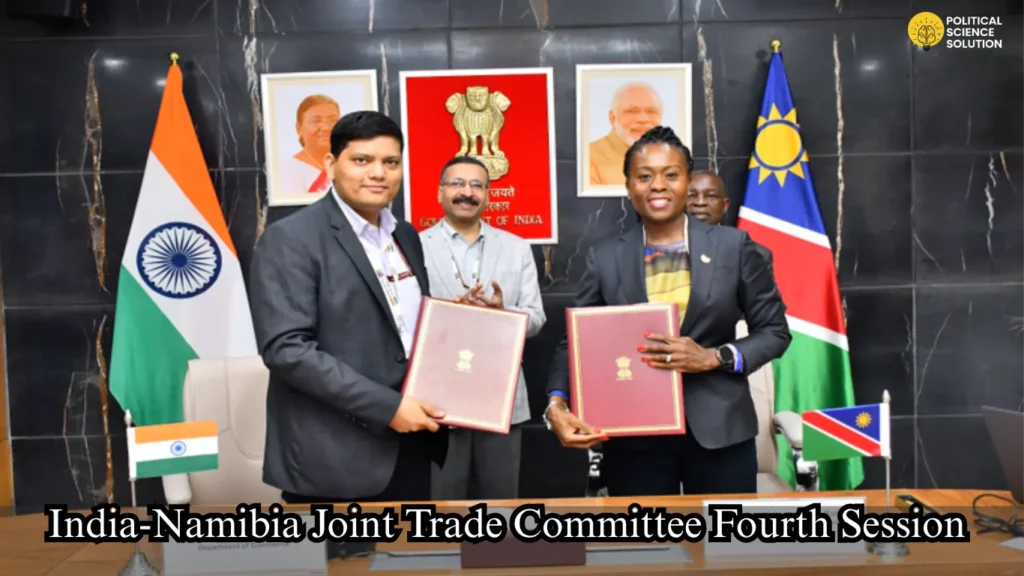
New Delhi: The Fourth Session of the India-Namibia Joint Trade Committee concluded in New Delhi on 11 August 2026 after two days of intensive discussions that produced a clear roadmap for transforming bilateral economic ties. Indian and Namibian officials signed the Agreed Minutes, committing both governments to shift trade away from a predominantly raw-material base toward greater value addition inside Namibia, backed by concrete mechanisms, timelines and assigned responsibilities.
The Indian side was led by Shri Amit Kumar, Joint Secretary in the Department of Commerce, Ministry of Commerce and Industry. The Namibian delegation was headed by Ms. Ndiitah Nghipondoka-Robiati, Executive Director in the Ministry of International Relations and Trade. Shri Yashvir Singh, Additional Secretary in the Department of Commerce, delivered the inaugural address that set the tone for the meetings held on 10 and 11 August.
Trade Performance Shows Steady Expansion
Official figures presented at the session confirmed that bilateral merchandise trade reached USD 592.94 million in the financial year 2025-26, up from USD 568.40 million in 2024-25. India’s exports stood at USD 349.09 million while imports from Namibia totalled USD 243.85 million. Separately, trade in services grew 7.34 percent to USD 380 million in the calendar year 2024.
Within the merchandise basket, engineering goods recorded the sharpest rise. Exports of engineering products expanded 124.06 percent to USD 30.24 million, driven primarily by motor vehicles and components. Pharmaceuticals and medical devices reached USD 36.50 million, positioning India as Namibia’s second-largest source of these products with a 16.4 percent market share. These numbers underscored the growing diversification already under way even as both sides emphasised the need for deeper structural change.
Investment Focal Points and Institutional Architecture
To convert interest into actual capital flows, the two countries designated Invest India and the Namibia Investment Promotion and Development Board as the official investment focal points under the Joint Trade Committee. Each side will nominate a named official responsible for coordination, creating a direct channel for project facilitation and investor support.
A dedicated Services Working Group will be constituted and will hold its first meeting no later than February 2027. The group is mandated to prepare and submit a detailed work plan to the Joint Trade Committee, ensuring that services trade receives the same structured attention as goods.
Health and Pharmaceuticals Cooperation Accelerates
Healthcare featured prominently on the agenda. The first Joint Working Group under the existing Memorandum of Understanding on Cooperation in the Field of Health and Medicine will convene by December 2026. Parallel progress was noted on the Janaushadhi cooperation agreement with HLL Lifecare Limited, which has reached an advanced stage of finalisation. These steps are expected to expand access to affordable medicines and strengthen technical collaboration in the pharmaceutical sector.
Critical Minerals and Downstream Value Chains
Both delegations identified structured cooperation across the full value chain of critical minerals. The focus covers exploration, offtake arrangements, processing and downstream beneficiation of lithium, graphite, copper, cobalt and rare earth elements. The approach explicitly aligns with Namibia’s policy priorities of domestic value addition and local employment generation, moving beyond simple extraction and export of unprocessed ores.
Gems, Jewellery and Skills Development
In the gems and jewellery sector, Namibia received an invitation to participate in India’s Special Notified Zones located in Surat and Mumbai as well as the India Rough Gemstones Sourcing Show. India also offered training support in diamond cutting, polishing and jewellery design, opening pathways for skills transfer and higher-value participation by Namibian enterprises.
Digital Payments and FinTech Framework
Digital financial connectivity continued to advance following the successful rollout of an instant payment system built on India’s Unified Payments Interface. The system was unveiled in Namibia as “WayaMe” on 15 June 2026. Officials discussed proposals for a FinTech Cooperation Framework between the Reserve Bank of India and the Bank of Namibia that would further deepen regulatory and technical collaboration in digital payments and related services.
Energy, Infrastructure and Green Technologies
Cooperation opportunities were mapped across multiple infrastructure and energy segments. These include railways and rolling stock, solar and wind power generation, battery storage systems, electricity transmission, green hydrogen, biofuels and desalination. The discussions reflected mutual interest in sustainable infrastructure solutions suited to Namibia’s development needs and India’s technological strengths.
India-SACU Preferential Trade Agreement Moves Forward
A significant regional dimension emerged with the finalisation of the Terms of Reference for an India-Southern African Customs Union Preferential Trade Agreement. The Terms of Reference are scheduled for signature on 12 August 2026. Negotiations are expected to commence within one month of signature and to conclude within one year, creating a broader preferential framework that could benefit trade with the entire SACU region.
Additional Sectors and Future Outlook
Beyond the core focus areas, the session advanced cooperation in agriculture and food security, micro, small and medium enterprises, textiles, tourism and sports. Officials described the overall atmosphere as friendly and cordial, reflecting the long-standing traditional bonds of friendship between India and Namibia.
The Joint Trade Committee remains the principal bilateral institutional mechanism for reviewing trade, investment and economic cooperation. The Fifth Session will be hosted by Namibia in 2028 on dates to be mutually agreed through diplomatic channels.
Strategic Significance of the Outcomes
The decisions taken in New Delhi mark a deliberate transition from transactional trade toward partnership-oriented economic engagement. By insisting on defined timelines, named responsibilities and dedicated working groups, both governments signalled that discussions must translate into measurable results. The emphasis on value addition inside Namibia addresses long-standing concerns about the composition of bilateral trade while creating opportunities for Indian technology, capital and expertise to contribute to Namibian industrialisation goals.
The sharp rise in engineering exports and the solid position of Indian pharmaceuticals already demonstrate commercial momentum. New institutional arrangements for investment facilitation, services, health, critical minerals and digital payments are designed to sustain and broaden that momentum. Parallel progress on the India-SACU Preferential Trade Agreement extends the potential benefits beyond the bilateral relationship into a wider regional context.
As the Agreed Minutes take effect, attention will shift to implementation. The Services Working Group must meet by February 2027, the health working group by December 2026, and the investment focal points must become operational channels for concrete projects. Success will be measured not only by further growth in the USD 592.94 million merchandise trade figure but by the extent to which value addition, employment and technology transfer take root in Namibia.
The Fourth Session of the India-Namibia Joint Trade Committee has therefore established a clear, time-bound agenda that seeks to convert traditional friendship into a modern, mutually beneficial economic partnership grounded in shared priorities of industrialisation, sustainability and inclusive growth.
FAQs
1. What was the main outcome of the Fourth Session of the India-Namibia Joint Trade Committee held in New Delhi?
The session, held on 10 and 11 August 2026, produced Agreed Minutes signed by the co-chairs that commit both sides to move bilateral trade beyond a raw-material-based structure toward greater value addition and local processing inside Namibia. Concrete mechanisms with clear timelines and assigned responsibilities were established across investment, services, health, critical minerals, digital payments, energy and infrastructure.
2. How much did India-Namibia bilateral trade grow in 2025-26?
Bilateral merchandise trade rose to USD 592.94 million in 2025-26 from USD 568.40 million in 2024-25. India’s exports stood at USD 349.09 million and imports at USD 243.85 million. Trade in services also expanded, growing 7.34 percent to USD 380 million in calendar year 2024. Engineering exports surged 124.06 percent to USD 30.24 million, while pharmaceuticals and medical devices reached USD 36.50 million.
3. Which new institutional mechanisms were created during the session?
Invest India and the Namibia Investment Promotion and Development Board were designated as official investment focal points, each with a named official. A dedicated Services Working Group will be formed and must meet by February 2027 to submit its work plan. The first Joint Working Group under the health and medicine MoU will convene by December 2026, and a FinTech Cooperation Framework between the Reserve Bank of India and the Bank of Namibia is under discussion.
4. What cooperation was agreed on critical minerals and other priority sectors?
Both sides identified structured collaboration across exploration, offtake, processing and downstream beneficiation of lithium, graphite, copper, cobalt and rare earth elements, aligned with Namibia’s goals of value addition and job creation. Additional areas include gems and jewellery (participation in India’s Special Notified Zones and training support), energy and infrastructure (railways, solar, wind, battery storage, green hydrogen, biofuels and desalination), and the finalisation of Terms of Reference for an India-SACU Preferential Trade Agreement scheduled for signature on 12 August 2026.
5. When and where will the next Joint Trade Committee meeting take place?
The Fifth Session of the India-Namibia Joint Trade Committee will be held in Namibia in 2028 on dates to be mutually decided through diplomatic channels. The Joint Trade Committee remains the principal bilateral platform for reviewing trade, investment and economic cooperation between the two countries.